Taste
Where the drinking began: these are Amsterdam's oldest cafés
Amsterdam is celebrating its 750th anniversary this year, and what better way to experience the city’s rich history than in its oldest cafés? Behind centuries-old facades lie stories of sailors, painters, mayors and fellow citizens who have been drinking here for generations. Cheers!
Cafe De Druif
The legendary atmosphere of Café De Druif starts at the front door. Situated on the quiet Rapenburgerplein, close to the Entrepotdok and the Maritime Museum, this pub almost feels like a time capsule. The building dates back to 1566 and according to the city archives, De Druif was granted a liquor license in 1631. However, the café in its current form was only opened in 1863, by a Catholic tailor and his Prussian wife. The name refers to the bunches of grapes that used to hang on the facade, as a sign of its former function as a liqueur distillery. That history is still visible: the wooden barrels on the wall, carpeted tables and gas chandeliers give the space an almost museum-like appearance.
According to tradition, even naval hero Piet Hein would drink his drinks here – although he died in 1629, years before the official establishment as a café. De Druif used to function as an embarkation café for VOC sailors who came here to sign up for long voyages across the sea. After the previous owner retired in 2022, the business was taken over, with the promise that everything would remain the same.
Café Karpershoek
According to historical sources, drinks were already served at this location in 1606, and in 1641 the inn was officially located here The Oldenburger Cellar, a popular stop for Frisian and German skippers.
Karpershoek was originally a boarding house for crew of the Dutch East India Company. The location was ideal at the time: right on the water. The canal has since been filled in, but inside it seems as if time has stood still. The sand floor – once intended to make it easy to clean up chewing tobacco – has remained and still gives the café its authentic character.
The rest of the interior also breathes history: original Delft blue tiles of more than 400 years old, proverbs and wisdom on the walls, old-fashioned wood carvings and photos from times gone by. Music is taboo here – the atmosphere is determined by the buzz, the tapping of glasses and the creaking of old floorboards.
According to the current owner Peter Brugman, Karpershoek can rightly call itself the oldest café in the city: “We were the first café to pay taxes.”
Tasting room De Drie Fleschjes
At the foot of the Nieuwe Kerk, on the corner of the Gravenstraat, you will find a true icon: De Drie Fleschjes. According to the municipality of Amsterdam, this historic establishment rightfully deserves the title of oldest pub in the city. The tasting room opened its doors in 1618 and quickly became a popular place for artists, distillers and other bon vivants. In 1650, the Bootz liqueur distillery took it over and it became an official place where customers could taste different jenevers and liqueurs before making a purchase.
The opening in 1650 was a true event, with Jacob Cats, Rembrandt, Jan Steen, Constantijn Huygens and even naval heroes such as De Ruyter and Tromp in attendance – although according to some this is just as legendary as the drinks served there.
The atmosphere has hardly changed since then. The sand still covers the floor, just as it was in the 17th century, and along the walls is an impressive drink organ: a wall full of wooden barrels, the sound of which was used in the past to determine how much liquor was left in them. Most of the barrels have now been 'adopted' by regulars, companies or famous Amsterdammers.
Cafe Hoppe
Since 1670, Café Hoppe has been a familiar face at the Spui. Once started as a distillery where you could buy drinks, Hoppe grew into a beloved café where the tasting room feeling is still palpable.
Hoppe is not only a place of history, but also of stories. Hans van Mierlo is said to have laid the foundation for D66 here, Freddy Heineken liked to come here for a drink, and even Princess Beatrix once honored the pub with a visit.
Nowadays, the café is still buzzing with life on Fridays. From students to business people, from regular Amsterdammers to curious visitors – everyone comes together here.
The Sluyswacht
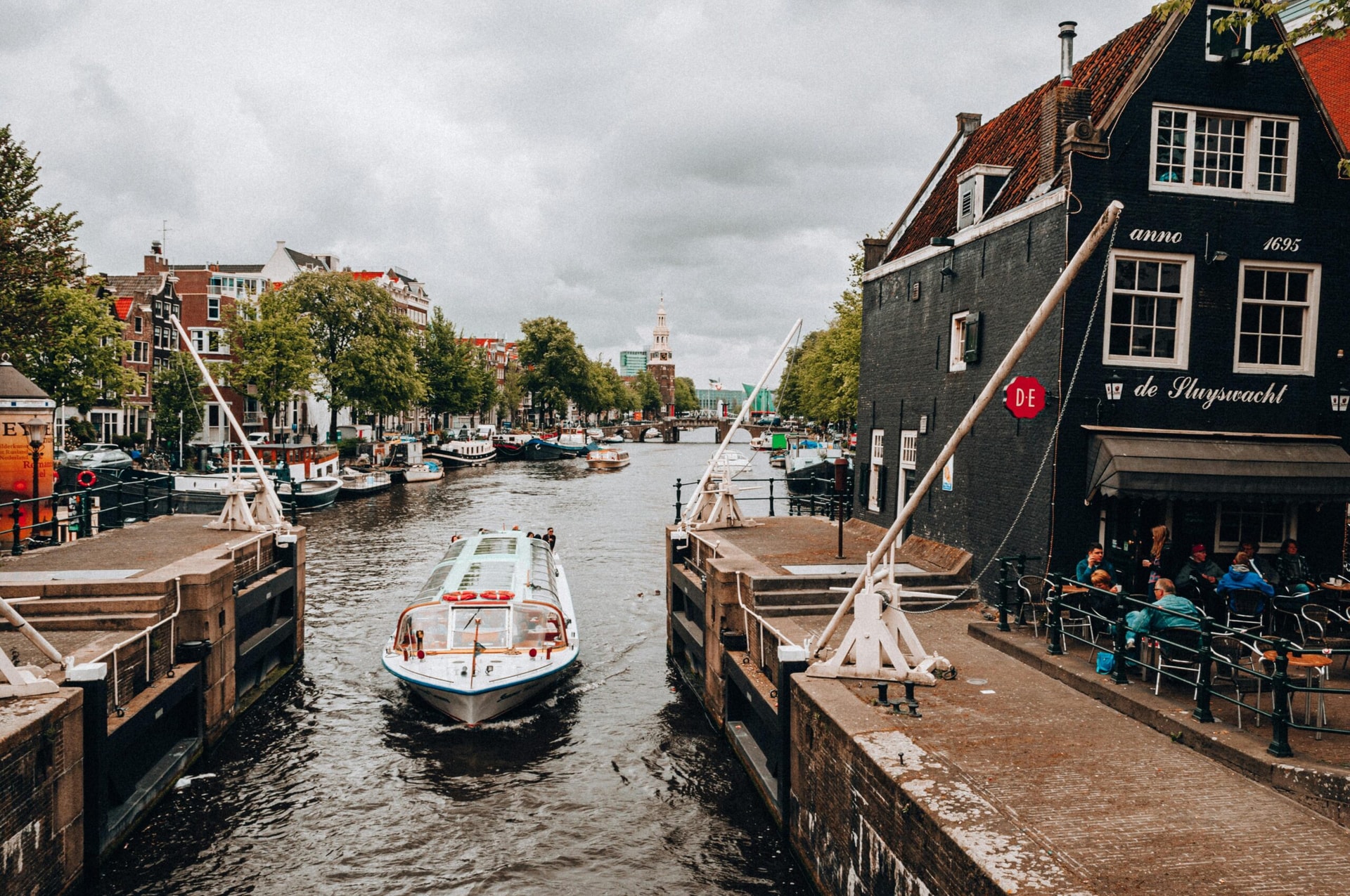
On the edge of the Oude Schans, right next to the historic St. Anthoniesluis, stands the characteristic, crooked house of De Sluyswacht. What is now a popular café was built in 1695 as a home for the lock keeper, who supervised the water barrier from here. The lock itself – built in 1602 – was of strategic importance: not only to keep out enemy ships, but also to regulate the Amstel water and refresh the canals. A function it still fulfils to this day.
During the Second World War, the neighborhood fell into disrepair and in the 1970s, much of the historical heritage disappeared under the wrecking ball for the construction of the metro. Yet De Sluyswacht was spared. In the 1990s, the building was beautifully restored and transformed into a café.
Fun detail: Rembrandt himself once drew the lock that this café overlooks, from his house with the red shutters on the other side – now the Rembrandt House.
Also read: 'The city is celebrating on all fronts: this is where you need to be'