Power
Guarantee for gold
From 1988 to 2012, Anky van Grunsven competed no fewer than seven times during the Olympic Games and won nine medals, including three gold. But not only that. During and after her career, she built a business empire, with an impressive horse complex in her birthplace Erp as its beating heart. On the eve of the Olympic Games in Paris, Jaap de Groot talks extensively with the woman who apparently guarantees gold in everything. “Top sport and performance is my goal.”
Photography Karoly Effenberger
Comments Jaap de Groot
You have not stood still even after your career. What don't you actually do?
“Hahaha. Well, I'm still basically doing the same thing. Put in a lot of hours doing things I like. Horse riding in the morning, guiding people with horses in the afternoon, I am also active as chairman of The Dutch Masters – Indoor Brabant and I am working on a children's book. I also supervise my children in their competitions; also because I enjoy being at competitions. I have sold our clothing line, although I still look at new designs. And I probably still forget half of what I do.”
Did you learn entrepreneurship from home?
"Yes. My father had a construction company, which my brothers expanded very well. So not me. When I was eighteen I really wanted to get into horses. My father wasn't really keen on that, but he did give me a cash book and from that day on I had to do it myself.”
So during your top sports career you were already busy business-wise?
“If you have your own company, you have to do everything yourself. I started when I was eighteen with a truck and two good horses, Prisco and Bonfire. From the start I learned to be able to pay for everything myself. That means arranging your own food, transport, you name it. During the day I worked with the horses, also for other people, and in the evening I gave lessons until ten o'clock. That is why I think that of all athletes, equestrians work the most hours. They have to manage their own stables and train horses, because the money has to come from somewhere. There isn't really time to rest.”
While you were at the top of the world at that time.
“In the beginning you build it up, as you become more famous it goes more smoothly. I first asked 25 guilders for an hour of lessons, but once I had ridden and even won an Olympic Games, the price could go up. In addition, sponsors and people came who wanted to invest in new horses. Horses were sold, clinics were given and a clothing line was set up.”
When were you forced to hire staff?
“After a year I started with someone for half days. When I qualified for my first Olympic Games in Seoul at the age of 20, I had to hire my first full-time employee because my horse had to be quarantined for weeks. That was in Nijmegen, while my stable had to keep running. From then on I had someone working.”
You have now built an impressive horse complex in Erp. All achieved while you were still actively mining gold.
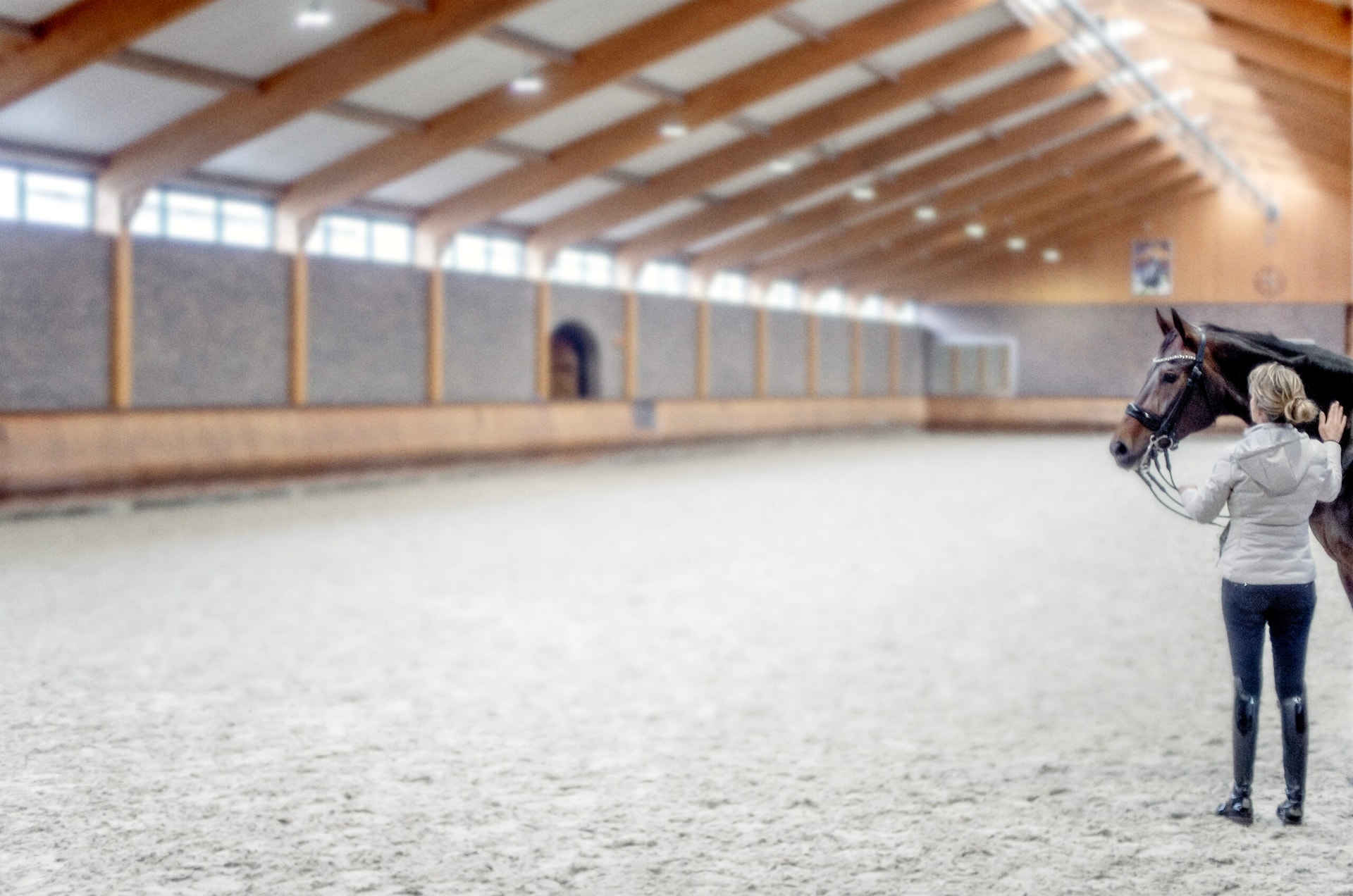
“I started with an indoor track and stables for my two horses. Inherited from my father. Just as my father also helped finance my first own horse. I couldn't afford it at the time so I was allowed to borrow it from him. I wanted to get rid of that as quickly as possible, because I really enjoyed being independent. So pay it off so you can make your own choices. That attitude has also been very important for my top sports career. As my own boss, the good horses were mine, so I could manage my own career. To prevent an owner from suddenly deciding to sell my horse. Through the other horses I got the money to buy and build more here in Erp. For a long time I only invested in horses, but when the children came I wanted to travel less to really be there for them. Then I no longer invested in horses, but in the buildings here. Apartments and additional stables have been added, allowing customers from all over the world to train and stay. All optimally arranged. That is essential, because you cannot ask a good price if you do not have things well organized.”
Describe yourself as a businesswoman.
“In any case, I am a very hard worker and very motivated. Motivated to drive, motivated to help people. And in business terms I know clearly where I want to go, but I am also very happy with the help of Sjef (her husband Sjef Janssen, ed.). I also think it is important that the atmosphere in the stable is good. Creating the feeling that you are doing it together and for each other. As a team. By the way, it is not the case that there are a hundred employees here, there are four, supplemented with interns and working students. All quite efficient. Moreover, I don't like it to get bigger, because you work with horses and you have to be able to give them all attention. If there are a lot of them, it becomes more complicated. In that sense I am a perfectionist.”
You were also a herald of the king.
“That was a very special experience that I would not have wanted to miss. The inauguration of the king was a unique moment. Being asked by him to be herald on that day was a huge honor as an equestrian. A magical experience.”
How is your relationship with the king?
“Our contact goes further than just hello and good day during the Olympic Games, where he was always present as a prince. The royal family is of course very horse-loving, so there is already something that you jointly like. For example, the Atlanta Games in 1996 were very intense for me. Everything went wrong there, and my grandmother died. Still, I won silver, which I was very happy with. Nevertheless, there was disappointment around me that I had just failed to win gold. Although I didn't feel that way as much myself, it was still an Olympic Games that I want to quickly forget. The prince got quite a lot from that. That's why it was nice that four years later he was one of the first to congratulate me when I managed to win gold in Sydney. Furthermore, after every Games you have a reception in The Hague, we meet each other at competitions and the king has been guest of honor at Indoor Brabant. Contact still runs quite smoothly.”
What do you think of former Olympic champion Jan Tops' initiative to set up a Super League for show jumping riders with the multi-million Global Champions Tour?
“I think what Jan does is really great. He finds major investors and organizes competitions in places where you think: how do you achieve this? I have a lot of admiration for that. However, there is a process underway in which equestrian sports are somewhat divided in two. Previously you had people in the countryside who had a farm and a horse and who also rode. On the other hand, there were people with money who could compete in the more expensive races. The great thing was that those two worlds flowed into each other. That happens less now. There are fewer farms, which means fewer horses, and that worries me. Far fewer people grow up with animals, while the group with money is increasing. Not necessarily in the Netherlands, but worldwide. So I think what Jan Tops is doing is very clever. He has courage and takes initiative. Apart from that, it has nothing to do with him, but it is worrying that there are fewer horse people who grew up with the sport.”
How does the equestrian association KNHS respond to this?
“It is not up to an association to determine how someone grows up. There are simply fewer riding schools, which makes it more difficult for children to ride somewhere. Land, horses, buildings: it all becomes more expensive and more difficult.”
To what extent is there a sounding board with you, from the KNHS and NOC*NSF, about this?
"Never. I am an ambassador for the KNHS Talent Plan, which is great fun to do. I don't get asked much else."
How do you view the future of Dutch top sport?
“The real toppers are independent and down-to-earth perfectionists who work very hard. Not many people are able to give 110 percent all the time. Journalists sometimes asked me: 'What did you miss?' I replied: 'Missed it? I participate in top sports. Then you won't miss anything, will you?' Top sport and performance is my goal. Parties are great fun, but if I want to party I shouldn't become a top athlete. Was a conscious choice. Most people want both and, but if you do that, it just isn't enough.”
In the meantime, you see more and more conflicts between top athletes and associations. Two worlds growing further apart.
“If you want to achieve something, you are responsible yourself. You cannot place your responsibility on an association and think that it will do it for you. If you want something, you have to arrange it yourself. If an association thinks along, fine. If not, solve it yourself.”
You participated in seven Olympic Games from 1988 to 2012. In that respect, no one comes close to you in the Netherlands. Can you describe the Olympic Games phenomenon?
“It is always a very wonderful experience. An Olympic year is very intense and different from the very beginning. You're away from home for a long time. From three weeks in Seoul to six weeks in Sydney. With one horse, while you are used to riding about eight horses a day. This takes you very much out of your own routine. In the meantime, the whole world is watching. You have to perform better than ever. Unique to experience. It is also impossible to explain what an opening ceremony feels like. Especially if you can carry the flag, as happened to me in Sydney.”
In the meantime, the Games are increasingly moving in the direction of equestrian sports: sport in combination with business.
“That is also desperately needed. Take Athens in 2004. Two new stadiums were built there for equestrian sports. A drama. Huge investments have been made, but nothing remains. The ring and stables are still there, but nothing happens to them anymore. Waste of money. That is why it is positive that in Paris 95 percent of accommodations are existing locations. Just like in London. A temporary stadium was built there near Greenwich and everything was well organised.”
London 2012 now also applies to Paris as the standard. Did London also stand out for you?
“London, but also Sydney, was great. Atlanta was a difficult one, because the Americans had zero flexibility there. They had a rule and whether it worked or not, there was no discussion about it. While in Sydney they simply said: 'That's a stupid rule, let's skip it.' London was so special because you could feel the Olympic atmosphere throughout the city. That is why Sydney and London have been the most beautiful Games.”
Have seven Olympic Games provided any life lessons? You already talked about the way Australians deal with problems.
“I still say 'no worries'. I'm left with Sydney. I also learned that rules have to work. If that is not the case, you must ensure that it still becomes workable through adjustments. And don't leave it that way because someone says it should be that way. My positive memories of the Olympic Games also include the moments when everyone thinks along to make it pleasant and good for everyone.”
“Not many people are able to give 110 percent all the time”
That means thinking like a top athlete: when you encounter a problem or setback, immediately work on a solution.
"Indeed. Solve problems and move on.”
What is the relationship with the International Olympic Committee? With seven participations and nine medals, you are one of the icons in Olympic history.
“There is no relationship and I have no idea why that is. Last year, for the first time, I received an invitation from the FEI (Fédération Équestre Internationale, the international equestrian federation, ed.) to attend a World Cup final. I won nine of those, so maybe that was the reasoning behind asking me.”
You've done fantastic sportingly and professionally, but apparently a lobbying course wouldn't hurt.
“Lobbying is indeed not my strong point. As chairman of The Dutch Masters – Indoor Brabant, my fame in equestrian sports and the Netherlands are advantages, but I'm just not good at talking to someone. If I don't agree with someone, I say so.”
Indoor Brabant has now been lifted to a higher international level.
“The attitude at Indoor Brabant is to aim for the top result. We do it together and if there are problems, we solve them together. We have a positive working atmosphere, also towards the outside world. I have felt comfortable with these people for years, who all have and take their own responsibility. But I'm not going to talk to someone about what they want to hear. Poldering is not in me and, to be honest, I don't think anyone expects it from me. By the way, I'm not looking for a position. I add something to Indoor Brabant. A beautiful event where it branch-tak-tak is instead of endless discussions that go nowhere. I also have it in my stable. I work with horses, I work with people and I don't want meetings that don't make any difference. I don't have the patience for that. I have a business to run and enjoy giving time to my children. I set clear priorities for where I invest my time and where not.”
Are you still going to Paris?
"Yes. I was asked by a company to tell my story in a hospitality setting for three days. I like to talk, so that's a good thing. At the same time I can follow the matches. What's extra fun is that I'm going with my son.”
What is easier: managing horses or people?
“I'm better with horses. I am also a horse whisperer. Horses are very pure. There is no story behind it: it is what it is. If you treat each other with respect, you will get back what you deserve. This creates a bond of trust with a horse. It's difficult with people because they don't always say what they think. That doesn't happen with a horse. What you see is what you get. Ego and power play a role in people and money can get in the way. That doesn't always make it easy. That's why good people around you are just as important as having good horses around you.”
MASTERS Magazine
Every success starts with a dream. That is the leitmotif of the summer edition of MASTERS. As a little girl, Iris Hond dreamed of becoming a concert pianist. She had the talent, the discipline, the love for piano playing and the courage to pursue her dream. Even adversity did not deter her from her path. “Then I remembered the stories about the rough rock 'n' roll life that Jan Cremer told when he visited us: the pain, the misery – it's part of it”, she says in the major interview, with unique photography by Rahi Rezvani. Entrepreneur Harald Swinkels was also guided by a dream: first earn a lot of money, then make films. And so he sold his energy company and took the exit to Hollywood. Real estate entrepreneur Max Vorst uses his fortune to collect art. MASTERS received a private tour of the Beelden aan Zee museum, where part of his collection is currently on display. Dream trips are also being realized more and more often. “The need to invest in 'building memories together' is increasing," says Avila Reizen founder Tim van der Wel in an article about the future of travel. If only I had? If only I could? “I dream that I paint and then I paint what I dream,” said Vincent van Gogh. So, while leafing through the new magazine, dream of the Range Rover Sport SV, the Mulder ThirtySix or access to Ferrari's exclusive elite club Corse Clienti. MASTERS 58: a song to dream away to.