Power
A house like a tailor-made suit
Matt Dillon spoke to seven architects before selecting Peter Stutchbury as the man for his project. Not much later, he received a five-page letter with 63 points of interest, including details such as the pressure of the water and the quality of the light. The result is a house that perfectly suits the way Matt lives.
Over the past thirty years he has been able to call Tokyo, Hong Kong, Zurich and Bangkok his home. Matt Dillon has spent his life in the world's greatest cities. “Fascinating places, with all the hustle and bustle, sounds and energy that a city of millions brings. Which makes it even more special to finally end up in a place where I am overwhelmed by the silence of nature and can see the stars at night.” Back in his native Australia for a family reunion, he visited Blue Mountains National Park. This park is a UNESCO World Heritage Site and is located on the edge of the Great Australian Divide, a hundred kilometers from Sydney – although the immense desolation makes it feel like you are on another planet, light years away from civilization.
It was here that he fell in love with a neglected building with an overgrown garden and remains of a nineteenth-century orchard. With his brother John and a team of architects, gardeners, artists and craftsmen, he worked for four years to transform this location into a home where Matt can indulge his passion for landscapes, architecture and art. “We wanted to make it a kind of shrine,” he explains. “A custom-made home with an impressive garden, a place where you can completely relax.”
In the design of Pirramimma, as the name of the villa is, you will find traces of the heritage of this area. Blue Mountains provided ample inspiration, from indigenous history to the unmistakable footprint of settlers and naturalists, including Charles Darwin, who braved the mountains on horseback in 1836. Building on the various historical layers of this site, landscape architect Craig Burton also had to regularly don the hat of historian and archaeologist to ensure that he did not detract from the historical and cultural value of the former garden. By selectively removing dead wood and unwanted species, the sun has been given more space and the sky blue penetrates. Large sculptures by artists such as James Angus, Marta Moreu and Xie Yuanqing are like guides leading you past ferns and ruins to the meditation circle and the mist garden.
Due to his extensive experience with the Australian landscape, Peter Stutchbury was chosen to design the new house. “I chose Peter because he has such a strong connection with the unique geography and climate here, and respect for the indigenous culture,” said Matt. In his letter to Peter, Matt explained that he wanted a house that flowed seamlessly into the garden and blended in with the immediate surroundings.
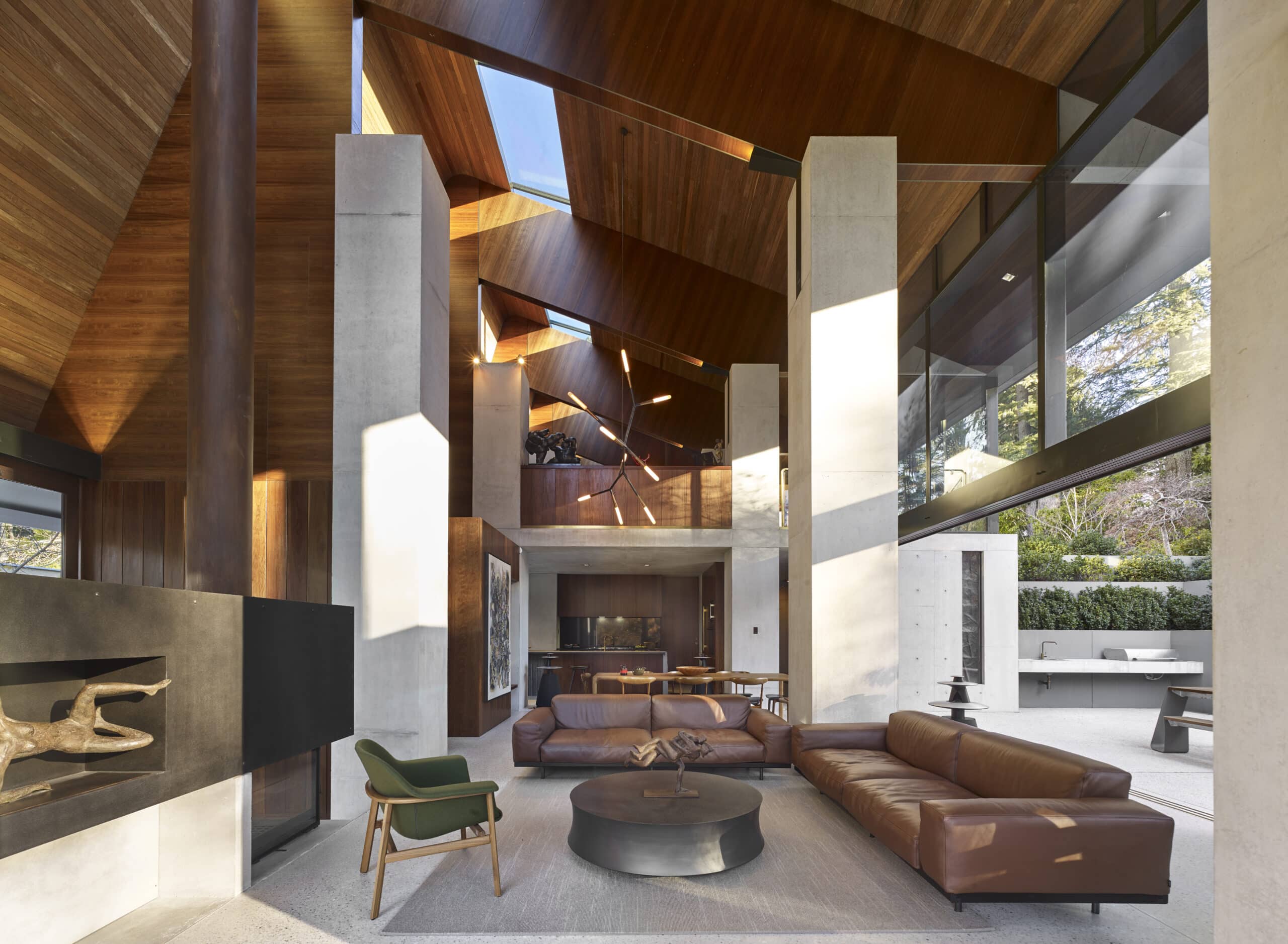
Before Peter made the first sketches, he camped on the site to gain more insight into the light and the lines. The most striking feature is the vertically rotating zinc roof, which resembles a sculpture with the tall trees. “On the north side of the building, where the roof is at its widest, you can completely open the house to the garden by lifting the window with a large iron turning wheel – really amazing! On the south side, where the bedrooms and library are located, the roofline becomes narrower and sleeker. The roof functions as a kind of diaphragm, varying from a large opening on one side to a small opening on the other.”
From an architectural point of view, art is woven into every crack and corner of the house, resulting in a colorful tapestry in which form and function blur. Ceramics by potter Peter Rushforth and paintings by Leonard French, Arthur Boyd, Miguel Macaya and Yoon Giwon are paired with glass sculptures by Lisa Cahill and custom joinery. The interior elements are custom-made or carefully hand-selected to complement or enhance Pirramimma's design language. Matt's penchant for mid-century design is evident in classic lamps by Frenchman Serge Mouille and furniture by Hans Wegner and Finn Juhl from Denmark. “I put a lot of energy into choosing the right piece for the right space.” Ingenuity everywhere you look. In the music room and library, a custom-made magazine rack uses magnetic handles to display the latest editions of various titles. And in the master bedroom, the side bed has an integrated folding table. “The entire house fits Matt like a tailor-made suit!”, says carpenter Jeffrey Broadfield.
The colors and materials were inspired by the rugged region of the Blue Mountains, with shades of blue, gray, yellow, eucalyptus green, rich red and reddish brown. “We chose the materials for their strength and honesty,” explains Matt's brother. The wood used both inside and out is recycled Gray Ironbark sourced from a bridge in Redcliffe, Brisbane. “When it was built, it was the longest man-made bridge in the southern hemisphere,” John continues. “After first serving as shelter and habitat and then being used for a bridge, the trees now have their third incarnation in the form of a house.”
That house is now occupied to everyone's satisfaction and fits like a tailor-made suit. The trees in the garden bear fruits such as almonds, figs and gooseberries, there are chickens running around, bees buzz around the beehive. With an artist-in-residence program, Matt gives artists, writers and gardeners the opportunity to further expand their creativity and expertise on site. “It has always been my idea to use Pirramimma as a place of inspiration for different purposes,” he explains. “A place where you can look back on life and develop new interests.”
MASTERS MAGAZINE
In the summer edition of MASTERS an interview with Sven Kramer, a driving impression of the Bugatti Chiron Super Sport and a study into the Effect of Max. But above all, it features people who bring light to the darkness. Such as Henk Jan Beltman, who took over Tony's Chocolonely because with a company you can make the world a more beautiful place. Chef Emile van der Staak, who has the ambition to change our food culture and therefore cooks with plants and vegetables that he obtains from the food forest. Designer Nienke Hoogvliet, who has introduced natural seaweed paint as an alternative to harmful textile paint. And Anna Nooshin, who criticizes the current social media culture of pretty pictures. In her documentary she also shares the less beautiful aspects of her life. All people who ask questions, hold up mirrors, take steps. Steps towards a healthier world and more understanding society.