PEOPLE
JAN DES BOUVRIE: HIS PASSION FOR CARS
Jan des Bouvrie's car collection used to be larger. Now it covers six iconic cars, from the period 1955-1965, which represent the style of the interiors of the country of origin at the time. “For me, the value is the look at it.” Originating from LXRY Magazine (2015)
Text: Bart-Jan Brouwer
Image: Rahi Rezvani | Online Editorial: Larissa Schaule Jullens
Collector
Jan des Bouvrie calls himself a 'real collector', where he is particularly interested in the design of the objects. Vitra chairs, watches and especially cars interest him. “As a child I collected those little cars. I even had cars built in the color I liked. I always kept that.” He shows a photo from the past, in which a young Jan is standing on the running board of a Mercedes. “My father instilled in me a love for cars. When he had done good business, he bought a second-hand Ford Ferlaine. And if he didn't earn much, he would exchange it for a Deux Chevaux. I liked that so much.”
Favorite model
His passion for cars started when he was at the Applied Arts School on Museumplein. “Every day I walked through Van Baerlestraat. A young guy lived there who had a Porsche 356 in front of his door, Porsche's first production car. I sometimes stayed there for ten minutes, fifteen minutes. I was impressed by the shape, which was very different from other cars. The first Porsche I had was also a 356. I remember well when the 911 came out. I was at the RAI together with Porsche importer Ben Pon, where it was launched. Ben said, “That's not going well. This is so innovative, the public doesn't want that.' We walked around the car and I said, 'Ben, boy, this is so beautiful. From Volkswagen to 356 to 911: it has only gotten better in terms of design and streamlining.' It was so well thought out. And maybe not, maybe it was one line. And that car is still there.” The 911 became Jan's favorite model. The most recent version, a white one, stands in front of his door at home. “Every time I walk outside and see that ass of my Porsche, I think: yeah, wow! I have always been loyal to Porsche. I also had all kinds of models.”
Handwriting
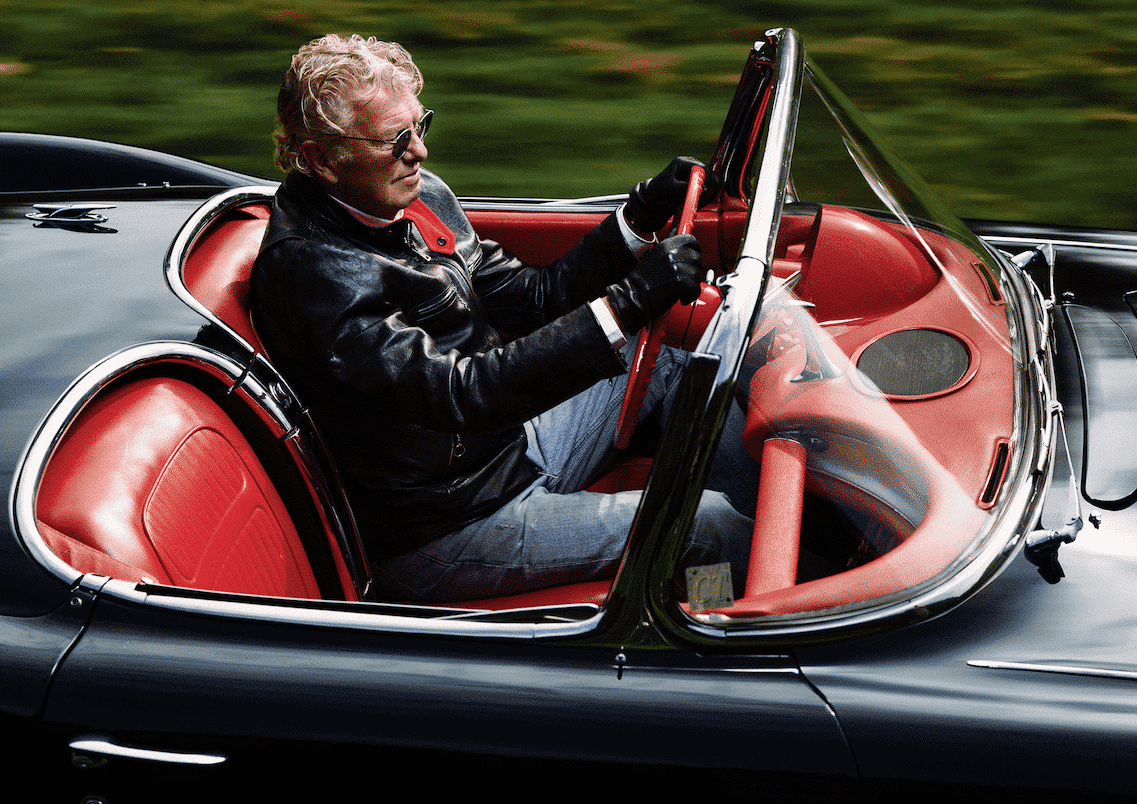
But the collection that he has parked on his lawn in front of LXRY does not consist solely of Porsches, but of six cars from six countries: the Jaguar E-TYPE from England, the Volvo 1800S from Sweden, the Citroën DS 21 from France, the Chevrolet Corvette from America, the Dino GT from Italy and the Porsche 1600 Speedster from Germany. “They are all models from the period 1955-1965. Cars that also represent the style of the interiors and architecture of those countries at the time. The interiors were so beautiful, so detailed and made with love. Now the similarities with the interiors of the countries of origin are much smaller. Since the car was developed on the computer, it has become uniform and the beautiful handwriting is gone.” Of course, all six cars represent value. Some have also become more valuable than when he bought them, such as the Dino. “But for me the value is the look at it. I also took very good care of them all. They are not in A1 condition, so they are, so to speak, even more beautiful than when they left the showroom. But the touch is still there.” What is immediately noticeable is that the cars are all black. Jan laughs: “I listened carefully to what Henry Ford (the founder of Ford; ed.) said: 'Any customer can have a car painted any color that he wants as long as it is black.' In other words: all colors are good as long as it is black. In any case, I like black in industrial designs, whether it concerns steel frames or outdoor lamps. The kitchen appliances I designed for Princess were also in black – that was very innovative at the time.”
Brigitte Bardot
In his garden in Naarden it is a small step from England to France. “The seat in a Citroën consisted of stretched springs with a cover over it. It may sound simple, but you were crazy in it: it molded itself to your body. And the seats in the DS, they were really armchairs. At Gelderland we have also designed chairs with springs. I have sometimes said: a car is even more beautiful if it has a fireplace. By which I mean: it must have an interior in which you feel at home. And I really think that most interiors today are plastic bins. When I look at that DS, I see Brigitte Bardot in it wearing a scarf and a tutu skirt. That car exudes the good French life. Citroën has never managed to build such a beautiful car again. Who can do that? The English with the Mini and the Italians with the little Fiat. They're just retro cars. The fact that they hark back to that period underlines that such beautiful cars were already being built then. The biggest example is Porsche: it still builds the same car.”
Sculpture
A car that suits the color black best is the Dino. After the tragic death of his son Dino in 1956 Enzo Ferrari decides to name the aluminum 2 liter V6 engine after him as a posthumous tribute. From that moment on, all V6 engines built by Ferrari carried the name Dino, secretly the most beautiful Ferrari according to Des Bouvrie. “In general, I think Ferrari, with its lines, is thoroughly Italian, and the Dino takes the cake. That design, how it runs… It's just a sculpture. Those Italians are very good at that. And especially during that period. They also attached great importance to beautiful clocks and other design objects in the interior. Things were a lot simpler at Porsche. Leave everything out. Just a clock, an oil gauge and a fuel gauge, that was it. Very functional. You can compare it with the televisions of the past: there was simply a button that you used to turn it on and off. You can see that in those old cars. Nowadays it's all about printing chips. It seems to have become easier, but it isn't. What I also like about Porsche: it has one atmosphere inside and out. That round window, the round interior. Nowadays an interior often has nothing to do with the outside.”
Enthusiasm
The Porsche was the first of the six he bought. “I don't consciously go looking, all my life - including in the field of art - I have come across things. This Porsche was owned by the German driver Wolfgang Graf Berghe Von Trips, who suffered a fatal accident in 1961 - the year in which he won the Zandvoort GP. I came across the car at a fair in Muiden. There were all kinds of cars there, and suddenly I see that thing among them. That man was not a car dealer at all, he was also a collector. That Porsche wasn't actually for sale: he was just showing his beautiful cars. I just kept talking until I got it. I am not a hard businessman and I did not offer too much, but the man granted it to me because of my enthusiasm. I had to promise him that I would never sell it. I've met him before. Then he asked, 'You didn't sell it, did you?'”
Lipstick colored
Although most American cars often had a long bench in the front - ideal for making out, for example, when visiting the drive-in cinema - Des Bouvrie's Chevrolet has seats. But it does have, very American, a lipstick-colored steering wheel and dashboard. “I bought this Chevrolet together with actor Guus Verstraete. He pointed out to me that it was for sale somewhere near Nice. We then drove there from Saint-Tropez. The seller had previously been a mechanic at the Grand Prix. We went back to Saint-Tropez in that Chevrolet, completely happy. We had our own car picked up later, haha. A while later, on a Saturday morning, I was driving through the port of Saint-Tropez with my son Jan. Does that Chevrolet fail? With hundreds of people around it. Jan crawled under the dashboard, haha. Nobody helped us. Then a Dutch family came and said: 'If we can take a picture with you, we will push you away.' You're so ashamed, aren't you? But the worst part was: the car was not broken at all, there was simply no gas left in it.”
Having breakfast
The white version of the Volvo 1800 S was produced in the sixties used in the television series The Saint, starring Roger Moore. “That was a truly Scandinavian car, including the interior. So beautiful! A friend of mine, to whom I showed my garage, said to me: I will visit you next week and we will have breakfast together between the cars. Just enjoy the design. I still think cars are one of my favorite hobbies. I have always been inspired by the design. For example, I once designed a chair for Gelderland, which I called Lotus. He also had that round. Just like my first tables: square models with a rounded corner. To the round shapes of the car and also of the female body. And if you apply that in designs, it creates an unconscious click. Just like the ass of a Porsche, that has something erotic.”
Final goal
Des Bouvrie has been collecting cars for fifty years. But that doesn't make him a technical expert. “I don't know anything about cars. I don't know what kind of engines are in it, how much horsepower they have... When I go to Porsche and they have a new one, they ask: 'Would you like to test drive it this weekend?' Then I say: 'No, that driving will be fine, they have undoubtedly thought carefully about that at Porsche.' I am purely design.” His collection of cars used to be larger. “But at some point you start making choices. What is really my end goal? And that was really these six. I will never buy one again either. I sometimes go to trade fairs and then I drive home completely happy afterwards. Because then I know: I have it. It's finished. Finished."