Power
Woman of Gold
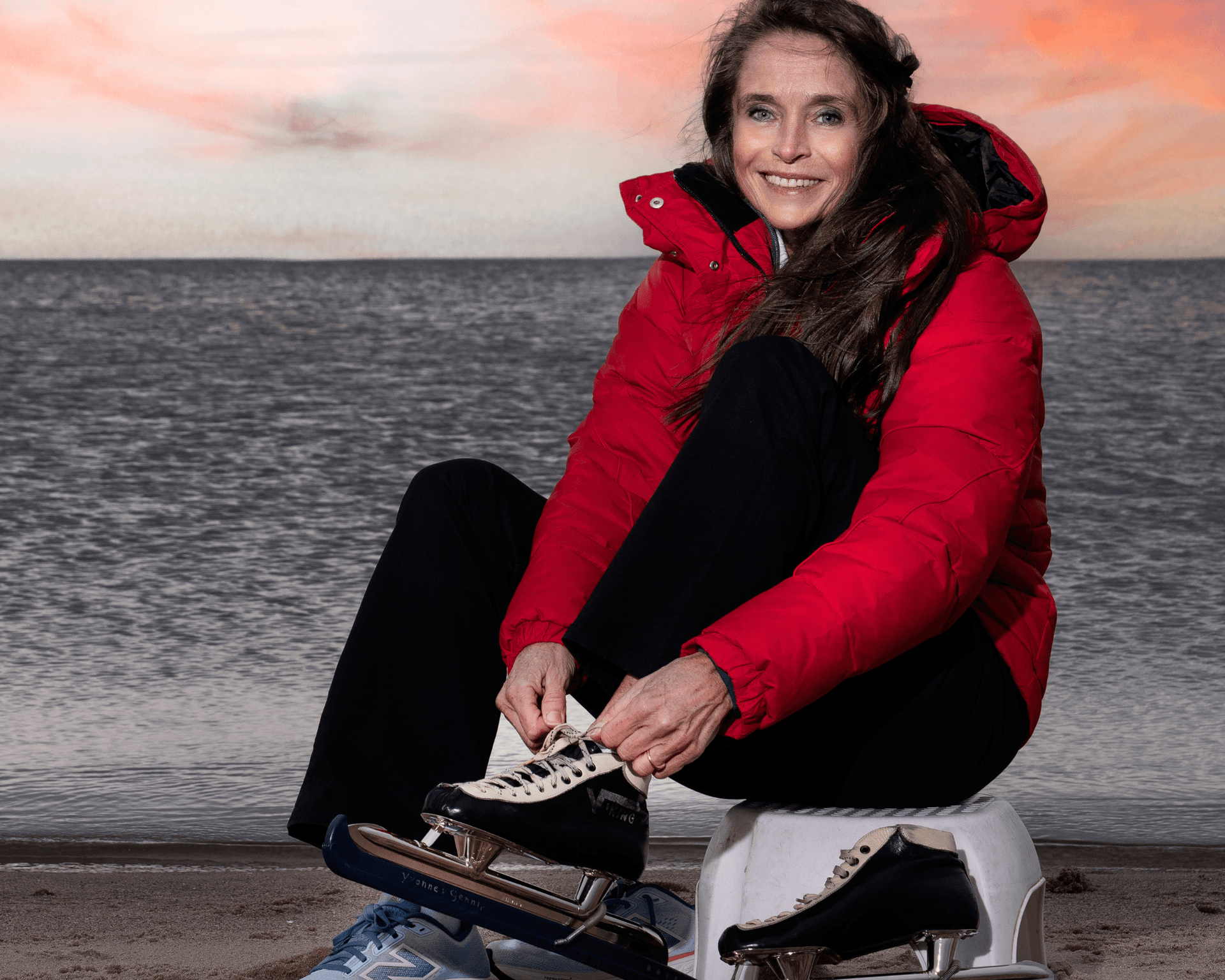
These will be her tenth Olympic Games. First as a speed skater, then as a celebrity, and from February 6th to 22nd in Milan as team manager of the Dutch speed skating team. Yet, Yvonne van Gennip is still considered by many to be the Queen of Calgary, where she won three gold medals in 1988. She is now working on all fronts to help the new generation secure a golden future. She speaks extensively about this and much more with Jaap de Groot.
Text Jaap de Groot
Photography John van Helvert
Thanks to Van der Valk Hotel Volendam
What are you doing now?
I divide my activities between two jobs. Currently, I'm the team manager for the national speed skating team and also actively support my own Yvonne van Gennip Talent Fund. Because of my skating, I'm less active in the winter than in the summer, but even now, I stay in constant contact with my organization.
What does the Yvonne van Gennip Talent Fund entail?
The fund's primary purpose is to support young sports and cultural talent financially, enabling them to continue developing and avoid falling behind due to a lack of funding. We do this through a crowdfunding platform, which is where it all began in 2016. Talented individuals can recruit donors and learn how to run their own businesses, building a network and fan base. It's a learning experience on the path to becoming a true elite athlete. That's why the Talentboek crowdfunding platform remains our flagship. It provides talented individuals with the tools they need to move forward.
Furthermore we are Mission 1 for 100 Launched: a new project where we guide talented individuals to neighborhoods, schools, and events to get children excited about sports, exercise, and a healthy lifestyle. Nearly half of children in the Netherlands don't get enough exercise, so that's one of our priorities. But also how to deal with setbacks, why good nutrition and enough sleep are important. That's the story the talented individuals share during a classroom presentation, followed by a clinic in gym class or on the schoolyard. This is usually led by a teacher. The project is called Mission 1 for 100, So they have to inspire at least a hundred children. They'll receive €500 for that, which we'll then donate to their crowdfunding campaign. This creates a win-win situation. On the one hand, you're combating physical inactivity, and at the same time, you're giving money to these talented children, who can use it to finance their athletic careers.
Our third priority is Talent Support. This is a program for talented individuals facing financial difficulties at home. Federations can apply to us for funding, which they must spend on the talent. We do this in collaboration with the Youth Fund for Sport & Culture and NOC*NSF. This applies to talented individuals up to and including 21 years old with NOC*NSF Talent status. Last year, we disbursed €936.000 through the crowdfunding platform, and together with Talent Support, we disbursed around €1 million.
You do this from April 1st to October 1st, from October 1st to April 1st you are active as a team manager at the KNSB.
In that role, I'm responsible for arranging everything off the ice. This applies to all the skaters from the branded teams who have qualified for the World Cups, European Championships, World Championships, and Olympic Games. I'm also the liaison between the skating association and the various local organizations and I liaise with national coach Rintje Ritsma about the composition of the team pursuit, which he ultimately determines. Furthermore, I'm responsible for arranging accreditations, transportation, special meals, and providing support if the rooms aren't suitable. And if someone is sick, I consult with the doctor. In short, it's a very diverse and enjoyable job.
Milan will be your tenth Games.
I've experienced the Winter Games three times as an Olympian, been invited five times, and this will be my second Olympics as team manager after Beijing 2022. All countries have their own support staff in Milan, multiple coaches and physiotherapists, and I'll be communicating primarily with them. It's all about keeping them well-informed about the relevant matters before, during, and after the competitions. I'm in a team leader app for all the countries, which is also useful for lobbying. Sometimes situations arise where it wouldn't hurt to collaborate with other countries to make a change. So, in Milan, it will be a constant collaboration with the coaches to ensure everything runs as smoothly as possible.
How does the new generation of skaters view you?
"Hahaha, some even ask, 'Can she skate too?' I like that, because you're not there for yourself; you're there for the athletes. They don't care if I've ever skated well, as long as everything is well-organized."
What do the Olympic Games mean to you?
It's still a competition with a lot going for it, of course. It's only once every four years, and that makes it unique. But the very first time I competed, in Sarajevo in 1984, I thought: is this it? The same ice rink, the same people, it's basically the same competition I'm used to. It was very sobering for me. The opening ceremony was spectacular, though. That was truly special, but the competition itself, no. If I can give athletes a tip: it's no different from what you're used to. The difference is that there's a lot of pressure and a lot of media attention. That's why I made it so small for myself, to make it manageable and reduce the pressure.
Four years later, in Calgary, it was a completely different story. Everything fell into place there, although I didn't really notice the impact of my performance. I was in the athletes' village and walked underground from the campus to the ice rink. I saw almost no daylight, was barely distracted, and was able to stay very much in my bubble. Back in the Netherlands, I couldn't keep it small anymore. There was a real life before and a life after Calgary. What I really struggled with was everyone's opinions and demands. While I preferred to sit in the back of the class in elementary school, my father had taught me to always comply when people asked for something. He taught me to be helpful. But after the Games, that was no longer possible. I had always struggled to say no, until I had to. I was overwhelmed by so much attention and so many things that came my way. It took a while before I recognized my privileged position and began to see it as a gift.
You've lived outside of skating for a long time. Consciously?
As an athlete, you live in a rather small world. Ever since I was a child, I've been quite curious and enjoy many things. After my skating career, I could finally let loose. The world is so much bigger than skating, and I wanted to explore that. When I retired in 1992, I was truly ready for it. I traveled a lot of the world back then. Not just privately, but also for charities and the work I was doing at the time.
Finally you calmed down.
After four years, I returned to sports. I was asked to join a project in Haarlem, aimed at getting children excited about sports. It was a trial project that seemed like a perfect fit for me. I took it on, driven by intrinsic motivation. Then you get back into sports and realize that this is my world, that this is the language I speak. I've never left. It's my habitat.
You were also a very talented TV presenter, why did you stop doing that?
“It's not really my thing. While I do remember with great pleasure the collaboration with Martijn Krabbé, for whom I was an assistant on a game show. I also did On land, at sea and in the airTelevision was purely for my curiosity. But I'm a people person and missed sports. So that project in Haarlem came at just the right time; moreover, it was linked to a TV program that was perfectly tailored to me. Sports in Holland "It was first broadcast by TV Noord Holland and later by SBS. Its theme was to get people excited about sports. Through wonderful interactions with people who spoke enthusiastically about their sport. For me, there's always a social component."
You are still very careful with your TV appearances.
I've been asked to participate in many programs, especially in the beginning, but I don't feel the need. I just let myself do my thing. It's a bit like when I won my medals in Calgary. My proudest moment was after my last distance, the 5K, when I went to the dining hall. Everyone was preparing for the closing ceremony, and I was sitting there alone in that immense space. It might sound strange, but that was my momentum. The realization that I had succeeded. I had achieved it. Moments like that give me the most energy. I don't need to share them with the whole world. A moment like that is enough for me. I don't need that pat on the back; my own satisfaction is enough. Especially the satisfaction that, with my own healthy body, I beat people who were later found to have been using stimulants.
Then did the realisation dawn on you that your beautiful roll of honour could have looked even more beautiful?
But even then. That's just outwardly visible. While it's primarily about how much I've been able to achieve with my own healthy body. Whether you become champion, second, or third doesn't really matter. So be itYou're given a body, you have to work with it, and the most important thing is that you've gotten the most out of it. It's purely about your own experience, not what others think. Whether you finish 100th or first, if this is your best, you can be proud. That's why I could live with second place, simply because the other one was better. Later, that changed when it became clear they'd used junk. That's beyond me. I would never, ever be proud of myself if I'd used that stuff. Then you're constantly being lifted up on that shield, while you realize it wasn't fair. I couldn't live with myself.
Back to the Yvonne van Gennip Talent Fund. To what extent have you explored a gap in the system with it?
When I worked at Sportservice Noord-Holland in Haarlem, I saw a lot of talented players, and the main question was always about money. When I joined the Dutch Juniors, where everything was reasonably well-organized, I already saw that things weren't as good in other sports. Even at sixteen, I thought it wasn't fair. Many years later, it resurfaced, and I saw how talented players still struggle to finance their careers. In a country like the Netherlands, that shouldn't be an issue. If you have talent, you should be helped to develop further. For me, that's a basic right. We live in a prosperous country, and if I can do my part to give children opportunities, I will. Regardless of whether they reach the top. That's not my motivation at all. My motivation is to prevent children from having to drop out at the grassroots level because there's no money. I just don't think it's fair.
"It may sound strange, but that was my momentum. The realization that I had succeeded"
What do you notice about the attitude of the business community towards sports and your fund in particular?
The advantage of sponsoring talented athletes is that they're already very happy with relatively little. Although a figure skater like Lindsey van Zundert needed €60.000 to €100.000 a year. A racing driver also approached me to see if I could help him raise a million. That's a sport, of course, where you don't need a fund. Although Max Verstappen is an example of how it can be done. He was supported by Jumbo from a young age and has remained loyal ever since. As a result, Jumbo has been able to walk the entire path from talent to world title alongside him. That's the best part. For my fund as well. Precisely because the amounts involved are relatively small, it's rewarding to walk that path together with a talented athlete. Of course, they don't all reach the top, but the skills they acquire can be invaluable for the rest of their lives. As a young talent, you live in a pressure cooker. The pressure that comes with that is very instructive. I hope more companies will realize that these kinds of development projects are about more than just performance. You're helping the next generation. to develop in other areas as well. We've now supported almost 3.000 talented individuals and around 200 teams through crowdfunding. We're currently running 176 campaigns, which is an ongoing process for us."
Your luck seems to be that the decision-makers of today are the love-struck boys of yesterday.
"Hahaha, I don't think so. Otherwise the fund would have been much larger."
You were successful as an athlete and now also successful outside the ice rink.
"With my fund, I certainly can't complain, but it's still hard work to raise awareness for talented individuals who need financial support. Many people still think the federation or NOC*NSF pays for everything, so we have to constantly reiterate that narrative. That there's a lower echelon beneath the top that also deserves attention. The fund should complement that. See us as a true support system for what's already there. That's why I emphasize, among other things, their role as role models, no matter how young they are. Think of it as a learning experience for people. Of course, you hope they'll become top athletes, but you can't guarantee that. I want them to realize that everything they learn now on their way to the top, even if they don't reach it, has been important. That they can benefit from it later. These are skills you don't normally learn at school. For businesses, this could be a point of attention for sponsoring, as there could be potential future employees among them. Not just the medal, but the entire learning experience and the social impact are relevant. It affects so much more."
What will the future bring?
I'm 61, and the way I feel now, I'd really like to stay in skating. I find the world of top-level sports absolutely beautiful. People who give their heart and soul to a single goal. I share that with other things, too. The fascination of someone who collects stamps or art; I can really enjoy someone who has a passion for something and goes all the way for it. That's why I hope to stay in the sports world for a few more years. Regarding my fund: ultimately, I don't have eternal life, and it would be great if there were structural support for this target group. We're currently working with NOC*NSF and the Youth Fund Sport & Culture, who have been doing a great job for years. We are the next stepIf children want to take music lessons or play sports, there's the Youth Fund. If a child turns out to have a special talent, there's a gap. That's why it would be great if my fund eventually merged with something like the Yvonne van Gennip Talent Fund for Sports & Culture. You name it. “In this way, forces can be bundled.”
What do you expect from the Milan Winter Games?
I'm looking forward to it. Just like I always look forward to the Games. They remain magical. It remains the most beautiful event imaginable. As for the Dutch performance, I can only give a rough estimate of the skating team's chances. There's a lot of international competition, but I have a lot of confidence in our coaches. They enable the athletes to peak at the right moment. That's a gift. I have a very positive feeling about it.