Taste
From Barcelona to Lisbon in style
Fresh winner of the 2026 Luxury Cruises award, presented at the Travel Gala, Explora II shows what travel can be: without the hustle, without stress, and without schedules. On board, travel becomes an art form, elegant, relaxed, and meticulously cared for. As the horizon unfolds a constantly changing backdrop, from Barcelona […]
Freshly crowned winner of the 2026 Luxury Cruises award, presented at the Travel Gala, Explora II showcases what travel can be like: without the hustle and bustle, without stress, and without schedules. On board, travel transforms into an art form—elegant, relaxed, and meticulously cared for. As the horizon unfolds a constantly changing backdrop, from Barcelona to Lisbon, a world of understated luxury, culinary refinement, and true indolence unfolds. Because sometimes the greatest pleasure isn't what you do, but rather what you don't do.
“Welcome, I am your sweet host.” Kukee is from India, our host on this cruise. We look at each other. Because to immediately claim he's a kind host? Well, we'll see if that's true later. He gives us his card with the number we can reach him 24/7; no wish will go unanswered. And then I read: Kukee, Your Suite Host. Aha. So that's it. The Explora II doesn't have staterooms, as cabins on luxury cruise ships are usually called, let alone cabins, no, on the Explora II there are only suites: Terrace Suites, Grand Terrace Suites, Penthouses, Deluxe Penthouses, Premier Penthouses, Grand Penthouses (with or without whirlpool), Retreat Residences in all shapes and sizes, up to the ultimate accommodation, the Owner's Residence of almost 300 m2 with a private pool on the private terrace, cinema room, etc. It costs an upper mid-range car per cruise, but then you get what you pay for.
On a cruise? You?
De Owner of That suite, and all Explora ships (number III will set sail next year, quickly followed by IV and V), belong to the Italian Aponte family, whose ancestor Gianluigi founded the company in 1970. It hasn't paid off for them, as Forbes and Bloomberg estimate the family fortune at around $30 billion, placing Gianluigi as the 48th richest man in the world. Cruising is big business, more than ever. Despite protests about environmental pollution, the number of travelers is steadily increasing every year. Cruise lines are therefore doing everything they can to drastically reduce their carbon footprint by using new types of fuel and recycling as much as possible, an ongoing and intensive process.
Kukee uncorks our bottle of champagne, brings us some sweets under a glass dome, and offers to unpack our suitcases. We'd rather do that ourselves. After all, we have our own walk-in closet. And then the ship's horn blows, and we majestically depart the port of Barcelona, bound for adventure. Adventure? On a cruise? You? Friends looked at me with pity. Isn't that only for… (fill in the blank: elderly, crippled, bored, rich). Not at all. A cruise sails at night, when you're gently rocked to sleep in your bed, and every day, when you open the curtains, you find yourself in a new port city where you can spend the entire day (sometimes two), only to embark again in the evening. One packing and unpacking session, while in between you can visit countless places around the world on your own without having to worry about a thing.
Champagne all day long
Exclusive cruises like this one are all-inclusive. This means that everything you consume is included in the price. Champagne all day long and always eating and drinking everywhere, is six restaurants under the auspices of Franck Garanger, the Michelin-starred chef who earned his stripes at places like the Hotel De Paris in Monaco and the ultra-exclusive Eden-Roc in Antibes. The food is undeniably excellent. I might just have the most delicious baguette I've ever had, baked here on the ship using the traditional "Retro d'Or" method, with Veron flour from a mill in Beauce, France. Nobility obliges, because Franck's father was a master baker and owner of a pastry-boulangerie where little Franc learned the tricks of the trade. It's a logistical marvel how they manage all this: 461 suites (so about 800 guests on board) constantly wanting to eat and drink. In every port, there's a massive loading and unloading frenzy, new supplies of Wagyu meat and caviar and Angus beef and whatnot, and the removal of whatever well done is.
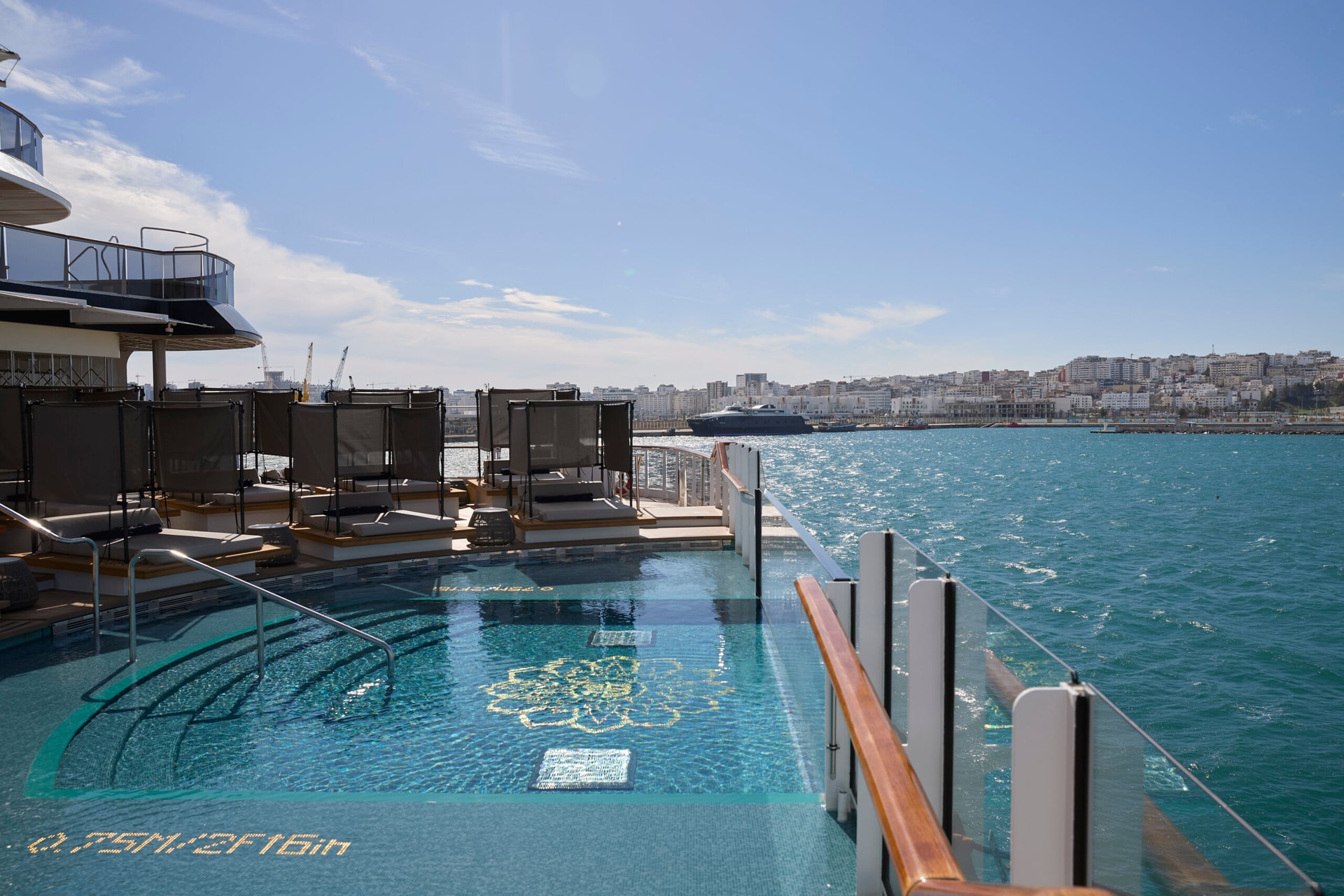
We explore the barge. What immediately stands out is the contemporary design, sleek and streamlined like a hypermodern New York penthouse. On the Explora II, there's no kitsch, brass, or frills, as is the norm on many other cruise ships. It's bright and open everywhere. And we're greeted everywhere by smiling staff who immediately press their backs against the wall to grant us a wide passage. This happens once. Twice. Three times. Four times. It never ends, that smiling "good morning" and have a good day Wishes, a never-ending stream of well-wishes and smiles, because, well, with some eleven hundred crew members on board, it just keeps going. It takes some getting used to, but by day two, it's already our daily routine, nodding and allowing doors to be opened, because looking back, I can't remember opening a single door myself during the trip. Just how spontaneous these smiles were becomes clear when we sneak into the staff canteen and see a large smiley face on the inside of the door with the following text underneath: 'SMILE! A friendly smile and a warm greeting makes a great start!' Captain's orders, then.
Blindingly full of diamonds
There's plenty of entertainment on board. Lectures, music, cooking, wine, whiskey, caviar, and art courses (theme: Why Is Art Sometimes Worth 100 Million and Who Pays for It?), films and performances, and special get-togethers for LGBTQIA+ (that's what it's called in English) and singles. There we meet Leslie Kanner, who immediately asks how old we estimate her to be. I say "at most seventy" (but I think at least eighty), and she proudly announces eighty. She's American and cruises non-stop. On this trip alone, she'll be on board for two months and will soon be joining the Cross-Atlantic crossing from Lisbon to Miami. Why is she cruising? "Mainly to have a reason to wear my jewelry, because where on land can you still safely wear it?" She's blindingly adorned with diamonds and gold, and it's only 11 a.m. She has a different outfit for each day and evening, so do the math: sixty days on board times two—that's a lot of carats. Should she want to stock up, there are shops on board selling Cartier, Piaget, Panerai, Hermès, even a Buccellati, the exclusive Italian jewelry brand that never sells outside its own stores. So why is it sold here? "The families have known each other for a long time; the Apontes and the Buccellatis are close friends," says salesperson Adnane Belbakri, "and then it's arranged quickly, isn't it?" "It's selling quite a bit," I ask. Belbakri: "Last night, a bracelet for thirty thousand, and one evening last week, a beautiful parure for over a hundred thousand. The best sales are on cruise ships in the evenings. Then people have eaten and drunk deliciously, and they're full and satisfied, so they're more inclined to pay those prices."
The art of doing nothing
Then there's Clement, a fifty-something from Germany, single and traveling alone. "It's wonderful being alone, you can do whatever you want, and you always meet new people on board—I've made a lot of friends that way." He reads a lot, does puzzles, but above all, relaxes. Clement: "You don't have to think about anything, you don't have to arrange anything; everything is done for you and brought to you, leaving you with all the time to stare out at the waves, contemplate, simply put, do nothing. Doing nothing is highly underrated," he says, showing the book in which he reads: Why Doing Nothing Can Change Your Life By Joseph Jebelli, Professor of Neuroscience at University College London. He's made notes everywhere and stuck post-its in the margins, and quotes: "Charles Darwin considered fishing just as important as developing theories because only rest produces new ideas, he said, and Leonardo da Vinci could stare for hours at his work in progress without touching a brush because rest gave him the most inspiration." Clearly, Clement is in good company, but even we find on day three that simply staring out at the waves has a kind of catharsis. Daydreaming on the terrace of your suite, taking a nap, naturally with a drink. "Bottle's empty," Herman, fellow traveler and photographer for this report, calls from our suite, "I'll just call Kukee."
Ships that pass in the night
Melvin, 32, from Belfast, is also traveling alone. The imposing, muscular man didn't attend the singles meeting because he's not here to meet anyone, just to train. "They have the best and newest state-of-the-art Technogym equipment here, that's why I chose this ship – I can train undisturbed 24 hours a day." He eats mainly in the French Red Line restaurant (grilled Bresse chicken, broccoli, risotto) and in the Japanese Sakura on deck 5, mainly sashimi, platefuls. Someone with such a stunning physique naturally wants to have their picture taken, we think, but no: "Maybe at the end of the cruise, I'm not dry enough yet." It's striking how quickly people tell you their life stories here and how quickly they connect with each other. Perhaps because they themselves are also here ships that pass in the night are, people are dependent on each other for a short time and eventually go their separate ways. Within five minutes, I learned that Leslie had been unhappily married for thirteen years, but that her parents had forced her to find a husband because that's just the way it was. She ended up with a beautiful daughter in the process (Immediately, a bunch of photos were thrown under my nose, "How old do you think she is?" I think she's sixty, maybe thirty, "No! Fifty-five! And no plastic surgery, mind you, pure nature!") and so on for another half hour...
True joy of life
I borrowed Clement's book and read that the author had extensive contact with the Dutch professor Ruut Veenhoven, who taught him about the typically Dutch practice of "niksen" (doing nothing). Jebelli even calls it a Dutch invention, the "Dutch art of doing nothing." "Veenhoven taught me that things like staring, people-watching, and hanging out in cafes can be incredibly satisfying and cathartic." And that it's "important, even healthy, and perhaps even vital, to shake off the nagging guilt about doing nothing, which robs us of true joy in life and the much-needed freedom of mind." This is taking place here aboard the Explora II.