Power
THEKLA & RAYMOND: BEAUTY VERSUS RAW REALITY
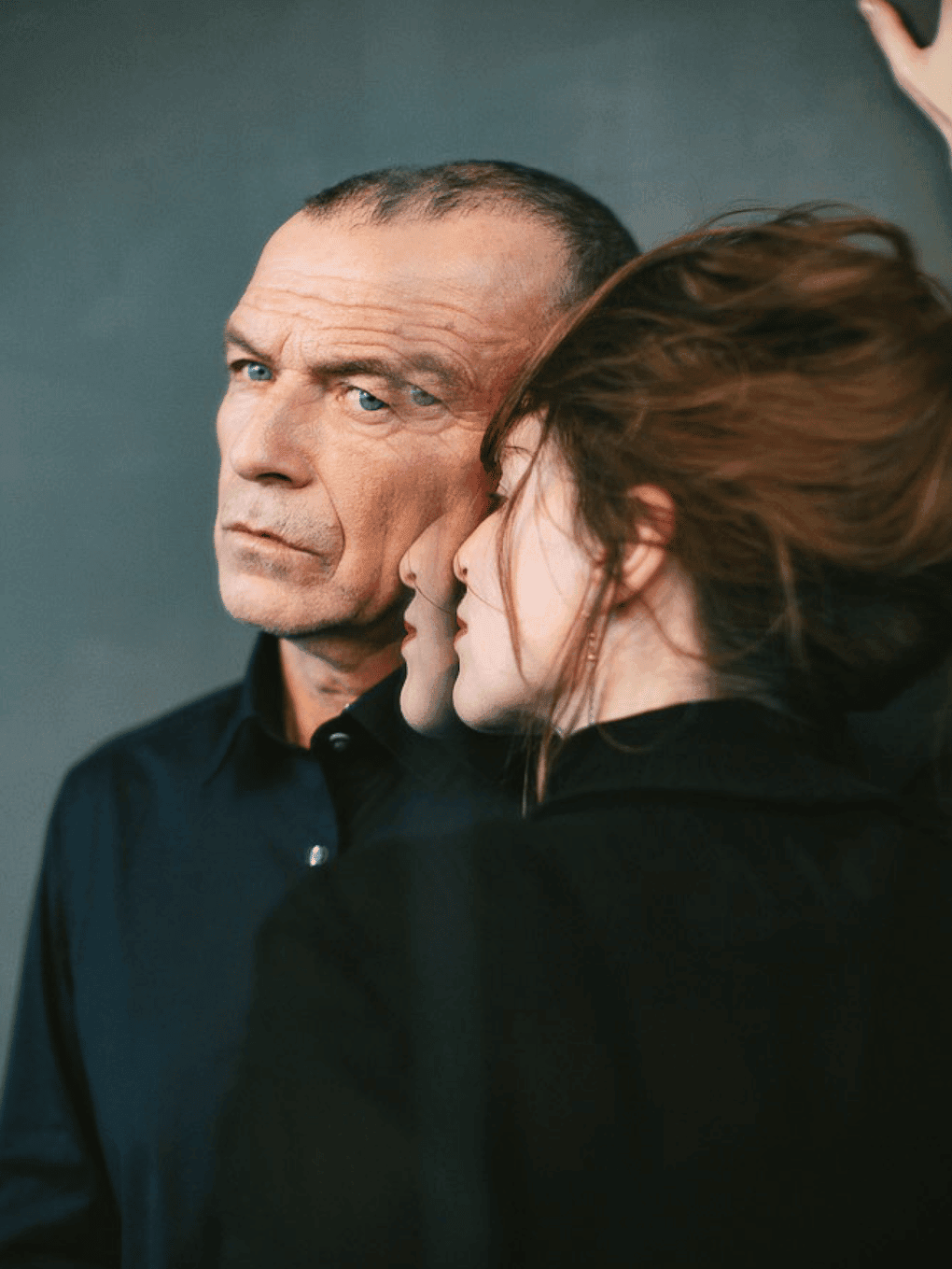
Thekla Reuten (Bussum, 1975) starred in Warrior Nun, Raymond Thiry (Amsterdam, 1959) in Undercover. MASTERS brings both together.
They have starred in two of Europe's most successful Netflix productions in the past year: Thekla Reuten (Bussum, 1975) in Warrior Nun, Raymond Thiry (Amsterdam, 1959) in Undercover. Series that are binge-watched worldwide. “I was approached by complete strangers from Singapore: 'Are you the guy from Undercover? We watch it at home!' “MASTERS brings both viewing figures together. Text: Bart-Jan Brouwer | Online editor: Natasha Hendriks
Image: Rahi Rezvani
You are sixteen years apart. What smells and sounds do you remember from the past?
Thekla: “The smell of the heath – I grew up next to the Bussumerheide, lucky bastard! The one with garlic and an onion in the pan. My mother cooks deliciously and was sometimes preparing something for dinner in the morning. Or the basil smell when she made kilos of pesto from her own basil plantation. And the smell of my father's jackets; he always wore suits. Sounds? 'It is half past seven!' – this is how I was called awake by my mother in the morning. My father would already be standing in the bathroom at the end of the hallway, always with Radio 1 on. He had quite high-maintenance hair. Every morning he washed it, after which he sweetly draped the few hairs he had left over his bald head and strengthened them with hairspray. It always fit impeccably. I find it very moving, in retrospect. That classic Wella hairspray is also part of the fragrance palette from my youth.”
Raymond: “My father couldn't smell, so I was his nose. I had to assess all products in the refrigerator for freshness. Is the milk still good? Are these meats still acceptable? Does this shirt smell clean? And we smoked a lot. The net curtains, curtains, the interior of the car: everything was soaked in nicotine. Smell has always played a major role in my younger years. When it comes to sounds, I always liked it when my parents were still talking in the living room, while I was in the next room waiting to fall asleep.”
You have a very different background. Thekla, your mother, a full-blooded Italian, worked with children who were difficult to raise, your father was a priest. How lovingly did they treat each other?
Thekla: “A marriage between a priest and the much younger daughter of Roman Catholic Italian ice cream makers, that was not how it should be, of course. But my father was a free spirit. He fought for gay and women's rights, criticized the Vatican... And he believed that love was also part of his faith, everything he cared about. So they consciously chose each other and I experienced the love between them as very natural - I saw how they looked at each other. Things were always very gentle at home, there was never any shouting. My mother was sometimes annoyed by things my father said. At such moments the Italian temperament reared its ugly head, but never loudly. My father was clearly very grateful for everything my mother did, for example appreciating out loud the flowers she placed. He really enjoyed the food she made every evening and carefully selected a nice wine to go with it. I always felt safe about the two of them.”
What is the most important lesson you received from your parents?
Thekla: “Taking care of each other, I think. And my father's winged words were 'don't fall from each other's grace'. I think that's so beautiful. Arguments, battles or fuss, always approach others with an open heart. It still resonates with me: keep seeing each other and keep looking for connections.”
Raymond: “My father always said: 'Trust no one, not even your best friends.' That was his motto. Very different from 'not falling out of each other's graces', haha!”
What was the atmosphere like in the Thiry house?
Raymond: “Sometimes to cut. I have seen my father pin my mother against the door with a Turkish sword in his hand, completely freaked out. I stood among them like little men. No idea what it was about, but the argument was unmistakable there. Still, home felt like a safe haven, also because my grandfather and grandmother lived next to us. But not in the sense that it was just surrounded by love. It was more the family bond that gave unconditional confidence that you were wanted.”
Raymond, your mother died when you were nine. How did you experience that?
Raymond: “That was quite a blow. But hey, life goes on. That was kind of the attitude. As a child you don't know any better, you don't get a brochure about 'this is how it should be done'. Of course I was afraid of losing a parent. I always asked my mother, even when she was still healthy, "You're not going to die, are you?" And yet, the moment it happens, it's a matter of moving on. I also think that a child is very flexible in that regard. The day after her death I went back to school. Although I didn't last all day. That was because all the girls were leaning against me to comfort me. Then I ran home and spent the rest of the afternoon gluing funeral envelopes.”
Thekla, when did you know you wanted to become an actress, what inspired you?
Thekla: “That has been a gradual process of cinema and theater visits. As a child I of course watched Annie and Pippi. At a slightly later, but still young age, my parents took me to films like Cry Freedom. And I myself watched work by Ken Loach and Zhang Yimou in the film house in Bussum, those social realist stories. There the inside of man came out, the underbelly of society. With Zhang Yimou I was suddenly in China, with completely different colors and smells and the social abuses he exposed. I wanted that too! Storytelling. Letting people travel, broadening their views. Be part of the heart of life. My antennae were very much directed outwards, also towards the big emotions. About what was bubbling inside, in terms of fears and desires. There wasn't much talk about that in our house. My father and mother had not experienced that. They were not asked at home what they felt, no way! That's what I was looking for, I think, in theater and film stories: to learn about life, emotions, human-male-female… everything! From my teenage years I went to the Youth Theater School in Amsterdam. I was serious about it and knew from a fairly young age that I wanted to do something with acting.”
You were accepted by both the theater schools in Maastricht and Amsterdam. What determined your preference for Amsterdam?
Thekla: “That was a very practical choice. I just knew that my father was ill and I liked being closer to home.”
Raymond, just like Thekla, you did your pre-university education, but you just didn't finish it. Where did it go wrong?
Raymond: “I gave it up in the third grade of the Reformed Lyceum. I couldn't concentrate, I was more concerned with cannabis. I did my homework in the coffee shop and when I was watching the Willem Ruis Show with my father in the evening, he lit a Caballero and I lit a joint. He couldn't smell, he didn't notice anything. Sometimes he came downstairs and I would sit with some friends in the former studio and it would be absolutely blue. Yet it never rang a bell with him. At sixteen I left school and left home. I lived in squats and was on benefits. According to the Social Services I was 'unemployable'. They soon realized: give that boy a few cents, otherwise he will do strange things. At first it was one big voyage of discovery through party centers and nightclubs. I spent a lot of time in coffee shops and tea houses, and had my own cannabis plantations in all kinds of places in the city: behind a fence on the Weteringschans, on the Ringdijk I had some wild plants growing, in my own garden... During harvest time I invited girls from leave school to pick weed. There were eight girls picking. From the crazy!”
Raymond, when did you come into contact with acting?
Raymond: “When I was twenty-one. At three o'clock in the morning I was sitting in Carels 3, a pub in De Pijp, reading an article about Willem Ruis in the Privé of Story. Above it was the headline this quote from him: 'First say yes, then think.' At that moment, a friend who was taking directing training approaches me. She was looking for people without acting experience to play in one of her plays. Or I wanted to participate. "Yes, that's fine," I replied immediately. I had never seen the inside of a theater, but I was guided by the words of Willem Ruis: 'First say yes...' That's how it happened. So I indirectly owe my career to him.”
Thekla: “Haven't you ever had the urge to act before?”
Raymond: “I could imitate many things in the past. For example, my grandmother who was dying. The moaning and all. Until my father said 'now it's over'.”
Thekla: “Did you watch a lot of films as a child?”
Raymond: “I liked watching Rawhide on television. I could lose myself in a story. And also in the game. When we played cowboys and Indians outside, I was completely involved.”
Thekla: “That is the essence, yes, that you can get lost in stories.”
Raymond: “Acting has to come naturally to me. I'm not a fan of methods and I don't empathize too much before 'action' is called. I just read the story carefully so that I have an idea of the atmosphere. I try to answer that, more with imagination than with method.”
Do you notice a difference with actors who have been trained, that you have a disadvantage?
Raymond: “Not behind. I sometimes miss the kind of confidence that people with a diploma have.”
Thekla: “Several roads lead to Rome. When you come out of drama school, you don't have that experience of two years of acting that you had. And ultimately, your acting career only really starts after school, by doing it. At drama school you learn subjects and develop talents. But you gained your knowledge on the road.”
Thekla, a year after your film debut, your father died. How did you go through that?
Thekla: “He was sick, so we lived with it. Ultimately, I also realize what a great gift it is that you can go through the dying process together. My mother, brother and I were there when he took his last breath. I thought my father's last thoughts, which he still clearly expressed, were very beautiful: 'Dying is being absorbed in… something eternal… mystery.' That you dare to doubt God on your deathbed, even though you were a priest. I think that testifies to something very powerful.”
Raymond, your father died when you were twenty-one, you had now lost both parents. Weren't you left with unanswered questions?
Raymond: “It's not that I have questions that I would like answers to. In any case, life is one big question mark. It was of course sad that I had lost both my parents, but at the same time it felt like a liberation. That you think: okay, now I stand on my own two feet. It also gives a boost of 'I'm going to do it myself'.”
You've lasted twenty-one years. Are you still challenged at some point?
Raymond: “Gradually the cake was a bit gone, at least the collaboration. Ko clearly wanted something different. He no longer necessarily wanted to make a performance with all members of the collective. That rubbed us a bit the wrong way. There was definitely a deep respect for the artistic direction, but at the same time there was a proud feeling that we were all doing it together.”
Raymond, you were perfect for the role of assassin Luther in Penoza. Did you have any idea that the role would have such an impact on your life when you read the script?
Raymond: “No. And it hasn't really changed my life either. I am in a good mood more often. During the photo shoot I just went to get a pack of cigarettes. In the ten minutes I was gone, three people wanted to take a picture with me. That makes me happy. I only get nice responses. Recently I was passed by a tram, Line 3, between the Ferdinand Bol and the Hobbemakade. It slowed down, and suddenly a loud sound came through the speakers: 'Hello Luther!' A police car also drove by once. The window opens: "We're keeping an eye on you." Haha! Since Luther, I have been able to walk safely on the streets at night in the poorer neighborhoods of Amsterdam. I am a hero to many youths and criminals. The other day I was standing at a traffic light, a big Mercedes stops next to me with four Moroccan Dutch people in it, the window opens: 'Hey Luther, you should write a book about us, man!' After which they sped off at full throttle. The strange thing is, everyone wants a stage. Criminals also want to make their success shine. They don't just want to make money in a disco with their stolen money, they want a book to be written about them, about what they do, the exciting situations they find themselves in. In their eyes, I kind of made it. I have a tough image – that's what that role entails – and I get away with it. That's what they appreciate.”
You played Luther for almost ten years. How does a character's psychology develop over such a long period of time?
Raymond: “Not! It is very clear what I do. I was just a second, a soldier who saved Carmen (Monic Hendrickx; ed.) from dire situations. There wasn't much else to play. Although there has always been sexual tension between Carmen and Luther, it was never developed, which could have led to more interesting game scenes. Somehow it could have been expanded, so that I had just a little more to play. Gradually it became more modeling. I had a pretty good handle on it, the character doesn't surprise you. There could have been a little more meat on it.”
In 2009 you won the Golden Calf for best supporting actor for your role in War Winter, six years later you received the same award for your contribution to Blood, Sweat & Tears. What matters more to you: the recognition by the public or the statues on the mantelpiece?
Raymond: “Just give me Line 3! I don't do it for the statues. But it does mean something to me. When I saw the first Golden Calf I thought: that's a coincidence. With the second one I thought: apparently I'm doing something right. Slowly a Wall of Fame is created in your home and you realize that you are not such a loser after all. I'm the first to always downgrade myself. That's just in me. Some people are very lucky with themselves, others feel like they don't really matter. And I belong to the latter group. Which doesn't stop me from performing well.”
As a native Amsterdammer, how did you feel about playing Joop Hazes in Blood, Sweat & Tears?
Raymond: “That was fun! André comes from De Pijp, he went to school in the block where I lived. And of course I knew the pub culture that is reflected in the film, where the entire neighborhood sits together around the bar and everyone is each other's aunt and uncle. I don't really like André's music, but he is one of the few Dutch singers with soul. Songs like Blood, sweat and tears and This is the last time really touch me.”
Does the metro ever stop for you, Thekla?
Thekla: “No, never. I have the opposite of the Luther effect, haha. I can be talking to someone who has seen a movie with me in it and they won't recognize me. No idea how that happens. But I don't find that unpleasant at all, because I am very fond of my private life. When I hear something, it is usually about the Dutch drama series Tessa (2015) or the films Schone Handen (2015) and The American (2010), in which I star alongside George Clooney. In Germany I have often experienced being approached by fans. They print out photos of you there, which is much more part of the culture there, and then they ask for an autograph. Very polite, 'Bitte, Frau Reuten…', but often a pack of ten photos, haha. Many Autogrammanfragen also arrive at my agent by post from Germany. I've played quite a lot in Germany. The funny thing about me and the Netherlands is that I have done a lot of things that many people here have never seen. For example, Lucky Man (2016), a major series for Sky, in which I play the lead role alongside James Nesbitt; the German films Hotel Lux (2011) and Da Geht Noch Was! (2013), a few BBC series… Those were big steps for me. And I don't think the driver of Line 3 will get that either."
Your CV is packed with international productions, including Sleeper Cell (2006), Lost (2008), In Bruges (2008) and last year Marionette. Where does that urge come from?
Thekla: “I love language very much, from an early age, also at school. I enjoy conquering them, those foreign languages. Soon after drama school I starred in a German film. And I lived in Los Angeles for a while and went to auditions there. The requests came my way and I was able to answer them in the sense that the language was not a barrier. I have never felt Dutch, more of a world citizen. I have acted in English, German, Italian, American with accent… I have even done scenes in Russian.”
How different is it to play in another language?
Thekla: “You have to do a lot more to find the comfort you have in your native language. And then it starts playing. I like that challenge. Every language also gives you something, a different sound, a different rhythm.”
Has the rise of streaming services changed a lot for you as an actress?
Thekla: “Certainly, they make it possible for a series to quickly become a worldwide hype. It also emphasizes that we are global citizens. On the other hand, so much is being made that there is also a good chance that you will be snowed under. Netflix can afford to take risks and gamble on that one big hit among the dozens of productions they make. That can lead to special things. They didn't think Stranger Things would be such a huge success. The makers were given the freedom to do their thing and that turned out to be something crazy. A film producer bets on far fewer horses per year, which is more difficult.”
Do you make a lot of friends on set?
Thekla: “On a set you sometimes experience very intimate moments of people. You share an intense experience together, sometimes literally taking a journey – that connects. But when the recordings are over, you may never see those people again, although sometimes a deep feeling of friendship has developed. That is a very strange thing that comes with this profession. For twenty years, every job I did was with new people in a different place. I've experienced great things, but it's also a lot of hard work to introduce yourself every time. to start over, to discover the code within such a group... I now very much long for repeated collaboration with the same people.”
Raymond, you performed on stage with your girlfriend for a long time. Just like you, Raymonde de Kuyper started her career at Alex d'Electrique. How do you come up with it: Raymond and Raymonde!
Raymond: “And then we also had a Ford RayMondeo, haha!”
Your relationship came to an end in 2013. Why did it break?
Raymond: “We didn't kiss wet anymore. But I still love that woman very much. I still see her every week, we even share a dog.”
Thekla: “Stopping is not a failure. There doesn't have to be anything wrong to break up. Actor Lykele Muus wrote a book about it. He says, 'Our relationship wasn't a failure, it was just finite.'”
Raymond: “One person writes a book about it, another is sparing with information in an interview. I think I fall into the latter category when it comes to such personal things. I think wet kissing is already transgressive.”
Is it going too far to talk about the fact that you have three teenage sons by other women?
Raymond: “No, I cannot deny that either. I was chosen by two lesbian couples who wanted children. They do the hard work of raising children. I'm not the guy who sends the boys to bed and cracks down on them for not doing their homework. I am the fun daddy. I do fun things with them, we go on adventures. And sometimes they call: 'Hey dad, are you home?' And then they usually prefer to hear that I am not at home, because then they can use my house to party.”
Looking back, what have been the warmest, most family productions?
Raymond: “Villa Achterwerk.”
Thekla: “The most recent film, which I shot last fall, was Narcosis by director Martijn de Jong. Maybe it also has to do with the fact that we were all very happy and extra grateful that we were able to run at all during this corona time. It's the only film I did in 2020. And it was such a loving, nice and well-cooperative club.”
Terry Gilliam once wanted to make a movie and everything went wrong. The documentary Lost in la Mancha was made about this production. Thekla, what is your personal Lost in la Mancha?
Thekla: “Waffenstillstand (2009), which was shot in Morocco. The setting was Baghdad in 2004, during the Iraq War. It became a very complicated film because it unexpectedly started raining very hard in the desert for the time of year. It looked like the Wadden Sea! In some places even blades of grass started to grow. We once had to pull it away all together so that we could still run. It was a kind of guerrilla filming. If a location was flooded, we would rush into our van – go! – on to the other. "Quick, now this part of the scene we couldn't finish yesterday!" The catering couldn't keep up with us, so lunch was a pack of biscuits; We were pelted with stones somewhere, which was very frightening... In the end the film was made, and you don't see any of the setbacks.”
What do successful Netflix series such as Warrior Nun and Undercover mean to you? That you can enforce a better contract?
Thekla: “It works that way in America, yes.”
Raymond: “Maybe I will gain a few hundred euros. But I am already in the top layer, I already belong to the Ajax of Dutch acting.”
Thekla: “It mainly creates extra fame, because a lot of people have seen it or know about it.”
Raymond: “I was approached in Bordeaux by complete strangers from Singapore: 'Are you the guy from Undercover? We watch it at home!' That's nice."
How are you coping with this corona time?
Raymond: “I live day by day, can easily adapt to new situations and don't need people around me all the time. And most of the films and series I starred in continued as normal. I have been tested thirty times in recent months. Next week I will have a conversation about the sequel to Doodstil. And I'm going to make a German film next summer.”
Thekla: “Of course I don't want trouble for anyone, but I do like the quieter, calmer world. And the standstill gave me time for something I always wanted: developing projects myself. I'm currently developing a film with a great writer and I'm really enjoying that process. Well before corona, I was also approached by comedian and program maker Ikenna Azuike to collaborate on a television series, which I am also very enthusiastic about. And I'm looking forward to the second season of Warrior Nun in May. Corona volente, if Corona wants it of course.”
MASTERS #45
https://mastersexpo.com/product/masters-45/


