Taste
Status of the art: when paint gets space
In Volumen, Swiss artist Fabian Oefner elevates paint to sculpture, challenging our perception of both form and medium. But he’s not the only one to step outside the traditional framework. From spice-coated internet cables to digital art that reaches straight to the soul, artists around the world are blurring the boundaries between material, meaning, and technique.
Painting as sculpture
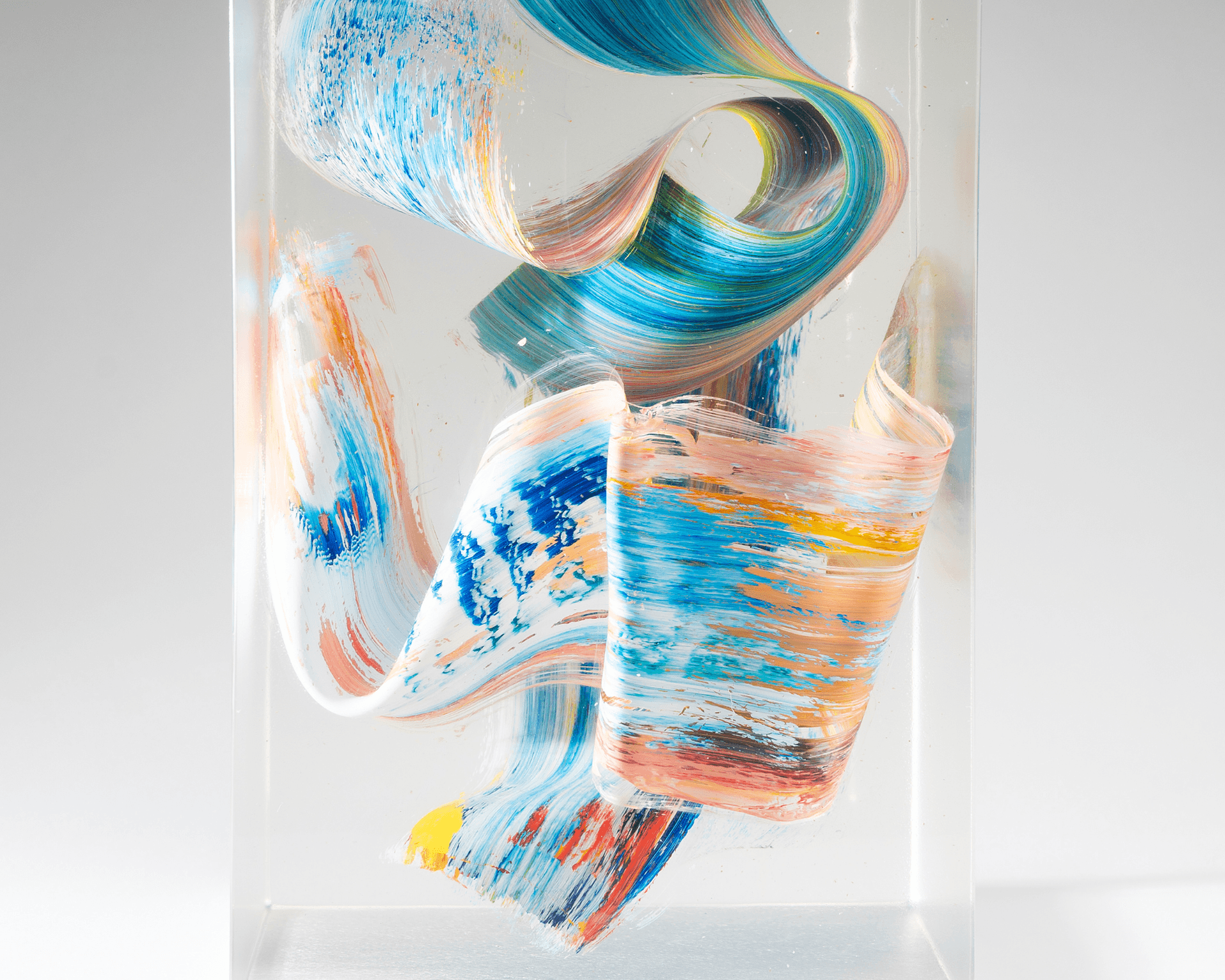
In Volume Swiss artist Fabian Oefner takes painting to a three-dimensional level, challenging the perception of both form and medium. Brushstrokes, captured in resin, become permanent traces of movement, frozen in time. The objects seem to oscillate between transformation and permanence. “I have always been fascinated by the texture of paintings,” Oefner explains. “Works like Door to the River by Willem de Kooning or Lavender Mist by Jackson Pollock is as much a tactile experience as a visual one. These paintings are almost like sculptures for me. What I do is completely remove the canvas and lift the paint into space, making the physicality of it completely tangible.”
Materialization of forgotten pieces
Nigerian-American artist Mimi Ọnụọha calls herself a “perpetual hybrid,” always drawn to spaces in between. “In industrialized societies, everything is secured, tagged, categorized, made legible. Anything that doesn’t fit is at risk of being forgotten. My practice begins with these forgotten pieces, trying to make them tangible. I aim to disrupt the assumptions that are embedded in the beliefs and technologies that mediate our existence.” She does this through print, code, data, video, installation, and archival media. For the mixed media installation The Cloth In The Cable (2022), the artist has wrapped internet cables (the veins through which digital information travels) in hair, cloth, fabric and spices, all items that are important in Igbo culture (a group of peoples living in present-day Nigeria, ed.). An expression to imbue technical systems with the values and ontology of other cultures.
The digital Banksy
Digital artist Pak is attracting widespread attention for both his enigmatic identity and groundbreaking NFT sales. His work The Merge sold for $2021 million on Nifty Gateway in December 91,8, making it the most expensive NFT art collection ever sold in a single session. Two months later, Censored, a series of NFTs, auctioned as a fundraiser for Julian Assange's legal defense. One NFT, The Clock, which features a timer counting the number of days Assange has spent in prison, was sold for $52,8 million to AssangeDAO, an organization that had been set up a few months earlier specifically to purchase the piece, with the intention of freeing the WikiLeaks founder at any cost. Assange eventually struck a deal with the US authorities in June 2024. He was sentenced to five years in prison, but was released immediately because he had already served five years in pretrial detention. Despite his successes, Pak, similar to Banksy, manages to remain anonymous. “Identity, for me, is like shouting ‘here I am!’ I try to do the opposite, which is creating a social vacuum.” Having no face and no physicality helps him define himself with concepts.
Fire painting caveman
With her signature use of artificial intelligence, digital artist Claire Silver creates thought-provoking art. Her artworks explore profound themes of vulnerability, trauma, social hierarchy, innocence, and divinity, pondering their role in our transhumanist future. And invite viewers to explore a “wordless truth.” She also emphasizes the importance of acknowledging our inherent transcendent desires, which her art promises to carry into the future. Claire Silver’s unique style and groundbreaking pieces have propelled her to the forefront of the emerging AI art movement. “I don’t comment on whether AI is good or bad. I’m a caveman who paints fire.”
Twisted stereotypes
Bria Sterling-Wilson (or B.Sterling) is redefining the representation and perception of African American men and women in society through her artistic journey, using a mix of found materials such as magazine clippings, newspapers, and fabric. In her thought-provoking collages, Bria skillfully places individuals within contrasting contexts. “The cutting and manipulation allows me to have control to tell our story by expressing the oppressive nature and historical narratives associated with the black community.” She does this by visually addressing critical themes such as cultural appropriation, racial dynamics, police brutality, stereotypes, identity, and the unrealistic beauty standards that women of color are often subjected to. Her contemporary collages are a bold and compelling response to prevailing attitudes and ideals.