Next
Sport & business: the Red Bull empire
Thinking of Red Bull is thinking of Max Verstappen. Figurehead of the Formula 1 team that has started the new racing season with a bang. Yet the brand name of an energy drink is not only linked to the fastest cars in the world: it is much, much more. Part beverage brand, part media company, part event organization, part owner of sports teams, part marketing concern, part rights distributor and part much more. Jaap de Groot takes you along in the seemingly endless Red Bull Imperium.
It all started in 1984 with a simple can of soda in Thailand. More than forty years later, Red Bull GmbH can be compared to the universe. You know where it begins, but not where it ends. An octopus with countless arms that are increasingly joined by hands and fingers. In the meantime, the legacy of Dietrich Mateschitz, who died in 2022, who entered into a partnership with Thai businessman Chaleo Yoovidhya as a starting entrepreneur at the age of 30. It concerned the energy drink Krating Daeng (Thai for 'Red Bull') developed by Yoovidhya. The reason? After Mateschitz drank it, his jet lag disappeared like snow in the sun. He managed to convince Yoovidhya to develop a European variant and they each invested 500.000 dollars in the establishment of Red Bull GmbH. Each received 49% of the shares, the remaining 2% went to Yoovidhya's son Chalerm. It was also agreed that the company, located in the Austrian village of Fuschl am See, just outside Salzburg, would be headed by Mateschitz. Between 1984 and 1987, Krating Daeng was adapted to the tastes of the Western world, after which Mateschitz gave the green light in 1987 for the distribution of the Red Bull brand in, first, Austria. From day one, the marketing strategy was aimed at the youth, the new generation.
For tough guys
Forty years after the investment of two times 500.000 dollars, the value of Red Bull GmbH is estimated at 22,15 billion dollars and the drink is sold in more than 170 countries. The annual figures for 2024 do not lie either: 12,7 billion cans have been sold worldwide, which is an increase of 2023% compared to 4,4. Turnover increased by 6,4% from 10,6 to 11,2 billion euros. Since the start in 1987, Mateschitz has determined that 10% of the company's profit will be invested in sponsorship and marketing every year. So more than 1 billion euros per year. This not only finances Red Bull Racing and Max Verstappen, but also around a thousand athletes, dozens of teams and hundreds of events. All aimed at the youngest generation, where challenge, ambition and excitement are the main themes. The scale on which this is happening has never been seen before in sports. I met Dieter Mateschitz once. That was on Saturday, June 30, 2018 at the Red Bull Circuit in Austria, which he also owned and where the Grand Prix would be held the next day. Then 74 years old, Mateschitz looked vital and sharp. Talking about Max Verstappen, he mentioned the Dutchman as an example of his vision. One one-liner in particular stuck with me: 'We are always looking for the next world champion.' Anyone who analyses Red Bull's numerous projects will also see that remark as a thick red thread. Whether it concerns Formula 1, football, ice hockey or cycling, the ultimate goal is not with higher budgets, but with top scouts and experts in the field of sports, events and marketing to be smarter than the rest. The first sporting event that Mateschitz organised in 1988 is telling: the Dolomitenmann. A cross-country in the Austrian mountain region with the elements of mountain climbing, paragliding, kayaking and mountain biking. Containing all the ingredients of the image that had to be projected to the rest of the world: exciting and only suitable for the toughest among us.
Youthful and cheeky
More than 37 years later, Red Bull is a jack of all trades in sports. From team sports to extreme sports and from eSports to unique record attempts. Often also niches that fit seamlessly within the oh so fickle social media and maintain and strengthen the youthful and cheeky image. Often corporate strategies look refined and cunning, but in the case of Red Bull you are sometimes also confronted with social spin-offs that mainly command respect. Take the takeover of the German fifth division club SSV Markranstädt in 2009. In eight years, the Bundesliga was reached under the name RB Leipzig. The capital of the German state of Saxony was deliberately chosen, mainly because of the condescending way in which this former part of the GDR is viewed in the rest of the Federal Republic. The residents were called 'Ossies' and the area was seen as a glorified disadvantaged neighborhood. But because the housing costs were low, many young people and students moved to Leipzig, a situation that Red Bull immediately anticipated. With a philosophy that not only had to win over an individual consumer, but an entire district. In January 2017, the first season of RB Leipzig in the Bundesliga, I visited the club. Among other things, I saw the academy, where thirty talents are trained internally every year. Of that group, two to three players make it to the A-selection, the rest can compete at the level of other clubs in the region such as Dynamo Dresden, FC Magdeburg, Carl Zeiss Jena, Chemie Halle, Rot Weiss Erfurt and Wismuth Aue. In this way, every club is provided with a quality boost at every level. By 'giving' first, a bond is created with the future consumer. That remains the ultimate goal, of course. Both in my hotel and restaurants and cafés in Leipzig: everywhere I saw a mini fridge with cans of Red Bull on the counter or bar. A combination of a social face, coupled with very subtle and targeted marketing. Red Bull was also the inventor of the 'training team' in Formula 1. Max Verstappen was thus eventually placed at Red Bull Racing via Toro Rosso. A strategy that has now been embraced by almost all racing teams and has even led to the establishment of academies where talented women have recently been trained.
heavy metal
The group's desire for perfection is also evident from the appointment of Jürgen Klopp as Head of Global Soccer as of January 1, 2025. The top coach, who recently left Liverpool, proved to be a perfect fit for the working class club from the English port city and the Ruhr area-based Borussia Dortmund. Add to that his heavy metal way of playing football and his profile is indeed close to Red Bull's target group. He now has to convey and sharpen that vision worldwide at Red Bull Brazil and Red Bull Bragatino (Brazil), New York Red Bulls (USA), RB Omiya Ardija (Japan), Red Bull Salzburg (Austria) and RB Leipzig (Germany). All owned by Red Bull GmbH and clubs that were still in an underdog position at the time of the takeover. Furthermore, a stake was also acquired in Leeds United (England), Paris FC (France) and Atletico Madrid (Spain) last year. But Formula 1 and top-level football are only a fraction of the empire that Red Bull has built up. In terms of world sports, Red Bull acquired a 51% majority stake in the Bora-Hansgrohe cycling team this year, which includes Primoz Rogliz and Danny van Poppel, and owns two top ice hockey teams: EC Red Bull Salzburg and EHC Red Bull Munich. As with RB Leipzig, an ice hockey academy has been set up in Salzburg. As part of the Red Bull Athlete Performance Centre, which facilitates two hundred ice hockey players at a high professional level. A service that all other athletes under the Red Bull umbrella can also use. From coaches to doctors and from psychologists to data analysts: the number of available experts is enormous. In addition, there are also figureheads such as Max Verstappen in other sports. As far as the Netherlands is concerned, speed skater Kjeld Nuis, motocrosser Jeffrey Herlings and Memphis Depay are associated with Red Bull. In 2022, Kjeld Nuis became the first skater ever to break the magical barrier of 100 kilometers per hour during a record attempt devised by Red Bull. Staying behind a special bolide, he reached a speed of 103 kilometers per hour on skates in Norway.
Highest jump ever
And what about the highest jump ever by Austrian Felix Baumgartner, who in 2012 made a jump of 39.045 kilometers from a spaceship built by Red Bull? During this free fall of 4 minutes and 19 seconds, he was the first person to break the sound barrier without propulsion at a record speed of 1.357 km per hour. Felix Baumgartner's jump is still regarded as the most ambitious publicity stunt ever. It had everything: courage, risk, magic and an unprecedented tension. Fueled by the perfectly executed live recording via social media, which allowed more than a billion people to witness an almost unreal human achievement. The take-off, the opening of the cabin door, the jump, the fall and the landing: it was all captured on camera in a way that had never been seen before. It was everything that Red Bull wants to radiate: dare, because what is not possible, does not exist. An image that is sharpened by an impressively executed media strategy via Red Bull Media House, which is described worldwide as the 'King of Content'. Everything that is linked to the more than 600 own activities falls within Red Bull Media House. Whether it concerns sports, music, culture, lifestyle or entertainment, the images, media rights, sponsor packages, ticket sales and hospitality are all in the hands of the company itself. Take the content alone. Television, mobile phones, digital, audio and print, everything is covered. Red Bull TV can be followed via the website and via the public channel Servus TV. Furthermore, a content library has been created for other media via the Red Bull Content Pool, where free photos and texts are provided. And to be honest, Red Bull also distinguishes itself from many other companies in this respect. Not only is the quality high, the brand name is rarely explicitly displayed. In this way, a gesture is also made towards media, who are not well off financially, to still obtain unique image material.
Media power
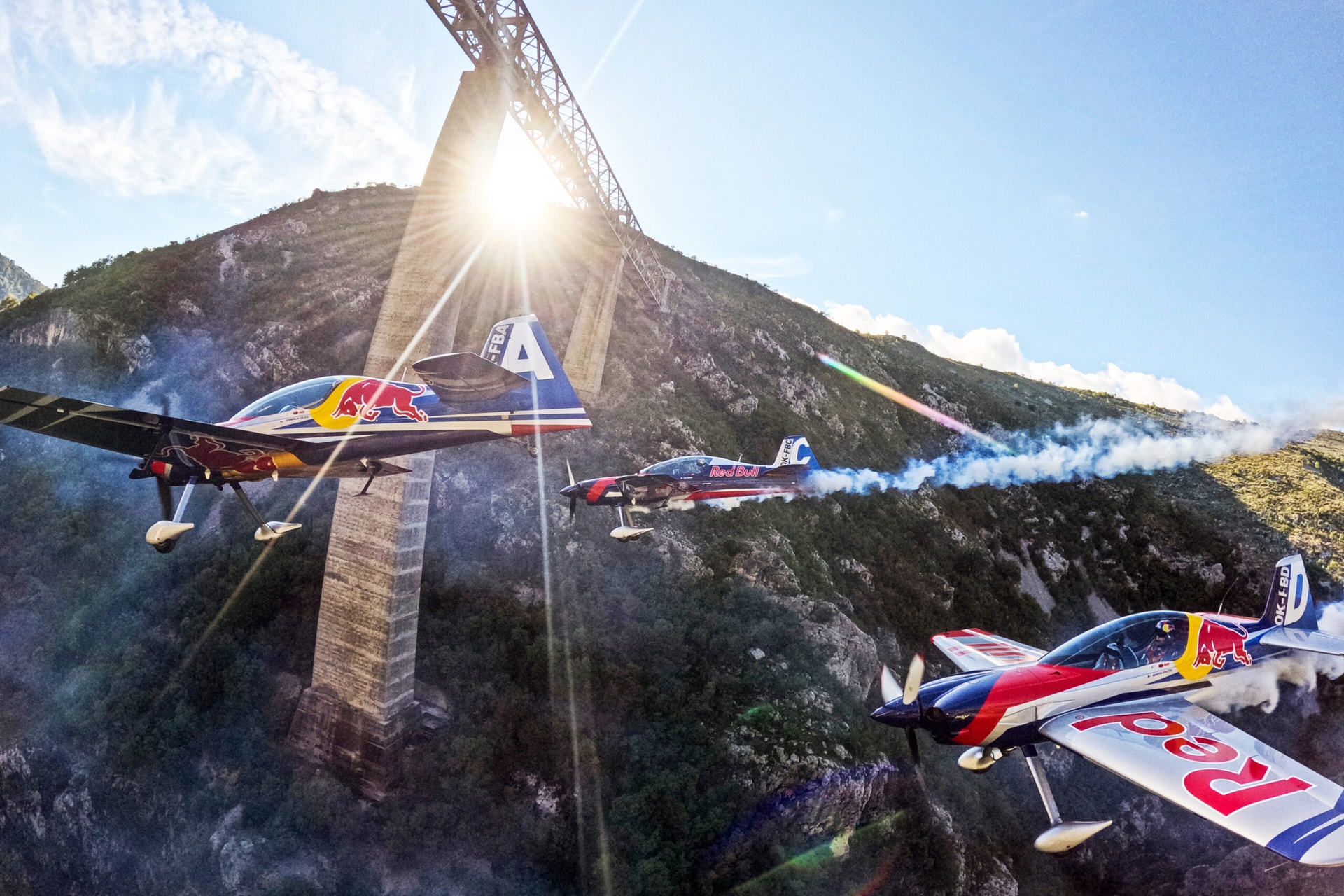
In addition, the media platform has proven to be an extremely effective tool in supporting new sports and activities that were already embraced by Red Bull when they were still ignored by other media. Sports and events such as motocross (MX), mountain biking, skateboarding, cliff diving, BMX, the Dakar Rally, breakdance, snowboarding, beach volleyball, 3×3 basketball, Crashed Ice downhill (won in 2011 by skating icon Rintje Ritsma), free solo climbing and, last but not least, the Red Bull Air Race, which was held above the Maas and the Erasmus Bridge in Rotterdam in 2005 and 2008. The media power is now also recognized by various international sports associations. For example, Red Bull Media House is the in-house producer of the international cycling union UCI, provides the broadcasts of the Beach Volleyball Major Series for the international volleyball federation FIVB and produces the World Rally Championship. In addition, it has taken root in eSports. Red Bull has its own section on Playstation, where all kinds of games can be found. Before his departure to Aston Martin, top engineer Adrian Newey, who is linked to Max Verstappen, designed a prototype Red Bull racing car for the video game Gran Turismo 5. The list of activities is not yet complete. Take Red Bull Arts, which includes culture and art. And let's not forget the fleet of self-designed aircraft, always cherished by Dietrich Mateschitz, which can be seen in air shows all over the world as the Flying Bulls. It doesn't matter whether it's a soapbox race (Red Bull Soapbox Race) or a freestyle rap competition (Red Bull Batalia de los Gallos), it has to be exciting and spectacular and appeal to young people. As a result, the company doesn't have to invest much money in TV commercials, because the self-organized and directed activities guarantee much more effective exposure. Or as founder Dieter Mateschitz once put it: 'I want to be part of great ideas, great people and great stories. Everything that gives you wings. A community full of dynamics.'