
Power
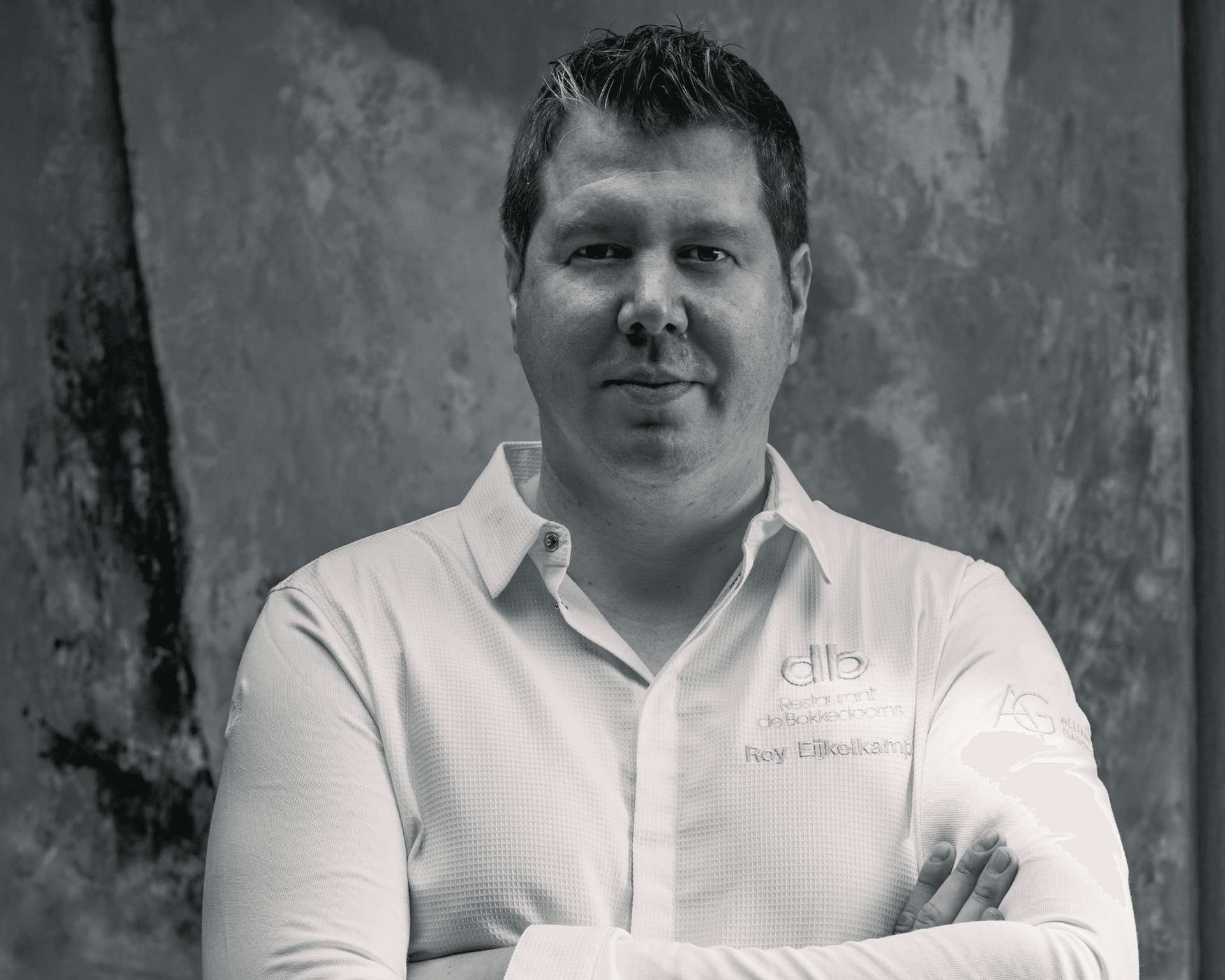
Roy Eijkelkamp: "Eating out should be a celebration"
Thanks to mentors like Cas Spijkers and Lucas Rive, Roy Eijkelkamp (Vorden, 1986) has worked his way up to the top. He is the second youngest two-star chef in the Netherlands and works at one of the country's oldest star restaurants, De Bokkedoorns. "Of course: one day I want those three stars. But the most important thing is a full house. You just want to do well and make people happy."
De Bokkedoorns has a particularly beautiful location, around the corner from the beach of Bloemendaal, in the middle of the dunes, in the Wethouder van Gelukpark. The name of the restaurant refers to the historical name of the area where it is located, named after the dune plant boxthorn, bearer of the Goji berry. The entrance to the restaurant is impressive: from the outside, a large round window offers a view of the dune lake on which De Bokkedoorns is located. The restaurant has large windows that make the inside and outside seem connected. Especially in the summer, when the terrace is open, it must be a lavish place to stay. Roy is used to the decor: he has been working for the family restaurant for fifteen years. The guests also prove to be loyal, as became apparent when the restaurant was renovated five years ago. The renovation was made possible by the contribution of sixty guests, who each paid five thousand euros for financing and were able to earn back that amount in three years in exchange for food and drinks. Interior architect FG Stijl took on the interior, resulting in a restaurant with allure and a warm atmosphere. The play of lines between the chandeliers, the carpet and the turquoise chairs is striking. From behind an espresso, Roy tells how he got on the culinary path. “When I was a boy of five, we often went to Ommen on Sundays to have lunch there. But especially the television program Cooking with Stars under the guidance of Cas Spijkers I found inspiring. At home I tried to decorate the plates a bit and when I was thirteen I wrote a letter to the bistro on the corner asking if I could do some odd jobs there. I could go there. It worked out well, on both sides. Eventually I did my first year of chef training there when I was sixteen. A simple restaurant with schnitzels and satay. You have to start somewhere and learn the game. Of course the logistics in De Bokkedoorns are different than in a bistro, but the game remains the same.”
Professional idiots
After two years of training as an Independent Working Chef, Roy went on to study Specialized Chef in Apeldoorn for two years and then transferred to the academy of his idol, Cas Spijkers. “I really enjoyed it there, also because it was only attended by professional idiots. Because of the great distance between my hometown of Haarlem and Boxmeer, where the academy is located, I slept at the academy the night before. Cas Spijkers would regularly knock on my door in the evening: 'Come on, let's have a glass of cheer.' In the pub he would tell me stories about De Swaen, the restaurant where he had cooked to two stars in the eighties. I hung on his every word! What I found so beautiful about that man: he was a real bon vivant, a bon vivant. Always eating and drinking well, making it a party. I do that too. For me, eating is one of the most important moments of the day. I never just throw a piece of meat in the pan, then I make a nice sauce or try something with other ingredients. I do want to eat well! Not just have lunch with a sandwich, but for example toast with blue cheese from the oven and pata negra on it. That is not complicated, but it is terribly tasty. My wife is from Hungary, food is also important there. Here in the Netherlands, less attention is paid to it. In contrast to my parents-in-law, my parents do not excel in the kitchen. They are incredibly sweet and have many qualities, but cooking is not one of them. They put the usual things on the table: mashed potatoes, macaroni, pasta. While my mother-in-law is busy in the kitchen with stuffed goose neck and chicken legs stuffed with liver. Who is in the kitchen at our home? My wife also works in the catering industry, at the Carlton Square Hotel in Haarlem. We are hardly ever home, I mainly eat here. And when we are free, we often go out for dinner. We have our regular addresses in Haarlem, such as Bistro La Plume. Not three stars, but they do make really tasty things.”
"For me, eating is one of the most important moments of the day. I never just throw a piece of meat in the pan, I make a nice sauce or try something with other ingredients"
Old stamp
In 2008, at the age of twenty-one, when he was still at the Cas Spijkers Academy, Roy ended up at De Bokkedoorns. “At the time, I worked at 't Diekhuus in Terwolde. I ran the kitchen together with another guy, but I wasn't ready for that at all: I still needed a mentor. I participated in a lot of cooking competitions and during one of them I met Lucas Rive, who had been head chef at De Bokkedoorns since 1990. 'Are you stuck where you work now?', Lucas asked. In principle not, I replied. 'Call me this week then.' I did and shortly afterwards I worked at De Bokkedoorns.” Wasn't he also impressed by the location and the view when he first entered the restaurant? “I really didn't care. I wanted to get into the kitchen, learn from the chef. I started at the bottom. It was tough, but I did learn a lot here. Lucas was an old-school chef, it was a tough learning experience. Long working days, getting a dressing down if you don't do it right. But I'm glad I went through that learning experience. That wouldn't be possible now. It's a different time, people don't put up with that anymore." Roy hasn't become a copy of his mentor, he has his own cooking style. "I learned the basics from Lucas. How do you deal with sweetbreads? How do you deal with fish? But then I developed my own style. Lucas dressed a bit more apart. I like to put little on the plate, to keep it compact – very tight, very clean –, with intense flavours and the focus on the main product: that should speak for itself. I don't like frills, no flowers and twigs on your plate for me: they don't add anything. Just make sure that the cooking and the balance in the dishes are good. Garnish should add something instead of something that just looks nice. A flower tastes like nothing. So why would you put that on the plate? It only costs money. In the winter, at the greenhouses, you pay ten euros for a bowl of flowers. Then I prefer to put a spoonful of caviar on the plate, that's at least tasty.”
Pat on the back
A product never reaches its final destination, according to Roy. “In the past, crab was boiled in court-bouillon, then I started steaming it, steaming at a lower temperature, now I have another method… You always keep developing. You want to, I am always busy with my profession. And new guys in the kitchen also come up with suggestions: 'Have you ever tried this?' Only it is increasingly difficult to find 'new guys'… It seems as if people don't want to work anymore. When I started, it was working five days a week, fourteen hours a day, now it is four working days of fourteen hours. And with us, you have Sunday evening off, you also have a long weekend. We are going the wrong way. You don't become a good chef in eight hours. It's not going to happen. Of course, there are always guys who work themselves to death, luckily I have them in my kitchen too. I wouldn't want to think about sitting on the couch at home every evening, I would go crazy.” In 2013, Lucas started his own business in Hoorn and Menno Post took over from him and Roy became sous chef. “My development accelerated as a result: I had more freedom to come up with ideas, to be an entrepreneur myself, to manage the kitchen. When Lucas left, I wasn’t ready to become a chef. When Menno started his own business in Haarlem in 2018, I was. Although I was a young chef at thirty-one, I had enough experience to manage the kitchen and create something good. I can certainly be tough on my staff, clear and direct. But I’m also someone who gives a pat on the back when someone does a good job. I believe that you should be able to express your appreciation, something I missed in the past. During those six years as a chef, I’ve become a bit calmer and milder. Especially in the first year, I was determined to hold on to those two stars. I still am, but it’s more balanced. I’m so confident that I know that what we’re doing is good.”
MASTERS Magazine
Curious about the rest of the article? Every success starts with a dream. That is the leitmotif of the summer edition of MASTERS. As a little girl, Iris Hond dreamed of becoming a concert pianist. She had the talent, the discipline, the love for playing the piano and the courage to pursue her dream. Even setbacks did not deter her from her path. “Then I remembered the stories about the rough rock 'n' roll life that Jan Cremer told when he was at our house: the pain, the misery – it's part of it”, she says in the major interview, with unique photography by Rahi Rezvani. Entrepreneur Harald Swinkels was also guided by a dream: first earn a lot of money, then make films. And so he sold his energy company and took the exit to Hollywood. Real estate entrepreneur Max Vorst uses his fortune to collect art. MASTERS received a private tour of the Beelden aan Zee museum, where part of his collection is currently on display. Dream trips are also being realized more and more often. “The need to invest in 'building memories together' is increasing," says Avila Reizen founder Tim van der Wel in an article about the future of travel. If only I had? If only I could? “I dream that I paint and then I paint what I dream,” said Vincent van Gogh. So, while leafing through the new magazine, dream of the Range Rover Sport SV, the Mulder ThirtySix or access to Ferrari's exclusive elite club Corse Clienti. MASTERS 58: a song to dream away to.


