Power
IT IS ALLOWED AND COSTS NOTHING: MAKING TRAVEL PLANS
Long-distance travel is becoming more feasible. We can now look beyond borders again and make plans. MASTERS explores
Long distance journeys are getting closer. We can look beyond the borders a little more and make plans. MASTERS explores the Philippines, a paradisiacal archipelago with the whitest powder sand and the bluest lagoons.Text: Harmke Kraak | Online editor: Natasha Hendriks
Image: Esther Quelle
Today is a good day
Today is a good day, says the cushion on my seat in the Boeing 777. And whether it is a good day! In Qatar Airways business class on the way to the Philippines, I have complete privacy thanks to the sliding door next to my seat. The stewardess regularly comes 'over the fence' to ask if I would like something to eat or drink. Once we landed in Manila, photographer Esther and I went to New World Makati Hotel in the business district. The notoriously busy traffic moves at walking pace, but we have plenty of time. From our private taxi we spotted Jeepneys, modernized American army jeeps in bright colors that serve as mass taxis. During the ride, our guide DJ sings a welcome song: Mabuhay. It stands for good wishes. DJ: “We Filipinos love to sing. We look like Asians, have the brains of Americans, but the hearts of Spaniards!” The Philippines fell under Spanish rule for three centuries. In 1898 America took over. The country has been officially independent since 1946. The name Philippines refers to the Spanish king Philip II (1527-1598). DJ takes us to the Legazpi Sunday Market a day later. We stroll past the food stalls. We taste bibingka galapong, rice cake that tastes like egg cake, and buy the super powder moringa, which consists of the finely ground leaves of a Philippine plant full of beneficial ingredients. A historical landmark in Manila is Fort Santiago on the Pasig River. Hundreds of water lilies float in the fast-flowing water. We also explore Intramuros, the Spanish colonial neighborhood. Most of the buildings here are replicas, as the district was destroyed during World War II. Only the Augustine Church survived the bombardment. Even more churches – Filipinos are more Catholic than the Spaniards themselves – can be seen outside the metropolis of Metro Manila. The white church in the village of Betis has ceiling paintings that are reminiscent of the Sistine Chapel. The church manager tells us from which point we should take a photo and even grabs Esther's arm to adjust her camera. We have to laugh about it. We drive back to Manila via Highway 54. The skyline by night consists of gold-rimmed buildings.
Surf vibe at Siargao
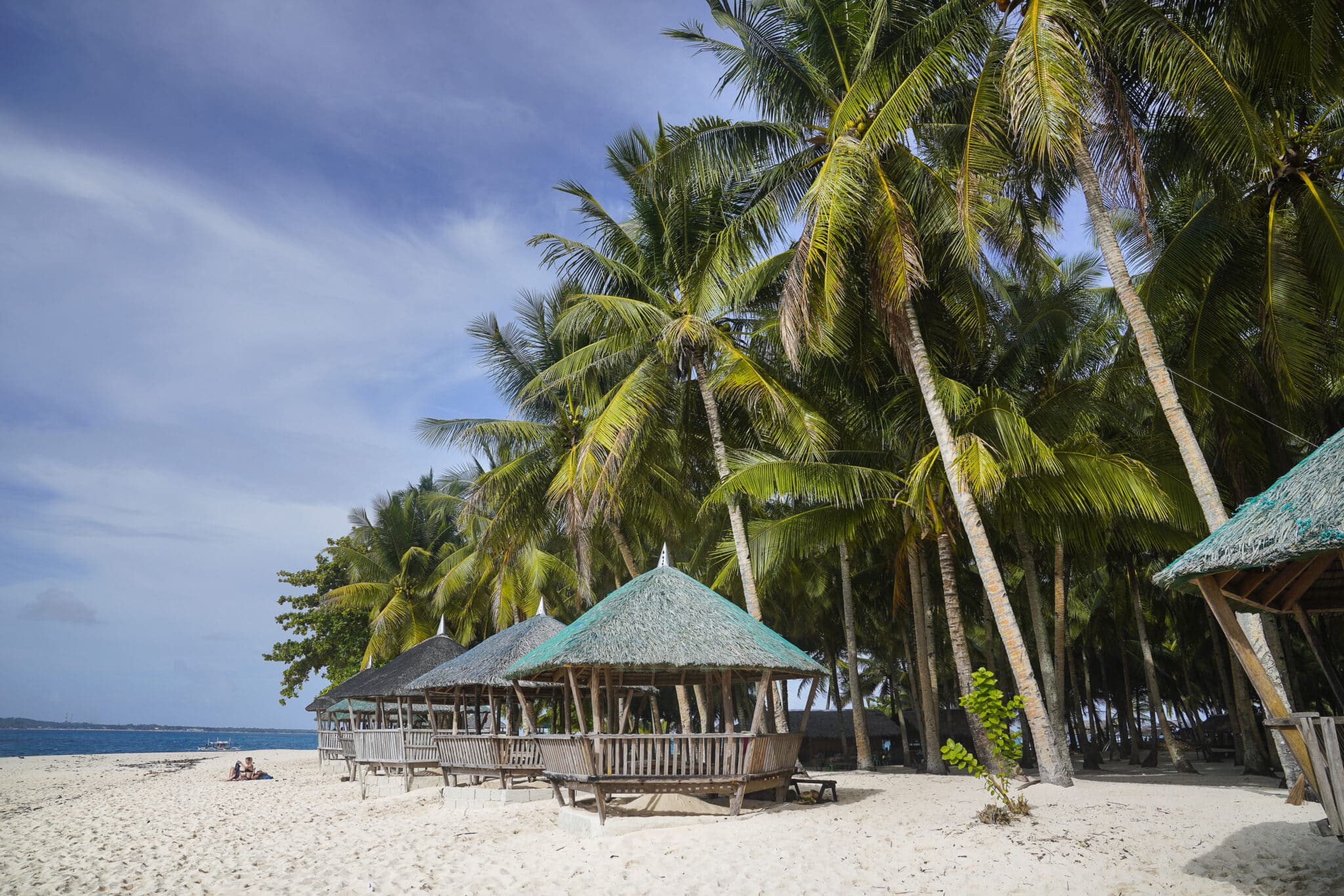
We leave Manila and land among the coconut palms on the island of Siargao in the southeast. The Philippines comprises 7.641 islands divided into three regions. Luzon is the region of the capital Manila, Visayas is the middle region and Mindanao includes the southern islands including Siargao. The guide for the rest of the journey has the 'fun' name Stalin. “My father had a passion for Russia, my full name is Stalingrad.” Drinking from a fresh coconut, we immediately get a holiday feeling on Siargao. The cheerful atmosphere at the Magpupungko Rockpool, a natural swimming pool between the rocks in the sea, also contributes to this. People jump and dive happily into the clear blue water. We then take a boat trip along mangroves to Sugba Lagoon, a lagoon where tourists are only allowed to enter in small doses. The Philippine government is increasingly paying attention to the environment, although our outrigger boat is not a textbook example of environmental friendliness. The engine makes a hellish noise. Fortunately, Qatar Airways business class earplugs offer a solution. We can swim, kayak and SUP in the beautiful green lagoon. The next day we visit Bucas Grande Island. 'Here you will find peace, serenity of the mind, tranquility of the soul, simplicity of the heart', I read on a wall. We sail in a paddle boat to orange jellyfish and have lunch on a paradise palm island. Bowls with mango, pineapple, rice, prawns and shells: spider shells are placed on the table. Some food is left on each tray. “Filipinos will never take the last bite, we find that rude,” laughs Stalin. At sunset we are back at our resort Siargao Bleu in the town of General Luna. There is a laid-back atmosphere at Siargao. The main street is a series of surf shops and restaurants. Tricycles, a kind of tuk tuk, drive back and forth. We take a look at Cloud Nine on the Pacific Ocean. It is the best surfing spot in the Philippines and there are international competitions every year. We watch the surfers from the pier. On the left, beginners are trying to hold their own, while on the right, experienced surfers are busy. It is sensational how they manage to brave the waves. We end the evening in the Rumbar, where a local band performs. There is a party in General Luna every evening.
Chocolate Hills on Bohol
We drive back to the airport along a country road with stray pigs and cows and past rice fields. From Siargao we fly to the central island of Cebu and cross by ferry to the island of Bohol. A delegation awaits us on shore as if we were Máxima and Willem-Alexander and we receive a bead necklace. The tricycles on Bohol carry religious texts such as 'In God we trust'. “Previously there were sexy pictures on it, but that led to protests from deeply religious people,” says Stalin. We go to Tarsier Sanctuary, a nature reserve. Tarsiers, or tarsiers, are unique. They are primates, although their long tails make them look like mini monkeys. They sleep during the day, but to our luck these nocturnal animals still show themselves. They cling to the branches of a pandan tree and follow us with their big eyes. Another attraction on Bohol is the Chocolate Hills, where we drive the next day with the tireless Stalin - he carries our suitcases, arranges our plane tickets, supplies us with water. The hills near the town of Carmen are not chocolate brown today, but green as mint chocolate. They were once created by volcanic eruptions and were simply called Carmen Hills, until an American noticed that the hills reminded her of Hershey's chocolates. We climb the two hundred steps to the top of a hill and look out over hundreds of other 'humps'. Impressively beautiful. Then we rush to the Loboc River for a river cruise. Our private boat glides silently over the emerald green water as we feast on bowls full of food. Children sing and dance along the banks for the passing boats. No visit to Bohol without tasting the chocolate from Dalareich Chocolate House! It is the success story of Ricardo Polot, a former tricycle driver, and his wife Elsa, who once swept the streets. From 2009 onwards they focused entirely on their chocolate business. Daughter Dalareich (sounds like Dollar Rich) even went to study at the Cacaolab in Ghent. Ten years later the family won gold at a prestigious competition in London. One of the daughters says: “Bohol is known for the Chocolate Hills, we wanted to put real chocolate on the map. The people of Bohol don't realize that they have gold in their backyard with all the cocoa trees!” Bohol Bee Farm is also a success. This bee farm, not far from our beach hotel South Palms, attracts crowds of visitors. They, like us, come not only for the bees and the honey, but also for the delicious organic ice cream.