Power
MASTERS speaks to Ray Klaassens & Dai Carter
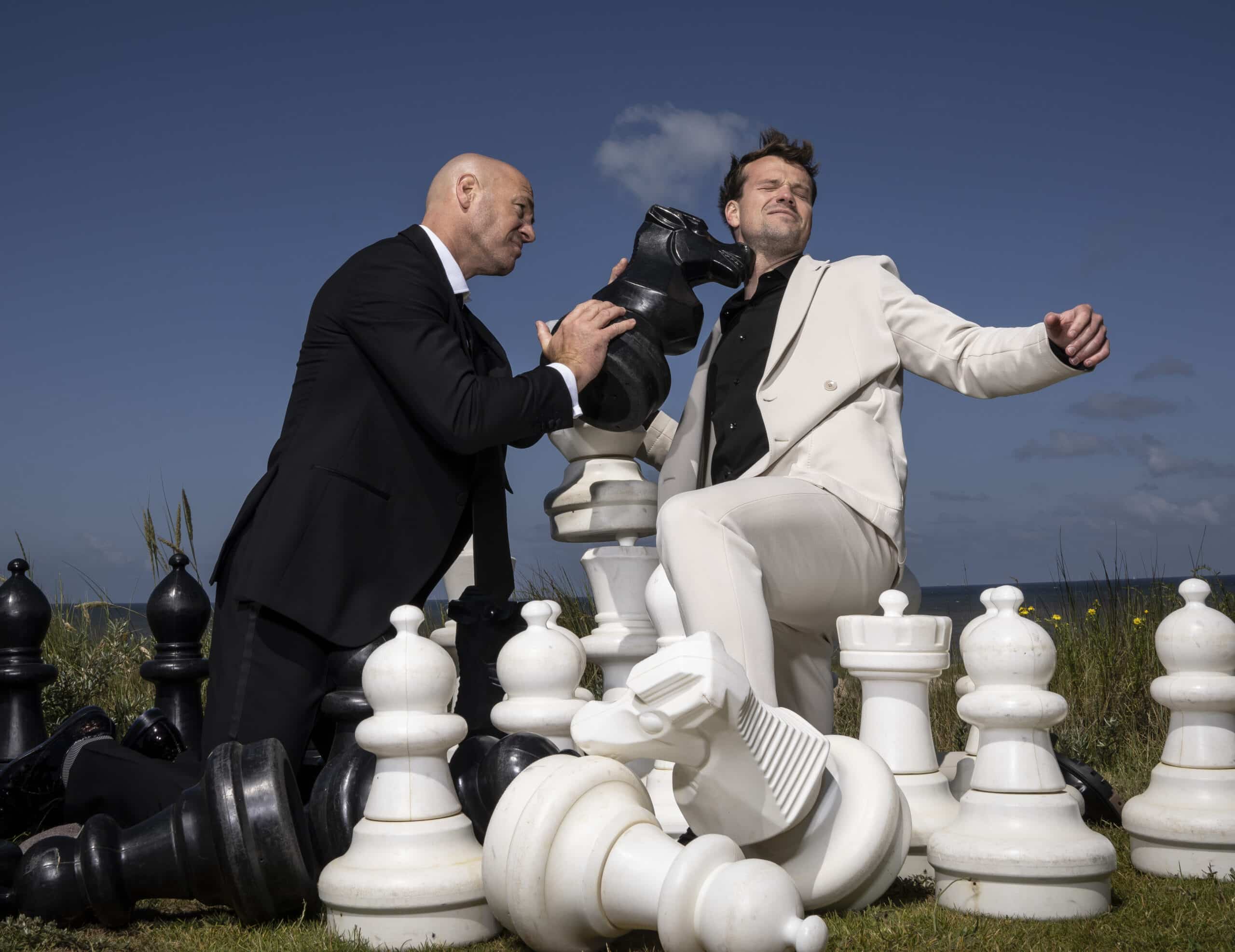
They both served in the Korps Commandotroepen and carried out secret missions in various conflict areas. Nowadays Dai Carter (1989) and Ray Klaassens (1973), the instructors from the TV program Kamp Van Koningsbrugge, use the experiences they gained in the Special Forces for a different mission: making the Netherlands stronger.
They both served in the Commando Troops and carried out secret missions in various conflict areas. Nowadays Dai Carter (1989) and Ray Klaassens (1973), the instructors from the TV program, use Camp Van Koningsbrugge, the experiences they gained in the Special Forces for another mission: making the Netherlands stronger.
Styling: Pascalle Koldenhof
Make-up: Selke Stojancic
With thanks to: Grand Hotel Huis ter Duin, Noordwijk
Dai, why did you choose a life as a soldier?
Dai: “Things weren't going so well at school. I was very searching. My then stepfather's father had served in Indonesia and came up with all kinds of great stories about the commandos. I started doing research and that's how that dream came about. From the age of sixteen I started training with the aim of becoming a commando. I got my green beret when I was twenty.”
Which conflict areas have you been deployed to?
Dai: “I have been to four different conflict areas: East, West and North Africa and the Middle East. I can't say much more about that, because it concerned secret missions and you don't have any attacks on your own soil want to provoke. As a country I can only mention Mali.”
As a Medic you were responsible for your Special Forces team in the medical field. Describe your tasks during a mission.
Dai: “On special missions, extra responsibility falls on the Medic, because no doctor or nurse accompanies them. You often only run a mission like this with about eight or nine people. If things go wrong, it comes down to your specialization, your skills. At the time I had an intensive 13-week training course that included attention to war trauma, diseases and suturing wounds. In the field I was the first responder, who had to keep the wounded alive for the first 72 hours before they could be taken away.”
What are the biggest dangers you have experienced?
Dai: “There are quite a few. I experienced missions in urbanized areas in particular as threatening. All kinds of people walk there. The groups that take action there blend into the street scene. An attack can happen out of nowhere. That happened quite often. You are not always with your team, sometimes you are alone on the street. If they have a crush on you, there's a chance they'll pull you back and you'll end up in an orange jumpsuit somewhere. These are scenarios that you do not want to experience, but are realistic. You can also end up in a firefight between warring parties.”
Is there a balance between excitement and fear when you're on missions like that?
Dai: “During commando training you are confronted with fear and trained to deal with it, for example when you are shot at. Fear makes you stiff, you can't have that. Because we are trained, we do not freeze but switch to action, to reacting to the situation. And with the tension that comes with it, you can still trade.
In Mali we once had to rush into the helicopter at our base because there had been an attack on a platoon of Nigerien soldiers. Nine people are said to have been injured. When we got there, they all turned out to be dead. We had to recover the bodies very quickly, I zipped seven boys into body bags myself. With a blood flow we laid the body bags in the helicopter, because the threat level was high. Because those bodies were in the chopper, there wasn't much room for us. At some point I became aware that my feet were resting on a dead dude. Then you realize: this seems very normal, but it is not at all.”
Do you often think back to such moments?
Dai: “Sometimes I get a smell when we are working on something Camp Van Koningsbrugge a flashback of a mission or a specific moment. That happens regularly.”
Do you also have fond memories of that time?
Dai: “Most memories are beautiful. They mainly have to do with camaraderie. That's what's so great about the television program, you feel that connection again, that brotherly bond. Would I want to return to the commandos if I could? No, I have closed that chapter.”
What have been the biggest lessons from your career in the Special Forces?
Dai: “They are about leadership, dealing with pain, brotherhood, mastery, learning to enjoy the process instead of the result... I have learned so much! That has become the basis for the person I am today. I thought I should share those lessons with anyone who wants to strengthen their mental strength. I wrote a book about that, Now or never. I also give lectures, master classes and inspiration sessions on this subject. Then I zoom in on the components that I believe mental strength consists of: physical, cognitive, emotional, spiritual. Partly due to the success of Camp Van Koningsbrugge and my book, my company Carter Training receives many requests from the business community, but also from education. I am very happy with that, because I think that we should learn at school how stress works and how to deal with it, for example. It is my mission to strengthen the mental strength of as many people as possible in the Netherlands.”
And what's your current mission, Ray?
Ray: “To make Dutch society more resilient. With Triangular Group, a company that I started together with Onno van Boven, we are responding to shortages in the labor market. Government agencies such as the police, Justice and Defense have a core product to deliver, for example 'blue on the streets'. But the economic situation is such that civil servants are more likely to move to private parties, thus creating gaps in the workforce. We catch the people who are leaving 'at the gate'. Do they not want to be broadcast anymore? Is there more need for variety? Do they earn too little? Do they need more flexibility? We can do something about that. We have a strong pool of people and many different projects.
We then look for the right match, possibly after internal training with us. An example: the police has a staff shortage and must scale up by 200 percent due to an increased risk in the Binnenhof. We offer a thirteen-week training course in which BOA officers become proficient in police work to strengthen the police force in high-risk situations. In this way we can strengthen the police force in a relatively short time. We have now helped almost two hundred people into employment who had closed the door behind them elsewhere. Those who take the step to leave are often the ones with potential. They are disappointed about something and want to do something with that energy, with their enthusiasm.”
Why did you choose a life as a soldier at the time?
Ray: “I went for the adventure and wanted to spare my parents, because this way they didn't have to pay for expensive studies. I attended the Military Academy and was trained as a leader within a unit. I enjoyed getting the best out of people, especially in the case of the Commando Troops: they want to get the most out of them and get better every day. It's better to work with people who like it want to than with people who have the idea that they moeten. For me, inspiring means getting people from having to want to wanting to.”
You have led snipers, among other things. Have you ever decided about life and death?
“I have been shot at, but I have never had to make a choice face to face that you would not wish on anyone. When you train people for this, you have a responsibility, actually an obligation, to ask the question behind this movement. Because it's not about whether you can shoot well or dare to do it, but what the consequence is. You touch a person that has a whole world behind it: you take the breadwinner out of a family, you traumatize relatives... There is an element of ethics behind it. Don't take it lightly. The exact same thing can happen on the shooter's side. As a commander, I taught my pupils to remove the threat as accurately as possible with as little force as possible. If you hit in one shot, there will be as few secondary casualties as possible. Like in a hostage situation. That is the skill of a marksman. When does something bother you? In the case of powerlessness, when you are unable to act and there is no safety net afterwards – Srebrenica! Then you will develop something that is post-traumatic.”
What are the most dangerous situations you have experienced?
Ray: “As far as I'm concerned, dangerous situations almost always involve crowds of people. In Ivory Coast we were a small club with few resources, but a large mandate. The enemy was not an enemy, they were upset citizens who were upset and took out their frustrations on Westerners who happened to be there. One mistake – taking a wrong turn, walking into the wrong shop – immediately leads to the images we know from Libya and Iraq. Then you are dragged through the streets and you have nothing more to say. Then you can still be so commanding that you will lose out. How to arm yourself against this? Purely through discipline, planning, preparation. Don't do anything crazy. There were boys who stayed behind there – not Dutch – because they made that one mistake. What can also lead to dangerous situations is a commander's decision. In 2003 I was deployed to Kabul. When we were about to fly there, a car from the club we were going to relieve crashed into a roadside bomb, resulting in one injured person and one seriously injured. Two other colleagues had to provide emergency assistance. In response to this attack, we had to move into an observation post and track down the perpetrators based on intelligence. But to get there, we had to go through an area where there were known mines. Then it was crystal clear to me: the boss says it, so we do it. Now I would think about it a little differently: What are we doing this for? What will it ever yield? And should our families be at risk for this? This is also the difficult thing, because if you are a soldier, you really shouldn't ask this question.”
MASTERS MAGAZINE
In the autumn edition of MASTERS an interview with LVMH boss Bernard Arnault (“being the richest man in the world meant nothing to me”), a driving impression of the electric Audi RS e-tron GT, a report with the 'tree matchmakers' of The Green Contractors , an interview with star chef Dick Middelweerd and a visit to Barcelona with Ronald Koeman. The war, the climate crisis, the energy problem... Leadership and entrepreneurship are being called upon more than ever. With MASTERS EXPO | The Colorful Edition (8 to 12 December, RAI Amsterdam) we want to contribute in our own way and give the world a push in the right direction. In this edition of MASTERS a colorful preview of the most exclusive business fair. Time to think ahead, innovate, connect!