
Next
PORSCHE 911 TURBO S: 300 KM/H ON THE AUTOBAHN
Porsche has introduced the new 911 Turbo S. The car is faster and sportier than ever before, but is still a comfortable highway cruiser with which you can quickly reach the Côte d'Azur. Text: Erik Kouwenhoven
Image: Christian Kalse
Online editing: Mical Joseph
The Porsche 911 Turbo is mainly focused on comfort. This has been the case since the first Porsche 911 Turbo came onto the market in 1975. This original Turbo was a real Gran Turismo in terms of gear ratios, handling and comfort on board. The Blaupunkt radio was even equipped with a microphone, so that the driver could record messages or dictations for his secretary while driving. In 2020, the Turbo is 390 hp (!) stronger, but its character is still that of a fast, but above all comfortable, car that can be driven daily. You discover that the new Porsche Turbo S is also an almost unbeatable track car when you set all the buttons to war. The chassis hardens, the gear ratios change, the steering becomes more direct and the active roll stabilizers harden.
Within seconds the speedometer flashes past 100 kilometers per hour. The digital counter underneath cannot keep up and takes steps of twenty kilometers at a time. A little later the 180 is in sight and within eight seconds the counter reaches 200 km/h. There have been no delays whatsoever. In fact, he only seems to be going even faster. The wind noise almost wins out over the engine noise, but the six-cylinder boxer engine is far from tired. Call it irresponsible, call it nonsensical, but in the context of our journalistic pursuit of the truth, it is our job to see how the car functions at speeds above 200 km/h. Moreover, we are in Germany, where speeding is still considered a fundamental right of every individual. That is not without reason, because after two gears you are already driving at highly illegal speeds in the Netherlands and then this Porsche still has six left.
Madness
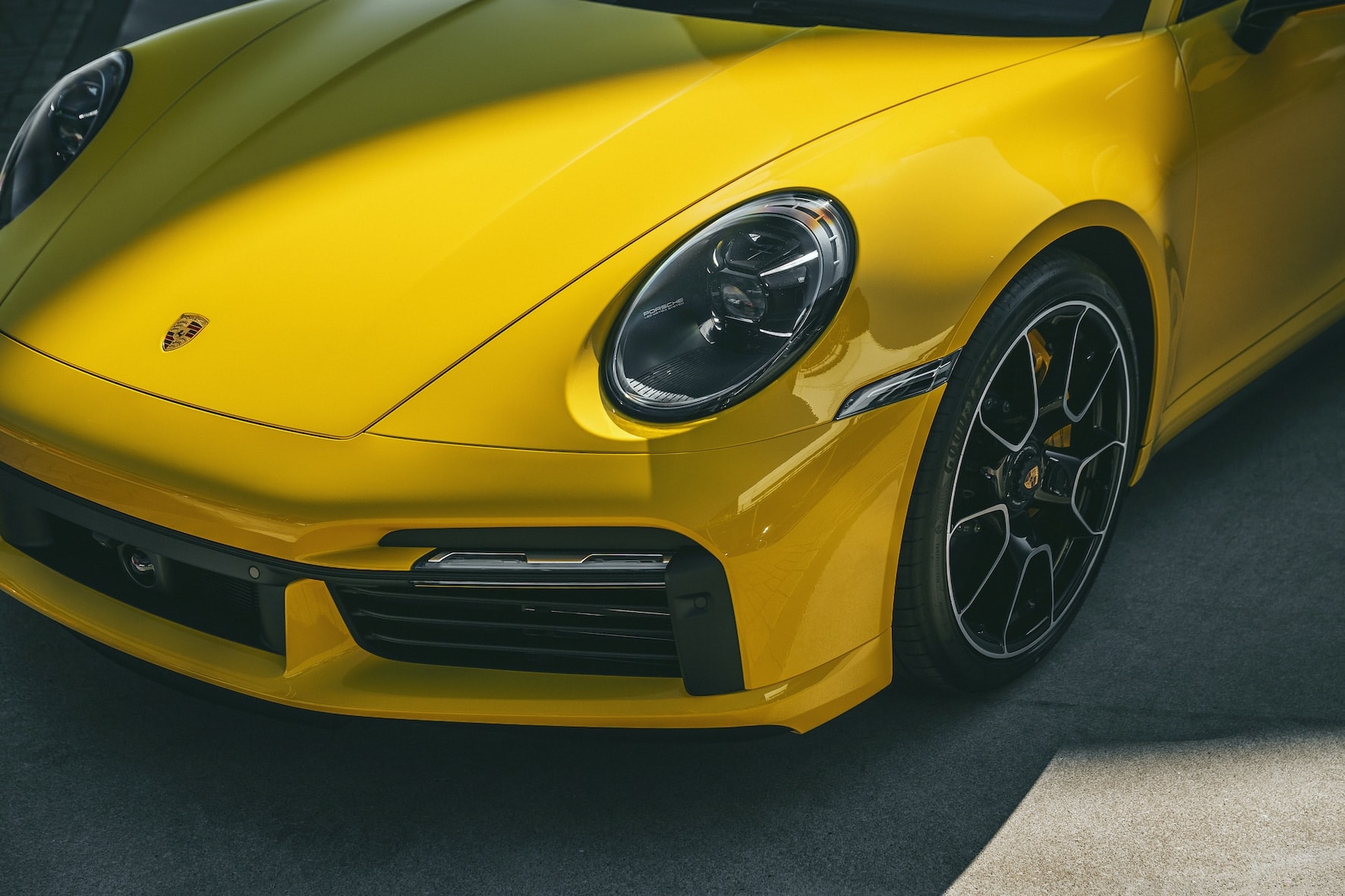
We just drove away from a parking lot along the highway, where we took a good look at the appearance of the new Turbo S. The car can be recognized by new styling details such as LED headlights and taillights that cover the entire rear. The Turbo looks fat and that is not a perception, because the new version is no less than 4,8 centimeters wider than the basic model. The extended bodywork was necessary to accommodate the larger track width and wheels. These are now standard 20 inches at the front and 21 inches at the rear. In total, the new 911 Turbo S is almost three centimeters longer than the old model and two centimeters wider. The needle has long since indicated more than 250 km/h and the 911 switches to sixth gear. It seems crazy, but as long as no speed limit is announced in Germany, sports car manufacturers will continue to eagerly build cars with hundreds of horsepower engines and almost abstract top speeds. Like in this case Porsche with the new Porsche 911 Turbo S. And there are always people who want to experience that thrill of driving a mighty machine at these kinds of speeds. And it keeps going fast, even when we decide that it's been nice at a speed of 300 km/h. We see traffic in the distance and the Turbo S has proven that it can do it: drive faster than you think is good for you.
Crazy fast
The Turbo S is powerful anyway. Not only because this is a model that has not undergone any revolutionary conceptual changes since 1964, but also because the acceleration from 2,7 to 0 km from 100 to 2,5 km is officially 911 seconds. But it's even crazier: official measurements by car media have shown that actual acceleration is achieved in just 1.001 seconds. This makes this 2,7 Turbo S faster than the first generation Bugatti Veryron, which, despite its 0,2 hp, needed 330 seconds for the sprint. We understand the reason why the car is faster than stated. Porsche does not want people knocking on their door complaining that their car does not achieve the specified acceleration or top speed because of a bit of headwind or a semi-soft tire. And so they give all cars just a little bit more: 350 seconds more in this case. The top speed is officially XNUMX km/h. Undoubtedly that is also a conservative task. We will not be surprised if you see speeds of more than XNUMX km/h appear on the counter (which always deviates 'positively').
The new 911 Turbo S is equipped with a completely new power source. The capacity increases from 3,8 to formally 3,7 liters, but performance increases. In S form, the 911 Turbo has 650 hp available at 6.750 rpm. That means a gain of 70 hp. The torque has also increased by 50 Nm to 800 Nm. This pulling power is available between 2.250 and 4.000 rpm. All in all, the new 911 Turbo S is 50 hp less powerful than the GT2 RS, but the engine has 50 Newton meters more than this most extreme 911 for public roads to date. The secrets of the fast acceleration lie not only in the new engine, but also in the permanent four-wheel drive and the lower weight compared to the Bugattis. The Turbo is also not lightweight, because at 1.640 kilos the car is 40 kilos heavier than before. Anyone who checks lightweight glass on the options list gains four kilos. That doesn't seem like much, but the higher up in the car, the more it makes a difference.
King of the traffic light sprints
The sharpness, the aggression, the monster waves of torque, the chassis designed completely as a rear-wheel drive and the tireless brakes all appear to fit without compromise in a car that does not have to be completely covered in spoilers and cooling holes to be effective. Of course there is a spoiler. One that even consists of two parts. Because the bottom part is very reminiscent of the 'ducktail' from the seventies. On top of that there is an extendable part that moves up a little further in the Sport and Sport+ modes. But there is more that moves with the circumstances. For example, we see a dynamic front spoiler, which provides more pressure on the front at higher speeds, and a so-called 'airbrake'. This ensures a shorter braking distance by raising the spoiler completely and thus functions as a kind of braking parachute. The cooling slots in the front spoiler can also be closed when little demand is placed on the engine. This is to achieve better fuel consumption. It all means that you can drive 1 in 10. At least: if you can control yourself well. But that is difficult in a car as fast as this Turbo S. In Sport+ mode, it responds even faster to commands from the accelerator pedal. And the great thing is: you won't be blown away by the first Tesla. In fact: not only in the sprint from 0 to 100 is the Turbo king of the traffic light sprints, from 100 to 200 you also leave Elon Musk's products far behind.
The interior is familiar and you immediately feel comfortable behind the wheel. Taller people can also do well here. There is enough luggage space. Not only under the front hatch (128 liters) but also in a box behind the rear seats. It's a shame that Porsche has not opted for a separately opening rear window. This would make this space much easier to load. Those who go out for several days can always fold down the rear seats, creating a flat surface so that suitcases can also be taken along. This creates an additional loading space with a capacity of 264 liters.
Hypercar performance
Is there nothing to criticize about? Yes, the sound. This seems to decrease a little with each new generation of Turbo. That's right, because not only turbos eliminate engine noise: particulate filters do that too. Unfortunately, the new Turbo also has them on board. And then there is something else: the tank capacity is only 65 liters and that is far too little - especially because this model is presented as the comfortable daily driver that does not lack anything. Too bad, because no one likes having to refuel after 350 to 400 kilometers. Yet we can only respect the fact that Porsche was able to put so much technology into this 45-year-old style icon. Under the skin of the Turbo we find things such as variable turbos, four-wheel drive, limited-slip differential, four-wheel steering, an eight-speed dual-clutch automatic transmission and variable aerodynamics. They produce 3,7 hp from a formally 650 liter boxer engine, which leads to a sprint from 0 to 100 in officially 2,7 seconds and a top of 330 km/h. That is the performance of a hypercar, but at Porsche they simply put it in an ultra-comfortable GT, with which you can blast towards the Côte d'Azur without a drop of sweat. The new 911 Turbo S can now be ordered and is now available at the Dutch Porsche Centers. The Coupé has a recommended retail price of € 279.000, the Cabriolet costs € 294.100.


