Taste
Packard Excellence: The Art of Ultimate Bespoke Craftsmanship
A bespoke suit on wheels: that's Bert Roubos's new car. As a car enthusiast, he became fascinated by the American brand Packard, which existed until 1958. At JB Classic & Bespoke, his dream came true: the Dutch company built him a modern Packard.
As an entrepreneur, Bert Roubos made a name for himself by "inventing" a new snack. For his son's birthday, he and a coworker combined spicy ground meat and Singaporean pancakes. This resulted in the creation of "Vlammetjes" (Little Flames), which he used to build his company, Topking. In the years that followed, new hits like "VlamTosti's" (Vlam Toasties) and "KaasTengels" (Cheese Tenders) were released. This allowed Roubos to devote time and attention to his other great passion: cars, primarily of American origin. Initially, he owned cars from various brands, such as Pontiac and Cadillac. Once he discovered the Packard brand, that changed: he began focusing on a single brand. This even led to the creation of his own private museum, The Dutch Packard Collection, where he occasionally welcomes enthusiasts. Roubos: “Packard existed from 1899 to 1958. My collection consists of 36 Packards in total. I've strived to get a good overview of what Packard produced. Later, there were several attempts to revive the brand, from 1978 onwards by Bayliff and from 1992 onwards by Roy Gullickson. Bayliff produced several cars, one of which I have. Gullickson only owned one example, which is also part of the collection.” A fine collection, but something still nagged at me. Roubos had to rely on other brands for his own transportation needs. Although that wasn't a disaster. “I'm also crazy about Bentley. Before the war, they called Packard the American Rolls-Royce, but as far as I'm concerned, it can also be called the American Bentley. I think that brand is on par with Packard in terms of quality, and vice versa.” This is how the idea came about to combine these two loves: a Bentley with the appearance of a Packard.
Angle grinder
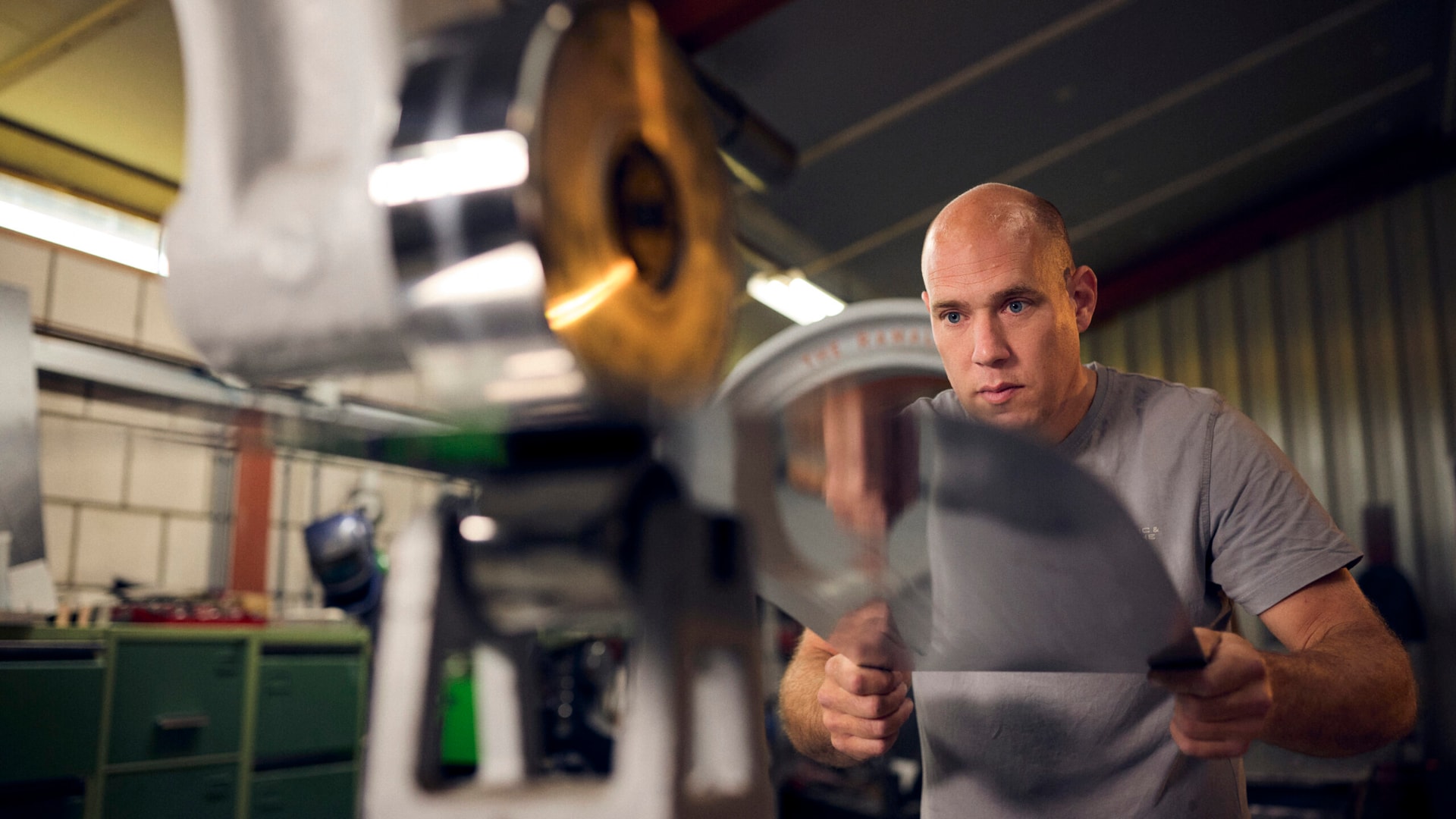
Putting a new body on an existing car—it sounds easier than it is. Just think: would you dare to install an angle grinder in a Bentley yourself? "It all starts with a design," says Jasper Beukenkamp, who built the car with his company JB Classic & Bespoke. I once made a sketch myself, with the idea of building a car someday. I now know you can't do anything with that, except hang it on the wall. So we needed someone who could design a car, and we found one. Frank Reijenga can do that with his company CinovarA. How did Bert end up with me? He has this wonderful collection of Packards, which also need some work now and then. I started this company about 22 years ago. In the beginning, we restored cars, and we still do, but the cars have become increasingly complex. If you want to restore something truly special, for which few or no parts are available, that's where we come in. That's how Bert came to us with his Packard Twelve, the car built by Roy Gullickson in the 1990s. He wanted to be able to drive it, but it was essentially a prototype. We still had some work to do on that. Gradually, Beukenkamp's company specialized in Packards. We actually specialized in restoring Facel Vegas, a top French marque that existed from the 1930s to the 1960s. Because of Bert, we also had to specialize in Packard. The funny thing is that Facel Vega and Packard almost started building cars together. Packard ceased operations in 1958, but there were plans at the time to build a new model based on the Facel Vega Excellence. That's where the name of our car comes from, so the design had to incorporate elements of both Packard and Facel Vega.
All new
For designer Frank Reijenga, this was certainly not the first car he'd built. In the past, he was responsible for countless stretched Mercedes models, and King Willem-Alexander's stretched Audi A8 was also his creation. Another notable project Reijenga was involved in is the Model SB, a shooting brake based on the Tesla Model S, which he created together with designer Niels van Roij. This time, however, Reijenga went further than in any of his previous projects. For the new Packard, the decision was made to redesign everything, including the wheels and lighting. And that requires a completely different approach. Reijenga: "You can come up with something beautiful, but you also have to be able to produce it; it has to be feasible. Not for a show car, but for a car that will actually drive."
Beukenkamp explains that a list of requirements was drawn up for the car. “For example, we absolutely wanted suicide doors—rear doors that open 'the other way around.' We wanted to make everything stainless steel, because Facel Vega had that too. And we didn't want to copy anything from other cars.” With that last requirement, the builders made things difficult for themselves. Even car manufacturers often use existing light units, for example. The Morgan Aeromax used the taillights from the Lancia Thesis, the Lotus Esprit had to make do with the taillights from the Toyota Corolla, and the Aston Martin DB7 got the taillights from the much more ordinary Mazda 323. A more recent example is the Bovensiepen Zagato, a German sports car with a Zagato-designed body: new from front to back, but the headlights were taken directly from the BMW M4, the donor car. However, that was deemed too simplistic for the new Packard.
Unique story
"Bert has a museum with beautiful Packards. The three of us walk through it and see what a car needs to be truly a modern interpretation of a Packard," says Reijenga. "We mainly looked at the 1930s, at the models Packard had back then. We reinterpreted those."
"Bert now thinks it's a unique story," says Beukenkamp. "That the three of us really did this together. It's fantastic to go through a process like this together, to decide all those things together. Sometimes you disagree, often you do. But you always have to find a solution as a team. Which is sometimes easier than just the two of us." It's quite a journey they've been on, he says. "We've worked on this car for five years; there are about 17.000 hours of work in it." Doesn't it sting that the car hasn't only generated positive reactions online? "Not at all; you often see that in coachbuilding. You create the perfect car for that one client, and they have to be happy with it. What the rest of the world thinks isn't so important. Suppose you have nothing to do with Packard, or you don't know the brand, then you won't see what the design of this new car refers to." If you're investing 17.000 hours of work into a car, wouldn't it make more sense to get a new one instead of a 2014 model? Beukenkamp: "No. In this case, the customer wanted a car with interior buttons, not just touchscreens. The interior, by the way, is virtually unchanged. There are now Packard logos, but otherwise, we haven't really done anything to it. Why not? Because the customer didn't want that; they were completely satisfied with the interior as it was."
Extremely difficult
What if another customer knocks at the door? "There were times when I was completely done with it," says Beukenkamp. "All sorts of things were happening, but there was no visible progress. For example, parts were being made outside the factory, and all I saw was that the car looked exactly the same at the end of the week as it had at the beginning. That was sometimes difficult for Bert too; he came every week to see how things were going. At the same time, it was a dream of mine to one day build a car myself. We've been restoring cars here for twenty years, and that's really not easy. But building something that doesn't exist yet is truly extremely difficult – and it's satisfying. If a next customer comes along for a one-off? Of course, we'll say yes. Whether the next car can also be a Packard is up to Bert Roubos, because he's the brand owner in the Benelux. What does such a process look like? The most important thing, of course, is to know what you want. Then we start thinking about what would be a suitable basis, a good donor car. And then you have to agree on the costs. You can keep those somewhat in check by building a coupe, for example. This Packard has doors that open differently." than the original doors. That certainly didn't make the project any cheaper. If you didn't have any back doors at all... But a project like that is never cheap, of course. The same goes for our restorations. You never know in advance what you'll encounter. Because of that, you can never say exactly what something will cost in advance. It's a matter of trust; you really have to have a good relationship with the client." And now? Getting used to the fact that Bert Roubos isn't on the doorstep every week anymore? "We happened to have dinner this week with everyone who worked on the project. It must have taken some getting used to, but pride prevails. We did a great job together. Were there any Vlammetjes at the dinner? Bert sold his company years ago. Shall I tell you something? I've never eaten Vlammetjes."
The new Packard Excellence was on display at MASTERS EXPO 2025.