
Taste
On course for the future
Last year, Jurjen Eerkens made waves with the first seaworthy full carbon tender capable of running both as a fast hybrid and fully electric. The hybrid drivetrain will soon also power an aluminum weekend yacht. This marks the beginning of a major rollout of this unique sustainable technology. "With our concept, you can sail completely green. We are ready for the future!"
Last year, Jurjen Eerkens caused a stir with the first seaworthy full carbon tender that can sail both fast hybrid and fully electric. The hybrid drivetrain will soon also be used in an aluminum weekend yacht. This has started the major rollout of this unique sustainable technology. “With our concept, you can sail completely green. We are ready for the future!”
As an engineer and captain on both container and river cruise ships, nautical technical director of a large cruise line and founder of a cruise management company, Jurjen Eerkens has acquired the necessary baggage in the maritime world over the years. He currently uses his knowledge to make the yacht industry more sustainable. At the end of last year, he launched the Hytender 28HY Monza, the first seaworthy full carbon tender that can sail both fast hybrid and fully electric. A groundbreaking boat, which he himself christened 'the tender of the future'. The project was a collaboration with Ribbon Yachts: this yacht designer was responsible for the design of the hull, the team of Jurjen Eerkens (Hytender) for the know-how and the technology: a combination of diesel ('methanol ready') and an 800 volt battery pack. During an interview with MASTERS in the summer of 2023, Eerkens said: “With the Hytender, we are showing what we can do. But our goal is to roll out the hybrid driveline to other ships and yacht builders. The concept is ready and only needs to be installed.” He wasted no time: fourteen months later, MASTERS visits him again in his office in Bemmel, where a concept brochure of the latest project lies gleaming on the work table. In addition to Eerkens and his technical manager Gert-Jan Fleuren, Tabe Stapert has also joined us, who is responsible for the design of the new yacht in which the Hytender hybrid shaft line will be installed.
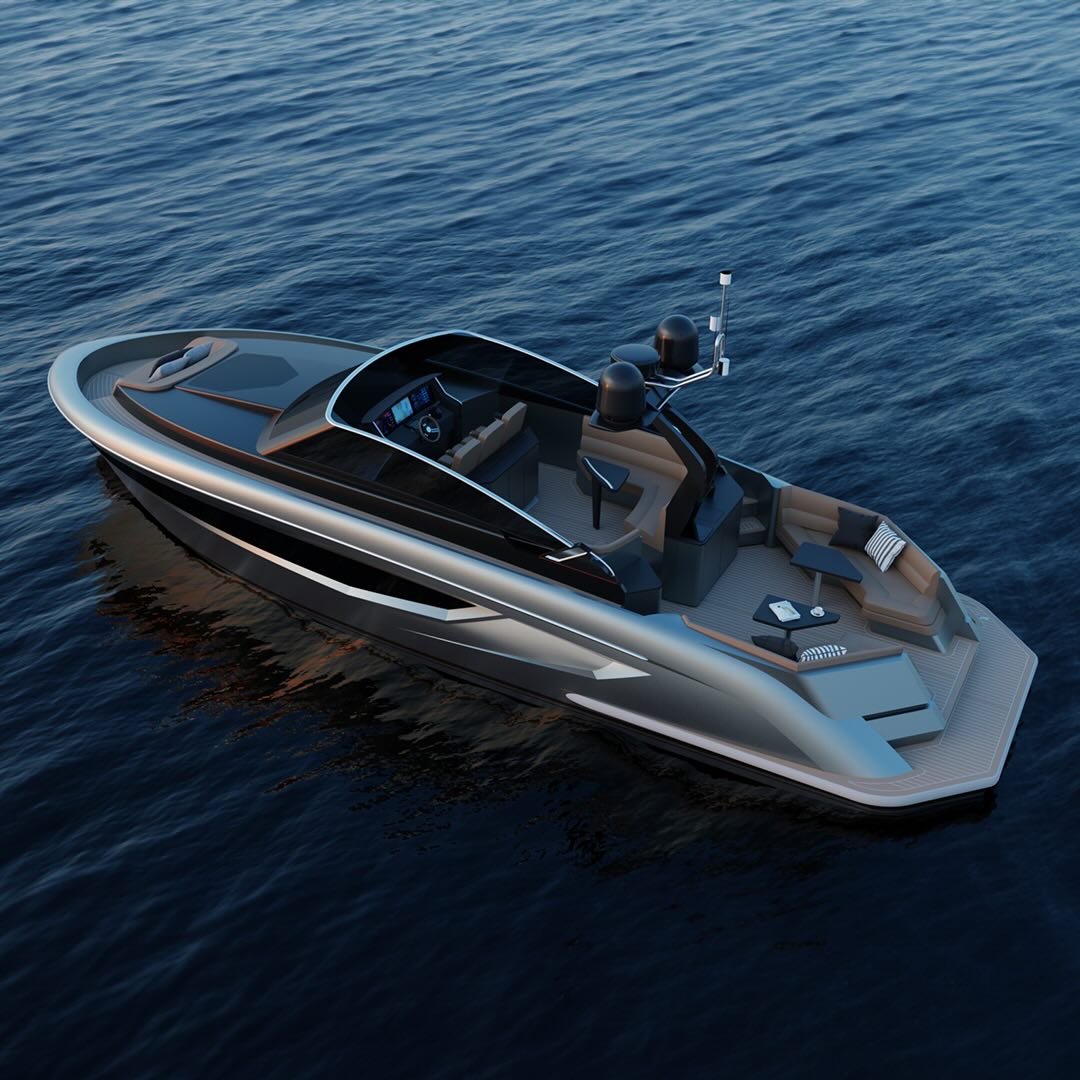
“We have known each other for fifteen years, so we know what we have in each other,” Eerkens introduces his new partner. Stapert’s company specialises in aluminium constructions: from manufacturing parts for ships to building hulls. Ribbon yachts are built from carbon, this time it concerns a completely aluminium boat. The brand name jumps out of the brochure: Exquise. In addition to the difference in material, the new boat is also heavier and larger. Where the Hytender 28HY Monza is 8,30 metres long, the Exquise 44 measures approximately 13,50 metres. “This is something completely different,” Eerkens explains. “With Ribbon, we are focusing on a trailerable tender that can also be taken on board superyachts, and therefore must weigh less than two and a half tonnes, the critical limit for hoisting it on board using a crane. The Exquise is not a tender, but an independent superyacht that is ideally suited for a weekend away: it has everything you need, sleeping places, shower, toilet…” “In addition to the hybrid drivetrain, of course, the Exquise distinguishes itself in a number of design details,” Stapert adds. “For example, you can stand upright in the cabin, which is not possible with most competing weekenders. And thanks to the open layout of the deck, you can walk all around the ship without encountering obstacles: from the bow around the cockpit to the swimming platform.” He opens the brochure to a render of the top view of the Exquise 44 to illustrate his words. “Building with aluminium also makes it relatively easy to customize the layout according to the customer’s wishes,” Stapert mentions the next advantage. “If you prefer the shower on the other side of the cabin, that is feasible – it is not a mass product. Another advantage is that the draught of the yacht is minimal due to the use of water jets. Finally, the Exquise is equipped with a dynamic positioning system, which automatically controls the position and course. For example, it stays neatly in place in all weather conditions.” “A design like this does not exist on the market,” Eerkens summarizes. “Fast-sailing hybrid and equipped with every comfort.”
Just like a Ribbon, the Exquise can also be equipped with conventional engines instead of the hybrid package. “Right at the beginning, there was the occasional hesitant customer who thought it was all too new and didn’t dare to try the hybrid drivetrain,” says Eerkens. “But we didn’t rush into things. We spent five years developing, the first three of which were trial and error. We tested the weight distribution in detail. Now that we’ve shown that the system works, there’s no reason to doubt. And look at the benefits the system offers! How great is it that you can sail around electrically for an entire weekend with the Exquise – and how cheap, compared to a petrol engine? In between, the batteries charge automatically when you take a spin. That’s very fast, not comparable to a hybrid car. All the power you use can also be fed back. Another advantage of a hybrid drivetrain, certainly in the long term, is accessibility: many ports will soon be environmental zones where polluting vessels are banned. And the Exquise may be quiet, but it’s quite sporty electrically with a maximum speed of 40 to 44 knots: if you want to show off, you push the throttle down and you can even water ski behind it. Until the ship goes into plané, you sail electrically, then in combination with diesel or, better yet, methanol. The engines are ready, the wait is now for you to be able to fill up with methanol. We expect that to be the case within five years. We can already sail with HVO (Hydrotreated Vegetable Oil), an environmentally friendly diesel made from vegetable oil and residual waste. With our concept you can sail completely green. We are ready for the future!”
After the 44-footer, a 55-footer is on the way. “That is our plan,” says Stapert. “But step by step. First, we want to market the Exquise 44.” The MASTERS EXPO has been chosen as the platform for this. Eerkens: “We want to reveal a part of the Exquise 44 there to show that it is under construction.” Stapert: “We are already working on the construction drawings, so that we can start building soon. In the course of 2025, the demo model of the Exquise 44 will be launched and interested parties can take it for a test sail.” Eerkens: “Once we have covered the entire Exquise range and proven that our technology can be used for yachts from small to large, we want to roll it out to other brands. To this end, we are already in talks with other boat builders, also abroad. There is a lot of interest.” There is also contact with brands that are in the Exquise corner. “They are curious about our technology. We hope that more major brands will want to sail with our technology. They are also working on it themselves, but we have a huge head start. For example, it is a lengthy process to be able to adapt purchased components to their own software and technology. We spent three years convincing Rolls-Royce that their waterjets can also be powered by an electric motor. We had to break into the established order and needed a lot of patience for that. That is why: instead of reinventing the wheel, other brands can better use our technology, because that is a matter of installing and turning.”


