
Taste
How the NIO ET5 Touring drives
We drove the electric NIO ET5 Touring to Germany. Although more and more cars are becoming electric, you still hear objections.
We went to Germany with the electric NIO ET5 Touring. Although more and more cars are becoming electric, you still hear objections like: 'What about the winter sports?' We were also gone a day longer than planned, but that was not because of the car.
Few markets are as dynamic as the car market. The number of dealerships in the Netherlands is rapidly decreasing, while the number of brands is increasing spectacularly. When we visited the Brussels Motor Show in January, we saw car journalists looking around in amazement on the press day: there were several brands that even they, professional experts on the car market, had never heard of. Automotive Magazine, a trade journal for the car industry, regularly produces a power ranking in which the chances of success of dozens of newcomers are assessed. For almost a third, this is called small or zero, but according to the magazine, NIO has a much better chance of success. 'It is distancing itself from important competitors and with more than 200.000 sales in 2024, there is a basis for further growth', the magazine writes. 'The energy branch is also taking shape seriously and other manufacturers have joined NIO. In addition, the cash position is good and the support from Abu Dhabi is solid.' However, we can well imagine that not everyone has all the new car brands mapped out. Time to get to know the brand better. For this, we did not go out with the top model, but with one of the few electric station wagons on the market: the ET5 Touring.
Battery change
Anyone who visited MASTERS EXPO in December was able to catch a glimpse of NIO's model range. There is a choice of two sedans, the ET5 and ET7. The ET5 is also available as a station wagon - that is the ET5 Touring on these pages. Because the market is currently mainly asking for SUVs, the brand also has them: the EL6, EL7 and EL8. Prices start at around 50.000 euros for the basic version of the ET5 and go up to around 84.000 euros for the EL8. In both cases, this is without purchasing the battery pack. With good reason, because NIO's unique selling point is that you can change the battery on the road, without having to leave the car. However, this is only possible if you rent the battery from NIO. Those who prefer to own the entire car themselves, including the battery, can also opt for that. For the ET5 Touring as we drove it, for example, that costs 12.000 euros, for the Long Range version that is 21.000 euros. However, we would always prefer the battery subscription, which NIO itself calls BaaS Subscription. Then you pay 169 euros per month for the standard version and 289 euros for the long-range variant. And to immediately mention that Long Range: according to the official figures, you get 560 kilometers on a battery charge, with the Standard Range that is 445 kilometers.
Exuberant colours
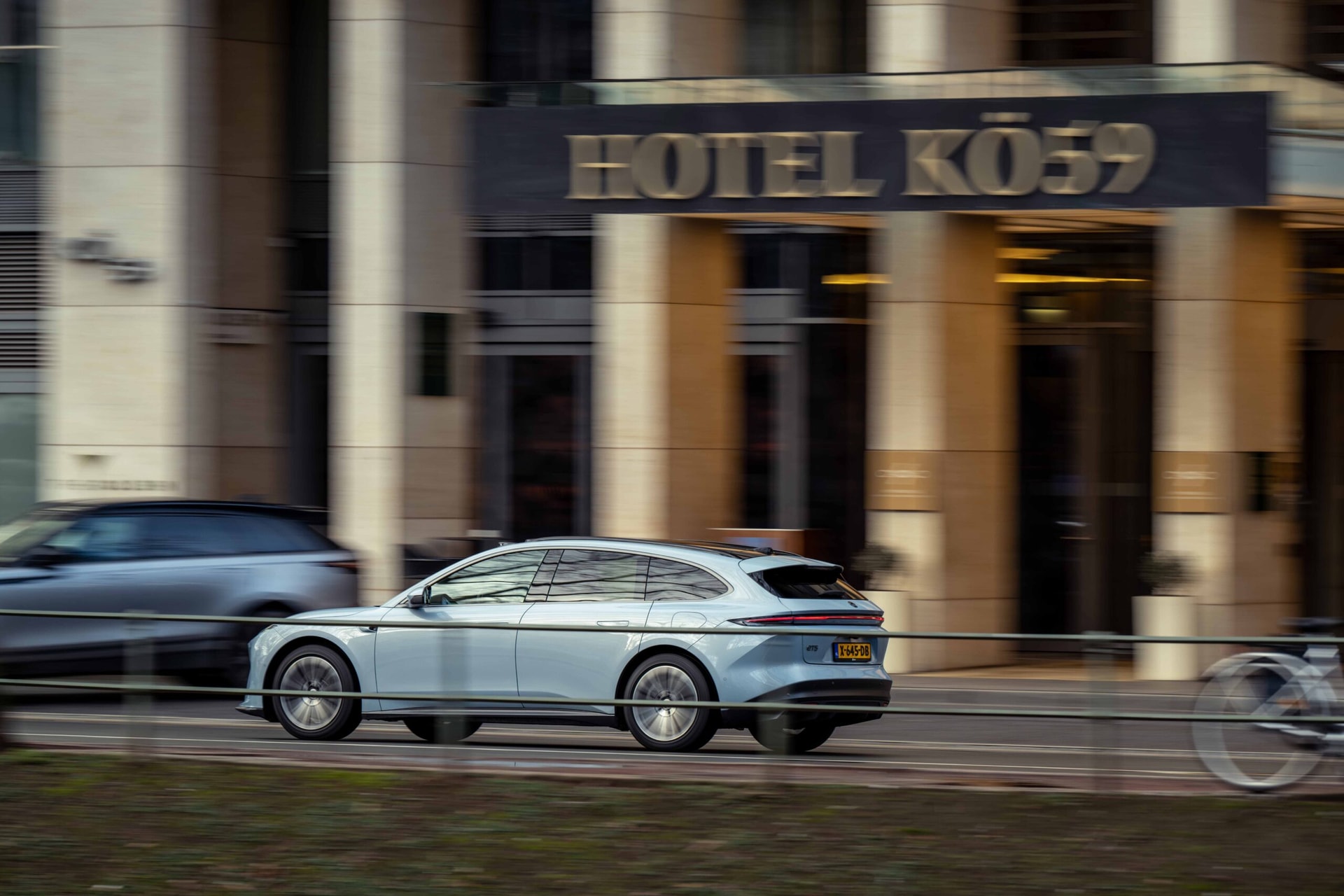
So much for the administration. We are curious to see how NIO will perform in practice, so we pick up an ET5 Touring at NIO Hub in Breukelen. The nice thing about NIO is that the brand also supplies cheerful colours, which we had specifically requested on behalf of the photographer. A silver-grey is always an option, right? The light blue colour of our model is called Stratosphere Blue. When we pick it up, it is standing next to a lavishly coloured model in Sunbathe Yellow.
We don't have any winter sports plans, but we still want to experience how NIO behaves on the Autobahn. That's why we decide to go to Düsseldorf, where we eat at a Chinese restaurant as a little hat tip to the origin of the brand. Incidentally, the Chinese origin turns out to be very relative: the head office is in Shanghai, but NIO does not consider itself a Chinese brand. NIO calls itself a 'global company'. We quote from the press kit: 'NIO is listed on the New York Stock Exchange and Singapore Stock Exchange. All NIOs are designed in Munich and the chassis technology in Oxford. The software is written in San José (USA), Shanghai and Berlin. The cars are built in China.'
Full throttle to winter sports
If you buy or lease a NIO, you install the NIO app on your phone. We sometimes neglect to do this with test cars and that takes its toll on our first attempt to swap the battery. The Power Swap Station in Arnhem turns out to be closed for maintenance on the day of our visit. If we had installed the app, we would have known. This stop was not necessary, but for us it was: we want to go full throttle on the Autobahn, so we need a full battery. Fortunately, there appear to be many fast chargers next to the Power Swap Station; the NIO can also use them. Swapping the battery is an additional option in addition to the fast charging that we know from other electric cars. We connect the ET5 to the charging station and a cup of coffee later we are good to go again. We are not making a world trip, but nevertheless we see the battery charge decrease rapidly. That is partly the fault of the Dutch NIO importer: he had fitted the car with large wheels. Nice for the photo, but they also cause higher consumption, just like the winter tires that were mounted. And it is partly our fault, because we want to try out whether there is finally a car with which you can go full throttle to the winter sports. The answer is yes, but that does not change the fact that the consumption shoots up when you thunder along the Autobahn at 200. The fact that the temperature during our trip is around freezing point does not help.
Faster than refueling
For years, range anxiety has been a problem for (potential) drivers of electric cars, but we arrive in the vicinity of Düsseldorf without any stress. Not much happens in the town of Hilden, but you will find a NIO Power Swap Station there. We occasionally pass the swap station in Apeldoorn and you rarely see anyone there, but here in Hilden it is a coming and going: according to NIO it is even the busiest swap station in Europe. The main claim to fame of Hilden (55.000 inhabitants) is that one of the founders of modern surgery comes from there, namely Wilhelm Fabry, who is usually called Fabricius of Hilden. However, many electric drivers know it mainly from the large charging station that can be found there: you will find fast chargers from Fastned and Tesla that are so busy that there is even a (nice) coffee shop there, where you can also eat a sandwich. We make a stop there, but that is because we feel like coffee and not because we have to wait for the NIO. At the Power Swap Station, someone is just changing when we arrive, but he is finished by the time we have confirmed via the navigation system that we indeed want to change the battery. We park the car in the specified spot in front of the swap station and from that moment on we do not have to do anything. The NIO communicates with the swap station itself, parks itself in the swap station and indicates when we can leave the swap station again. You do not have to get out of the car and within five minutes you have a full battery again. This is faster than refueling.
Barry Stevens
Is there nothing to complain about? Actually not. Nomi, the digital assistant on the dashboard, speaks a few crooked sentences in Dutch during the battery change. 'Trep het rrrempiedal in', she tells you for example. No disaster, but it is somewhat reminiscent of the enthusiastic 'voormost doorrrgaan' that Barry Stevens used to use as a mantra during the Soundmixhow. But where it was fun with Stevens, it is a bit laughable with NIO. NIO presents itself as a premium brand and such a clumsy translation is a bit strange. For the rest, the assistant works fine, which may also be because Nomi does speak English. Incidentally, over-the-air updates for the software are released regularly, so there is a good chance that it will be fixed sooner or later. A fully Dutch version of Nomi is not expected anytime soon: because Dutch people speak English well, that is not considered necessary. This specifically concerns the voice-controlled assistant; the written text on the displays is written in Dutch, good Dutch at that.
Little Tokyo
After our visit to the exchange station we roll into Düsseldorf. We did not choose the capital of the state of North Rhine-Westphalia entirely by chance. Of course there are sights such as the Kunstsammlung Nordrhein-Westfalen, the Deutsche Oper am Rhein and the botanical garden, but that was not our aim. The Königsallee was not our goal either. Admittedly, the Kö is one of the most luxurious shopping streets in Germany, so we did take it in – after all, that is what everyone in Düsseldorf does. The real reason for our visit, however, is Little Tokyo, where, contrary to what the name suggests, there are also quite a few Chinese and Korean shops and restaurants. How did that come about? After the Second World War, quite a few Japanese companies settled in Düsseldorf. They chose the city because of its central location, although it also came in handy that the Ruhr area was nearby. This led to the creation of the largest Japanese community in Germany. Not only do you find Japanese restaurants here, but also Bookstore Nippon, a Japanese school and even a Japanese garden. Over time, however, more and more Chinese and Korean restaurants have also appeared in Little Tokyo. And today we focus on the Chinese restaurants, because we are with the NIO. Apart from that, Little Tokyo is above all one of the nicest neighbourhoods of Düsseldorf. (See more about the city in the section City Guide later in this edition, ed.)
Unexpected overnight stay
We first do a round of photos. To start with the Uyghur restaurant Tengri Tagh, then at China Lounge Rote Lanterne. We are not yet satisfied, because we know what we are looking for: a traditionally decorated Chinese restaurant, where we can park our ET5 in front of the door. The characteristic lamps, if necessary the characteristic calendar on the wall, and then as a contrast the NIO that you can see through the window in front of the door. The next place we try is the Chinese Skewer Bar. And that is where it goes wrong. After having photographed a few restaurants, we are now hungry ourselves. We decide to park the NIO in a nearby parking garage to have something to eat. The restaurant is simple, but good. We cannot stay there too long, because the photographer still has big plans. When we leave the restaurant, however, it turns out that our parking garage is closed… We read that it closes at eight o'clock in the evening, we are ten minutes late! It costs us an unexpected overnight stay. The next morning we continue, with other plans. We photograph the car in Düsseldorf, pick up another full battery at the swap station in Hilden and speed back over the Autobahn. On the way back we skip the swap station in Arnhem this time: we drive via Apeldoorn, where there is also a swap station. Anyone who has a NIO as a daily car for the drive to the office will of course use the charging station more often in practice. However, swapping is a nice addition, which in some cases is also considerably cheaper than charging at the fast charger. You can swap twice a month for free and after that it costs ten euros each time. You always pay for the electricity and NIO charges 29 cents per kWh for this. If you hand in a battery that is still 20 percent full and you get the next battery with a battery charge of 90 percent, then you pay 70 times 29 cents. For comparison: at the Fastned fast charging stations the standard rate in the Netherlands is 74 cents per kWh.
Added value
Anything else to complain about the NIO? Not much. If you often switch from one car to another, it takes some getting used to: some functions work a little differently than in many other cars. If a NIO is your only car, you will of course get used to it after a week. An exception to this is the neutral position of the transmission. You can only engage and disengage it when you press the brake. This means that you cannot actually go through the car wash with any decency, because you are not allowed to brake there when you are standing on the tire. There is also a simple explanation: such car washes do not exist in China. NIO promises to adjust this in the next software update. The fact that a triviality like this is our main objection to this newcomer is a major achievement. The car looks good, drives well and you also sit well. The battery change is a unique addition that gives the NIO added value compared to its competitors. In addition, as a NIO driver you can also use the NIO Houses in Amsterdam and Rotterdam, where you can go for coffee, lunch but also if you need a meeting room. So we definitely wouldn't want to say that a NIO is almost a 'normal car', but it is one that you can drive just as carefree as a car with a petrol engine. As long as you don't park in the wrong parking garage...