Power
"Don't copy, but innovate"
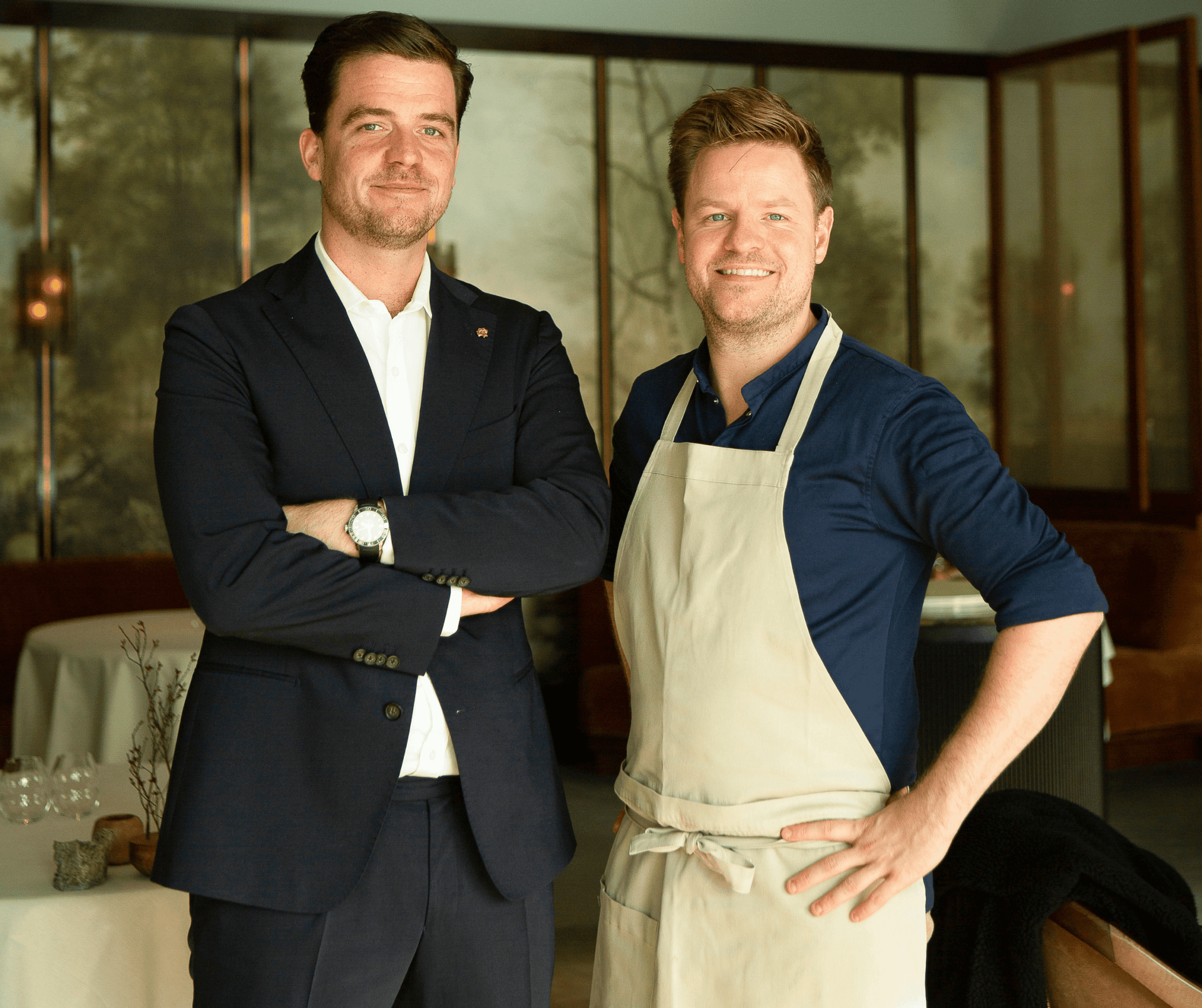
During the corona period, Bas van Kranen reinvented himself as a chef, resulting in a complete transition of his restaurant. Only natural ingredients, clouds on the ceiling and even a new name. Flore was full from day one and in its first year it was rewarded with two Michelin stars and a Green Star. “We are no longer everything that Bord'Eau was. Only the place is still the same.”
Since I interviewed Bas van Kranen in 2018, a lot of water has flowed through the Amstel. After gaining experience in mainly Limburg kitchens, including Da Vinci and De Leuf, he became chef of Bord'Eau that year. The restaurant located in De L'Europe had been cooked to two stars by Richard van Oostenbrugge in the previous years. Bas started again from zero. Now, four years later, the restaurant has undergone a complete metamorphosis: interior, cuisine, name, philosophy... everything! That the right course had been chosen was emphasized by Michelin on May 30 last: Flore was rewarded with two regular and one Green Star in one go. At a table in the restaurant, Bas shares his success story behind a coffee. “The reason I came to Amsterdam in 2018 was to measure myself more against the top level: you have many talented chefs here within a radius of two or three hundred meters. That competition encourages me to get the best out of myself. I've been everywhere. To see what's happening in Amsterdam, what everyone is doing and what I shouldn't do. Fine dining in the Netherlands in general is quite a copy culture. We all cook a five- or six-course meal; everywhere you get scallops, langoustines, pigeon, Wagyu, caviar, sea bass; everyone follows the same techniques... At the time of corona I asked myself the question: who is Bas van Kranen? To this end I talked to many people. I came to the conclusion that I was actually doing a compilation of everything I have learned from all kinds of chefs over the past fifteen years. I asked myself the question: do I want to continue cooking like this or am I going to reinvent myself?”
Development
Bas chose the latter and focused on development. “If you copy something, you are identically copying a dish. But if you apply a technique in your own way with your own ingredients and perhaps a different binding, then you are innovative. But that is of course the most difficult path. In the beginning at Bord'Eau I was not nearly as innovative and I had less individuality. This also had to do with the fact that the name and concept of the restaurant were already there. Everything was about luxury products from all over the world. That's what Bord'Eau has always been. A very international restaurant with almost only international guests. And they also expected Wagyu, lots of caviar and truffles. That was the box in which I found myself placed: this is what to cook. The pandemic gave me the opportunity to break out of that box. It was a time of reflection: what are we actually doing? Right from the first week that we were closed, we started projects into research into the food industry, dairy, fishing techniques, the operation of large and small companies, emissions in the meat industry, the difference between rationally and biodynamically grown vegetables... We are also go picking in the wild. What does the Dutch landscape have to offer? Dewberry, rosehip, angelica… We learned a lot from all those studies, and I was also quite shocked by the outcome. Flore was not created from a greenwashing program or sustainability initiative, Flore was truly created from research. And ultimately this has led to a certain individuality, in which we express a preference for Dutch products that have been grown or grown in a good way. Fine dining became conscious fine dining. How big is our contribution to sustainability at the moment? We are making very good progress in this regard, but we are still far from there. That is why we focus on awareness: thinking about what you do, why you do something and where you get the ingredients from. Instead of placing an order for twenty kilos of turbot, you could also ask the fisherman: what is currently at the auction, where does it come from, how is it caught, when is the spawning season?”
Challenge
Due to the method of production, the life of the cow and the emissions, Bas decided to completely stop using dairy in the kitchen. “Look at Asian culture, how little dairy products they use there and how pure the cuisine is. Suppose I barbecue a piece of turbot with a gelatin from the fin and finish it with a gravy from the head. That is very natural, pure fish what you taste. Or I add a thick beurre blanc. Then I mask the fish and the butter, the fat, dominates. Without dairy it is much more complicated, because it is purely about the taste of the fish. I make it less easy for myself and my kitchen, but the challenge does make you more creative. Don't copy, but innovate. We have gone deeper into this in a natural way. Due to overfishing, we no longer work with langoustines, scallops, turbot, red mullet... In fact, we have stopped using the entire line of popular ingredients for fine dining. But then there are still so many fish left. Think of pike-perch, plaice, mussels, crayfish, cuttlefish, squid. Everything from the North Sea or the rivers. I called my fishmonger and asked if he had any garfish. That is an eel-like fish with a deep green bone, which is caught in the Oosterschelde and the IJsselmeer. A fantastic fish! But hardly anyone knows the garfish anymore. Even my fishmonger said: 'Bas, in the twenty-five years that I have been in the business, no chef has ever asked me for this fish.' While it just swims around in the Netherlands and is super tasty. But it's not the standard in fine dining. Our garfish beats the turbot. A hundred percent. Why? You will find perfectly cooked turbot in all 120 star restaurants in the Netherlands. But what's so exciting about it? Turbot can be found everywhere, but not garfish. We surprise the customer with this.”
MASTERS MAGAZINE
Want to read the rest of this article? The winter issue of MASTERS was created in collaboration with Jordi van den Bussche. Many will know him as YouTuber Kwebbelkop, but he has been working hard as an entrepreneur for some time, as he explains in the Great Interview. What is new is that his company JVDB Studios offers to do social media marketing and short format content marketing for other companies. “They can also figure it out themselves, but we cracked the code.” Jordi gives a platform to like-minded entrepreneurs such as Jay-Jay Boske, Demy de Zeeuw, Chahid Charrak and Marcella de Bie, and discusses developments surrounding games, crypto and NFT: “Just as bitcoin turned the financial system upside down, will that also happen with gaming.” This extra thick winter issue also focuses on Lengers' first own ship, an interview with Corendon CEO Atilay Uslu, specials about the new BMW 7 Series and Samsung foldables, and - exclusively for MASTERS! – an interview with Max Verstappen.