
Taste
Morgan road trip: From Craft to Better
Morgans have been hand built in Malvern for over a century. Knowledge is often passed from father to son. That makes a Morgan the perfect car to get acquainted with craftsmanship on Dutch soil.
Text: Perry Snijders
Online editing: Mical Joseph
Image: Luuk van Kaathoven
It is still early when we arrive at the Dutch Wine Growing Center in Groesbeek. Although the number of pigeon growers in the Netherlands is growing rapidly, 'we' are not yet known as a wine country. Here they are doing everything they can to change that. In addition to wine making, you can learn wine tasting both as a hobby and professionally. “The wine experience is central here,” they say. Not surprising: the Netherlands may not be a wine country, but Groesbeek is a wine village, with the Wine Growing Center at the heart of the village. That is the place where Freek Verhoeven started the Colonjes vineyard in 2001. Over the past twenty years, it has grown into the largest organic vineyard in the Netherlands. Verhoeven himself has now passed away, but the craftsmanship lives on. This becomes apparent when Berry Emmen shows us around the company. Together with Jeroen Wismans and oenologist Adam Dijkstra, he runs Wijnhoeve de Colonjes. “We have ten different grape varieties spread over three locations here. We also have the advantage that the vineyards are located on a loess soil, which gives a full and mineral-rich taste.” We can't taste it, because we still have to spend a whole day with the three Morgans we have with us. Not that that is a punishment, because we started our trip to have a day of driving fun with these hand-built sports cars. However, that was not the only intention we had. We also wanted to notice how big the differences between these three Morgans really are. Is a Plus Four with an automatic transmission a completely different experience than a manual one? And does the six-cylinder make the Plus Six a completely different car than the Plus Four with its four-cylinder? So it is not only a journey of discovery in craftsmanship, but also an extensive introduction to the three Morgans.
Three core elements
The term craftsmanship also applies to the Morgans. Pickersleigh Road has been the place where Morgans have been built for more than a century, a craft that is often passed down from father to son. This is not surprising, because the factory is located in Malvern Link, a small community with just over six thousand inhabitants; If you have been building cars there for over a century, it is obvious that entire families are involved in a company. That doesn't mean it isn't a serious business, because about eight hundred cars are built every year. Nor is it to say that Morgans are outdated, because since the company stopped using the steel chassis last year, every Morgan is built on the CX platform, a brand new aluminum platform that is much stiffer than the steel previously used. And what about the wood? That a Morgan had a wooden chassis is a myth. However, wood was (and is) used in the construction of the bodywork. Morgan even calls it one of the most important parts of the car. “Each Morgan is expertly handcrafted from three core elements: ash wood, aluminum and leather,” according to the brand itself. Yet the brand is not ahead of the music. The old Peter Morgan, who led the brand from 1959 until his death in 2003, once said in an interview that he was not against change: “We change our cars if we have to, but we leave them the same if we can.” However, you should not be mistaken about the brand. The factory sometimes even looks cozy in photos and quotes like those from Peter Morgan may give you the idea that cars are being put together in an old shed, but nothing could be further from the truth. The craftsmanship has not changed, but every Morgan has an aluminum platform underneath it, and BMW's most modern engines are used. That would not have been approved in Munich when he was alive when it came to craft projects.
Driving pleasure
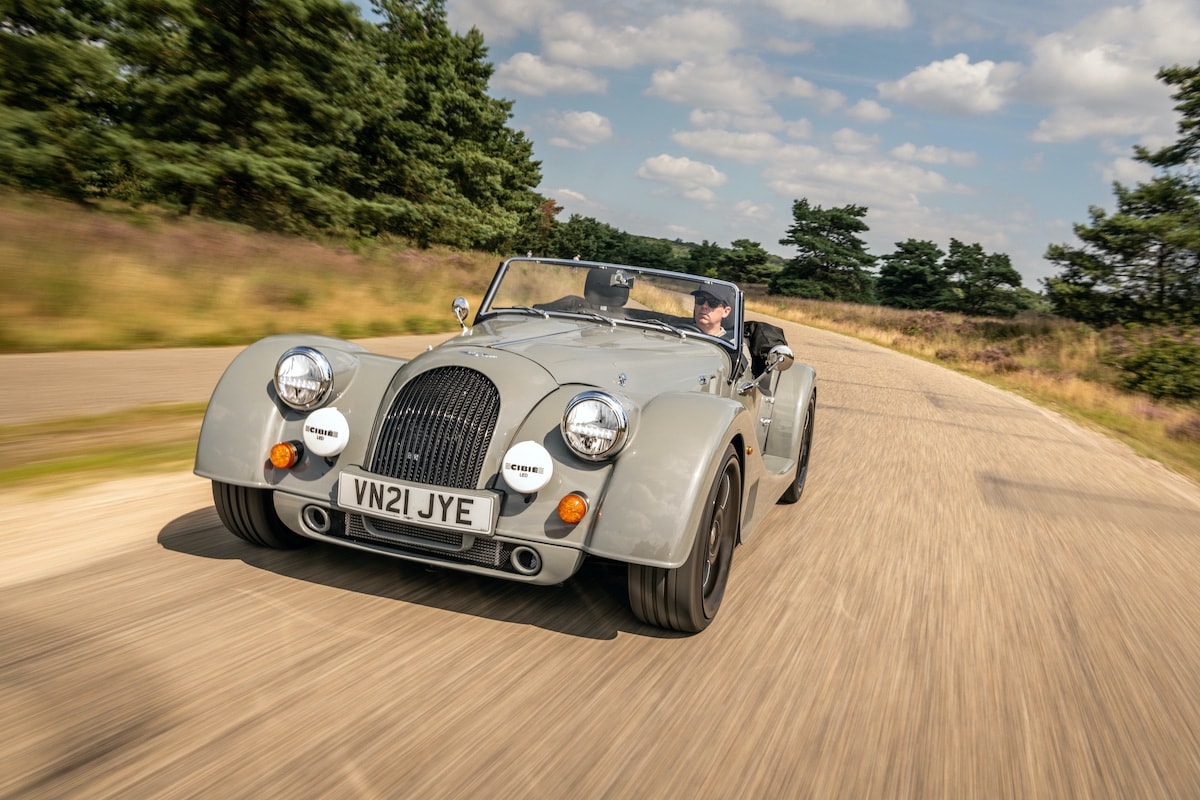
Modern or not, driving pleasure is of course the first priority with a car like a Morgan. We are lucky with the weather, because it is warm and sunny during our road trip through the Netherlands. Although the cars have a roof, you should drive a Morgan if it can only be partially opened. From Groesbeek we set course for Apeldoorn, where we do not have a very specific destination; the aim is mainly to find beautiful roads on the Veluwe. After all, with a Morgan what actually applies to every car applies even more strongly: a highway takes you from A to B, but driving pleasure can be found on completely different roads. All three are at ease here: the manual Plus Four offers old-fashioned driving pleasure, the Plus Four with automatic transmission surprises you with the ease with which it is driven and the Plus Six is noticeably slightly heavier, but will amaze you with its speed. with which you can attack these roads. Especially if you get on the gas again when accelerating out of the bend, you can be amazed at its speed again and again. The Plus Four doesn't lack anything at all with its 258 hp, but these are the places where you feel that the Plus Six has more than 80 extra hp at its disposal. If you know these engines from BMWs, you know how eager they are. Only they have hundreds of kilos less to carry in these Morgans.
Gathered wood
As we enter Apeldoorn, we pass the shop of Hans de Louter, who started manufacturing guitars, violins, violas, Irish bouzoukis and mandolins 35 years ago. De Louter is known far and wide for his craftsmanship, also because he is one of the few luthiers who actually builds instruments (most only repair them). The store appears to be closed: De Louter is only open by appointment, because he is usually working in his studio. We know from a previous visit that it is worth it. If you like musical instruments, this is the place to be. Even if just to hear De Louter's story. It was the movie Woodstock who inspired him to start building his own instruments. He built his first sitar with wood gathered in the Orderbos. According to him, a complete failure, but the seed had been planted. A little further on we stop for a short break at the artisan ice cream makers of Van Swoll. Owner Klaas Brasjen immediately looks up when he sees the three Morgans. Not surprising, because with his classic Bedfords he regularly attends car events, including the annual Concours d'Elegance Paleis Soestdijk. That classic event has its origins at the Het Loo palace in Apeldoorn and was therefore a home race for Van Swoll. With a sincere “have fun!” the ice maker waves goodbye to the three Morgans.
Welcome exception
And fun, that's what you have with a Morgan. While some expensive cars sometimes evoke negative reactions, a Morgan with its classic appearance only gets sympathy. The message you convey with a Morgan is not 'mothers, keep your daughters indoors', but simply that you like beautiful things and have the right dose joy of living has. But of course the fun isn't just in the reactions of bystanders. In a world where cars are becoming increasingly digital, a Morgan, every Morgan, a welcome exception. Because the technology may be modern, but the feeling while driving is old-fashioned, in the best sense of the word. Driving goes faster than we think. Almost unnoticed we ended up from the Veluwe via the Utrechtse Heuvelrug in Stoutenburg, close to Amersfoort. There is De Kopermolen, the cheese farm of Martin and Marieke van Klooster. Although the name 'cheese farm' does not do justice to their company: not only is cheese made, but there is also a farm shop, where they also sell their own milk and butter. Here the animals are not hidden away in a large stable that looks more like a factory; the stable is modest in size and when the weather is nice, the cows are outside. You can come here for a cup of coffee, but they will be just as happy to tell you the intricacies of cheese making. We don't have too much time for the latter, because we still have a visit on our list. For that we go to Rotterdam, where we meet Herman and Dave Braun.
Discreet
They manufacture bicycles in their workshop in Spijkenisse. Their brand is called Braun and if you've never heard of it, that's not surprising. The annual production that the two of them achieve is not very high. Quality trumps quantity here, and the quality is impressive. There are even pros who ride a bicycle from a well-known brand, which is actually made by Braun. The Brauns themselves are of course discreetly silent about this. A well-known example is the bicycle with which Leontien van Moorsel set her world hour record, but Maarten den Bakker and Jeroen Blijlevens also rode Braun bicycles. However, like Morgan's car builders, Braun swears by traditional materials – carbon is not included. “It actually only has disadvantages,” says father Herman. “It breaks quickly, is less comfortable and makes cornering less easy. We weld our frames ourselves, Dave does that. But this is preceded by a whole measuring session, because it is tailor-made. We use a computer for the geometry of the frames. Then you might think: what's so special about that? But there are only eleven of this computer in the whole world.”
Braun's basic models, made of steel, are somewhat heavier than carbon bicycles. Herman: “You may wonder whether that is a bad thing. If you cycle for fun, you don't need a bike where every gram counts. But you do want a bike that runs smoothly, with low rolling resistance. That is what we focus on, the force you exert must be converted into movement – as efficiently as possible.” That does not mean that there are no light bicycles from Braun. The top models, for which you can easily spend 15.000 euros, are made of titanium.
Dedication
It is nice to hear father and son Braun talk passionately about their bicycles, just as it was nice to hear the stories of winemaker Berry Emmen, or those of cheesemakers Martin and Marieke van Klooster. Each one is a story of craftsmanship, of love for a craft. And that is exactly what is so beautiful about a Morgan: you can see that it has been worked on with dedication. The enthusiastic stories we heard during our road trip made the time pass faster than we thought. That means we end up on the highway on the way back. We have to sit down a bit to get out of the wind, but otherwise it goes without any problems - and especially without having to remove the roof and the top half of the side doors. It's actually a relaxing end to a wonderful day. The only question remains which of the three we would choose ourselves. Are we going for the relaxed character of the Plus Four automatic, the pure character of the manual Plus Four or the brute power of the Plus Six? All three have their own qualities, a stronger character than you expect. That is the answer: you cannot make a wrong choice here. And if you ask me, that has been true for the entire Morgan brand for over 110 years.


