Power
MATTHIJS BOSMAN: A MOMENT OF MAJOR CHANGE IS MY STAGE
Matthijs Bosman (Eindhoven, 1976) is an artist who uses society as his canvas. He is often engaged when two parties find themselves in opposition. His role is to creatively build a bridge between them. "I am the link that tries to expose the passion in everyone's convictions in a dedicated and honest way."
Matthijs Bosman (Eindhoven, 1976) is an artist with society as a canvas. He is often called in when two parties are opposing each other. It is his job to creatively forge a bridge between the two. “I am the link that tries to expose passion in everyone's beliefs in a dedicated and honest manner.”
Text: Bart-Jan Brouwer | Online editor: Natasha Hendriks
Image: John van Helvert
You first went to drama school, then to art academy and later you spent another year at the Academy of Architecture and Urban Planning. What does that say about the shift in your interest?
“My interests have shifted in terms of medium, but I have always continued to create. At drama school in Maastricht I quickly switched from acting to directing. I actually don't understand why I was ever accepted for the acting training there. I thought actors were special people that I couldn't work well with at all. I didn't get happy on stage, more nervous. Until I was introduced to directing. I found that interesting, because it is about studying the meaning of what you are making. Finding the dramaturgy, the interpretation, the language to bring others to a certain performance. Unfortunately, during that time in Maastricht, I lost control of my life due to events at home: my parents had attempted to commit suicide shortly after each other. That turned my world upside down.”
What did your parents' double suicide attempt do to you?
“My parents had just divorced and coincidentally got tired of life at about the same time, without knowing it about each other. There is also a certain romance in the fact that they wanted to end it separately and at the same time. That episode, that extreme low point for both of them, has been somewhat covered up; we never talked about it in depth afterwards. My mother dismissed it with a simple explanation: life hurt too much and it had to stop. When the situation at home had calmed down a bit, I did not return to Maastricht: I felt the urge to go out into the world. While traveling I started to long more and more to make things. Once back, I moved to Antwerp, where I started a studio and started painting. That went quite well. But more than paintings I wanted to make images. I wanted to learn more about that: I went to the art academy in Den Bosch. I entered there and experienced an instant fall in love with that course. There I could do all the things I had dreamed of over the years. I could literally walk from a forge to a film set and from a screen printing studio to a DTP course in one day. That made me so happy that I wished it would never end. A golden time! With tears in my eyes, I closed the door behind me after my final exams. I immediately started a studio in Den Bosch and started working as if the academy was continuing as usual. That led to exhibitions and interest arose. That was a lot of fun for a number of years, but also tough because you are floating around in a kind of opportunity pool. I was lucky enough to be picked up by a number of people who started writing about me. Among them Ann Demeester, the current director of the Frans Hals Museum. She offered me a major solo exhibition in Amsterdam. Those are crucial moments.”
You belong to the generation of artists who started putting social design – at the time it had no name – into practice. An example is the Practice of the Ideal. Tell.
“It almost always starts with a problem: 'project developer wants something, local residents don't' or 'company wants to implement a strategy, employees are against it'. My stage is a moment of change. And my goal is above all to look at the problem with enthusiasm and sometimes to create understanding on both sides, other times to cause something that seems worse than what is originally going to happen, so that people think 'it's going to happen'. still along'. Take the Practice of the Ideal: a corporation wants to build new buildings in a special location, but the local residents are already fed up with it in advance because everything around that location has always gone wrong. I'm being hired to do something about that situation. I don't belong to anyone, I am the enthusiastic outsider who conveys the romance of the new plans and works on the narrative power.”
You don't work with numbers, but with emotions. Isn't that difficult?
“No, because when I see emotions, I think: ha, now we're getting somewhere. For the project The Café That No Longer Existed, I was given carte blanche by the municipality of Heerlen to create a large work of art in a neighborhood: 5.000 square meters had to be influenced by it. The only condition the municipality set: if the neighborhood doesn't embrace it, then it won't happen. They warned that it was 'not an easy neighborhood'. I organized an evening in a local hall – let's get acquainted. Started wrong. Because I already had an idea when I came. I thought: I just need to learn their language and then explain in their words what I want to do. I went there with an idea and a handful of tricks to make that idea a reality. One such trick: never let people name objects but verbs. So they are not allowed to say 'we want a slide', but they can say 'we want to play'. Because then you have the freedom to come up with a completely different play object. It went completely wrong. Bad evening. Bad start. We stood opposite each other, I was already just like the rest. At home I asked my wife, who is a journalist: how do I get those people to accept something from me? Said replied, “You should learn something about them.” Have you ever thought about actually asking them something?' I went back to that neighborhood and said: 'We're going to do things differently. I want you to be my guide in the neighborhood.' A little later I was walking through the neighborhood behind thirty guides - all with an umbrella in the air, I made something fun of it. The ice melted, we started talking to each other. It turned out that they had one strict requirement: they wanted flower boxes in the neighborhood. But I didn't feel like making flower boxes at all. After further questioning, it turned out that they thought that people were driving too fast in their neighborhood and that they had thought that those flower boxes would be nice obstacles to ensure that people drove less quickly. My contact person at the municipality told me that a decision had just been made to install speed bumps and turn it into a 30 km zone. I was allowed to deliver the news. Jaws dropped open, and I asked: 'Can we stop talking about those flower boxes now?' To which she said: 'We don't like flower boxes at all!' Hahaha.”
What did you end up making?
“There used to be a café in that neighborhood, where at the end of the week their fathers would break the wages they had earned in the mines. They had fond memories of that, but at the same time they no longer wanted a café because of the nuisance it causes. Then I came up with the 'Café that no longer existed': a steel frame as a base, which you can cover with sails with life-size black and white photos of the café in the past, from the past that they cherished so much. You simply zip the sails to the construction and then it is as if you are sitting in the café of the past. The artwork can then really be used as a place for an event. The people who were so critical in the beginning stood emotionally at the opening, building a replica of the café where their own father used to drink a pint when the weekend started. The emotion that a place can suddenly evoke after the right intervention... That of course also affects me very strongly.”
Your art lies more in building new ideas.
“People should get more help in finding their inspiration. The real intrinsic conviction to do what we are doing instead of life is what happens while you're making other plans. I think sometimes we are very wasteful with our time. Ignorance is bliss, but at the same time I think: if you don't do anything, do it with conviction. That's what many of my projects are about: identifying the true intrinsic value of something. Also doing nothing. Or do all sorts of things and fail. It can be helpful to say 'we did this together, we thought this was important'. In essence, nothing means anything until we find the right words for it together. And that helps resolve deadlocks or conflicts. Search until people, or two opposing parties, share a passion. I am the link that tries to expose passion in everyone's beliefs in a dedicated and honest manner.”
Yet you also create tangible images, such as Choreography of Pure Armoede, in which you depicted the toil of the unemployed during the crisis years in Zwolle.
“One hundred years after compulsory employment in the Netherlands, I was asked to create a monumental statue that would allow passers-by to experience something from that time, of the fact that tens of thousands of people did very hard anonymous work at a time when there was no good social system yet. used to be. There was charity through the church, but no social safety net. During the crisis years, people not only wanted to rely on charity, they wanted work. They knew that. In today's money, a family could receive about 250 euros per month provided the father did 60 to 70 hours of physical work per week. To avoid distractions, he was taken to the other side of the province to work six days a week. Barefoot and with a shovel or wheelbarrow, they could, for example, dig a two-hectare pit to build an air base or a canal. This is also the case in Zwolle. You can see that human angle in all my projects. That story of that worker, who, stripped of everything, had to fight very hard to support his family: I thought that sacrifice compared to the total anonymity of the work was fantastic. All they had left were the footprints and the trail of their wheelbarrow that they left in the earth. On the same land where the heavy work was done at the beginning of the twentieth century, I made a forty-meter-long embankment side of dark brown concrete. I walked over it barefoot with a wheelbarrow. As if it were an archaeological site, footprints and wheel tracks are now visible there. My footsteps, in workers' shoes of different sizes, and also the footsteps of my children.”
A decent storyteller thinks of the ending first. Your end is visible at the Verbeke Foundation, in the form of your grave. How did you come up with the idea of In Loving Remembrance and what was it like designing your grave?
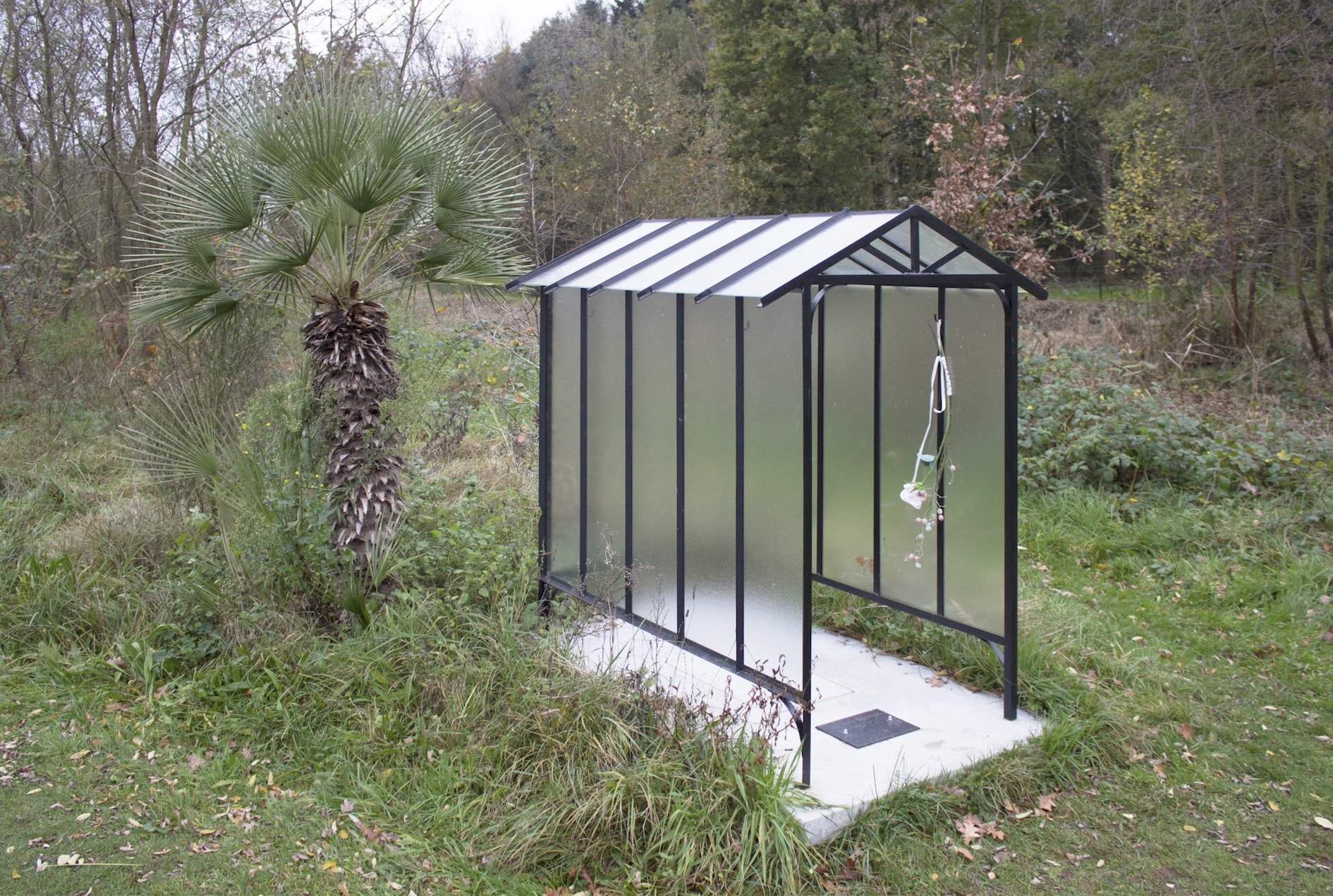
“It was very emotional to design and build my own grave monument. That project made me very sad, but it also calmed me down. Because I have become friends with the idea that I will die one day. And I think I have managed to secure an honorable place, already: in a museum near Antwerp that manages the art collection of collector Geert Verbeke. Amid the modern and contemporary art exhibited there, my grave is waiting for me: a concrete plaque topped by a small steel chapel with glass – a truly French grave. And there is a winter-hardy palm, to symbolize the exotic places I am so in love with. For now, the epitaph only consists of my name and year of birth, the rest still needs to be filled in.”
You have two children aged eight and twelve. How do they look at the grave?
“They laid flowers next to it when it was first exhibited. I explained it to them, but they found it difficult.”
So you will later lie in state like a work of art in a museum?
“I have a contract that states that I will be buried in the open-air grounds of the museum, and so will my wife. Wouldn't it be good anyway to lay people where they belong, for example the grave of a great writer near a library? What I like: my work turns every visitor into a grieving passer-by, just as I adopt and shed identities myself. Young and old walk with their hands behind their backs through a field with all kinds of statues and installations, including the shortest highway in the world and a gigantic replica of the human digestive system from Atelier van Lieshout, and then they suddenly find themselves in front of a grave. My art and my life, and therefore also death, have merged in such a way that the boundary between them is blurring. Perhaps a nice addition to the epitaph would be: 'Here rests the remains of my work.'”


