
Power
Masters of Sport: Ronald Koeman
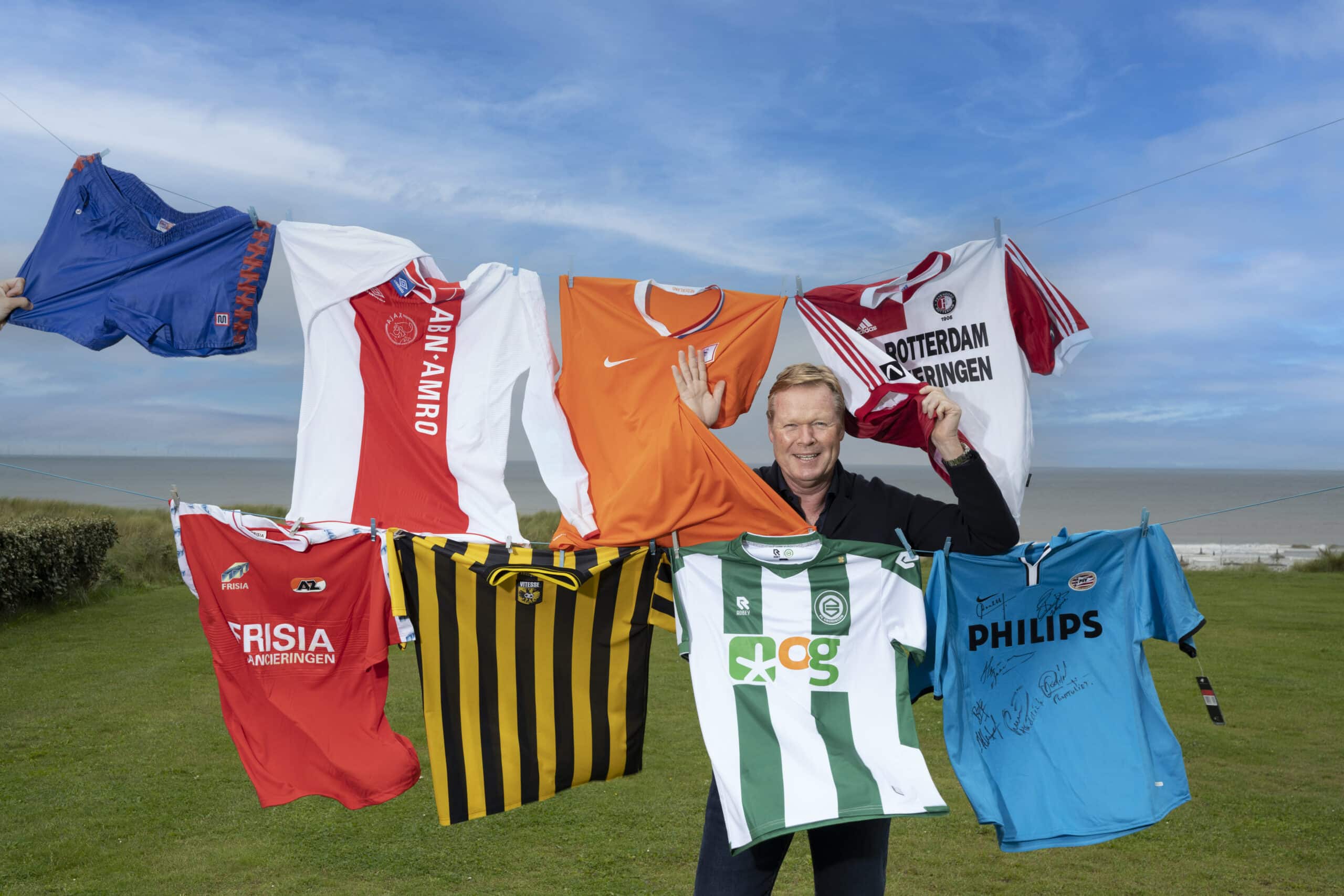
He started as a player, then felt more like a coach than a trainer and is now also developing as a manager. As of January 1, Ronald Koeman will resume his role as national coach of the Dutch national team, which he guided to the final round of the European Championship in 2020. On the eve of the World Cup in Qatar, he is waiting to see what legacy his predecessor Louis van Gaal will leave behind. In conversation with Jaap de Groot, Ronald Koeman not only discusses this in detail, but also discusses his own development and that of top football.
We'll start at the beginning. As a player, were you more of a trainer or more of a coach?
“More coach. Actually from an early age. I always thought about tactical moves in the field. As I got older it only became more intense. I have always had a clear idea of how football should be played and it was clear as day that I would continue as a coach after my career. At FC Groningen I started slowly. I was the youngest in the dressing room, yet I thought it was the most normal thing in the world for me to take penalties. I didn't think that was rude, because I knew I could do that well and that's why I wanted to take them right away. After that, in the beginning at Ajax I was a bit of a farmer from Groningen, but because I played in the 4 position, I experienced significant growth in Amsterdam as a player and as a person.
I remember well the first confrontations with Johan Cruijff, who had just started as a coach. On the one hand it was very refreshing for me, on the other hand there was also struggle. Especially about the way I had to choose the defense position. Then he thought I was too early again, then I was late again. Not always fun, I didn't always agree with it, but it did trigger me. Ultimately, that eye for detail shaped me. When I went to PSV, under Hans Kraay and later Guus Hiddink, I was more concerned with the team than just my own game. With Hiddink this continued and eventually I also came up with ideas together with Sören Lerby, Wim Kieft, Hans van Breukelen and Erik Gerets. Later the same happened to Rinus Michels with the Dutch national team. So I became more and more an extension of the trainer and that has only grown.
Your own football life obviously has a lot of influence on this. I played in a position where you had a lot of overview of the team and the field. A striker like Marco van Basten was much less concerned with that. Attackers want to have the ball to score goals. As a defender you have to think more about the team's tactics, also because you don't want to get into trouble yourself. As a result, I quickly started thinking as a coach. So not as a trainer. That is something fundamentally different.”
How did you experience the KNVB coaching course after your playing career?
“Very well. I had Jan Rab and Bert van Lingen as teachers and once a week I went to Foppe de Haan, who was a coach at Heerenveen at that time. Although I had been a good footballer who had played at a high level abroad, I had gained a lot of experience in coaching, but less as a trainer. In that respect, I went into deep detail during the course. The training mainly gives you insight into things you need to learn. Things you don't control. Then it is not a matter of whether you know football, but how you translate that knowledge into training. That's why I found the training science part so interesting. How do you train physically, preferably with a ball?
Someone like Foppe de Haan was very good at that. I also found that interesting, because I hadn't learned that as a player. Or rather: I hadn't looked into it as a player. When I had passed the accelerated professional course, I was included by Guus Hiddink in his staff for the World Cup in 1998 with Frank Rijkaard, who had also obtained his diploma. We became his assistants together with Johan Neeskens. Hiddink thus killed two birds with one stone. As novice coaches, we immediately gained unique experiences and he had people with a great understanding of football, whom he could trust and who also contributed their ideas. That is why I look back on this period with great pleasure. Not only was it quite intense, but also a lot of fun. A beautiful and interesting start to a new chapter in top football.”
But did the trainer course make you a coach or a trainer?
“More like a coach. Because I have stayed close to myself. I also think that is an essential condition. Stay true to yourself and hold on to your own ideas. Of course you have to look around you carefully to pick up things, but the vision that you have developed over decades as a player in top football is and remains leading. That is why I am not in favor of making former players of a certain status spend years working at the highest level. For them in particular, it is all about the common denominator and not everything needs to be taught during the course. Like what happened with Frank Rijkaard and me and worked well afterwards.”
How has your development gone after the training in Zeist and the internship under national coach Guus Hiddink?
“After the World Cup I was included in Louis van Gaal's staff at Barcelona. At least, in my first season I was placed as an assistant at Barcelona B, which played in the Second Division. With talents like Xavi, Gabri and Puyol, who were all seventeen and eighteen years old. That first season was actually a bit of everything. Completely with the second team and occasionally I was involved with the first. Then Van Gaal showed me first team matches and wanted to know what I thought.
I also sometimes received a call from his assistant Frans Hoek during matches, while I was watching the TV at home. Did they want to know what I thought about it or what I would change? When I later joined the first team, we regularly went through the training sessions and Van Gaal involved me in the debriefing with the group. He also always gauged the opinions of his other assistants, such as José Mourinho and Gerard van der Lem. Van Gaal always used his assistants very functionally. Only I only worked at the first one for a few months. In December I signed a contract with Vitesse, which was then managed by Karel Aalbers. The new stadium had just opened and enormous ambitions were expressed. All very interesting. Moreover, I noticed that the then Barcelona president Josep Lluís Núnez increasingly saw me as Louis van Gaal's successor. You can explain something like this both positively and negatively. In any case, I didn't really have a good feeling about it and thought it would be better to seek refuge elsewhere first.”
After a long career as a coach, you have now become more of a manager.
“I have been working for years at top organizations, where there are specialists for everything. Like someone who lives from training, while I am someone who lives from competitions. With the Dutch national team I have increasingly grown from coach to manager. This means that you recognize the specific qualities that are necessary for a good organization, not only in the players, but also in your guidance. With specialists who know some things better than I do. That view has only been strengthened after I started having problems with my health. Fortunately, my heart is now functioning fine again, but I have learned to make choices. By no longer focusing directly on how a player receives a ball, but on how I can best get the best players to function together. That is the essence now.”
That is obvious. But now that you are going to work for the KNVB again, to what extent are you also a sounding board for the association for, for example, the implementation of the trainer's course? Ultimately, retiree Louis van Gaal had to be called upon, because other Dutch coaches were not considered good enough.
“First of all, the national team is something for an older coach. For someone with more experience. I did not start this profession with the idea of becoming a national coach. That came later. Everyone thinks it is the best job you could get, but at the right time and not at the start of your coaching career. Marco van Basten and Frank Rijkaard are the exceptions, who also did well. But then again, they are the exceptions.
There are so many things that come your way in this position that you do not experience during the course. As a national coach, I have therefore become even more of a manager. There must be unity and everyone must feel involved. Not just the players. After January 1, I will again manage 55 people and 35 players. Before the selection arrives, I always convene a meeting with my staff of thirty people. From the cook to the equipment man. To make it clear to them that they too influence performance. Furthermore, in addition to all the trainers and physios, I also have someone who looks very specifically at the process between trainer and team with the eyes of a trainer. I especially want to say that in top football it is not just a matter of technique and tactics for a coach. In any case, it extends further than being a trainer, while as a coach you are ultimately also forced, in addition to the match, to make the right choices as a manager for the process outside the dressing room.”
MASTERS MAGAZINE
Want to read more of this interview and find out what Ronald expects from the World Cup? In the autumn edition of MASTERS an interview with LVMH boss Bernard Arnault (“being the richest man in the world meant nothing to me”), a driving impression of the electric Audi RS e-tron GT, a report with the 'tree matchmakers' of The Green Contractors , an interview with star chef Dick Middelweerd and a visit to Barcelona with Ronald Koeman. The war, the climate crisis, the energy problem... Leadership and entrepreneurship are being called upon more than ever. With MASTERS EXPO | The Colorful Edition (8 to 12 December, RAI Amsterdam) we want to contribute in our own way and give the world a push in the right direction. In this edition of MASTERS a colorful preview of the most exclusive business fair. Time to think ahead, innovate, connect!


