Taste
Mario Ridder, Azurite: The hunt for the stars is open
With Azurite, Mario Ridder is deliberately pursuing the top. In Huis van Delft, he is building his most personal restaurant.
With Azurite, Mario Ridder is purposefully aiming for the top. At Huis van Delft, he is building his most personal restaurant ever: small, uncompromising, and entirely at the service of the kitchen. No nostalgia, but a hunger for perfection, consistency, and recognition. Azurite is his return to the highest level, with one clear ambition: two Michelin stars.
Formative years
How did you first come into contact with the kitchen?
“I wanted to become a car mechanic. Together with my mother, I went to the open days at the vocational school. In the large hall we entered, the world literally split in two. On the left, the machines of the automotive department roared: metal, noise, blue dust coats, dirty hands. On the right was the consumer department: bread, scale models, cooking, serving. It smelled good, everything was clean, and there was an almost serene calm. I looked at my mother and said: 'I’m not turning left, I’m turning right, to the kitchen.' That’s how it started.”
Which flavors from your childhood or home kitchen have stayed with you the most?
“As a little boy, I was already cooking regularly, often for my grandparents. It started with mashed onions: onion in the masher, mashing away vigorously, and adding some soda so it would foam. My grandparents tasted it out of love for me, but it was inedible, haha. The flavors from the past that have stuck with me the most come mainly from my grandmother. She cooked very classically: hachée, for example, on one of those old kerosene stoves. It would simmer for days. I can still remember those deep, intense flavors of onion and meat in minute detail. Cooking at home was also encouraged by my parents. They always said: 'Mario, come join us.'” My father had his own business and was very clear: his children could do as they pleased – he would always support us. Eventually, my brother and I both became entrepreneurs, each in a completely different discipline. My brother is a lawyer, I am a hospitality entrepreneur. The only common denominator is that we are both masters: he in law, me in the kitchen.
When did you realize: this is becoming more than a profession, this is becoming my life?
During culinary school, I worked at the former Château Marquette in Heemskerk with two exceptionally passionate chefs who had earned their stripes in Michelin-starred restaurants in the south of the country. They showed me what cooking at a higher level truly means. They also gave me confidence: 'Mario, you are doing well here. You absolutely have the potential to advance into the high-end segment.' That was in 1988. At the time, I sent letters to just about all the top restaurants in the Netherlands. One of them was De Kersentuin in Amsterdam. I was hired there as a fourth-year apprentice – my first Michelin-starred restaurant. That was my first real taste of fine dining. That was once again a significant step up from where I came from. At De Kersentuin, I worked with John Sistermans, a striking personality in the hospitality industry: a very idiosyncratic cuisine and a very distinctive way of communicating – I quite like that. He taught me a lot, including about top-quality products. Next, I went to Lucas Rive’s De Bokkedoorns. At the time, that was the highest level in the Netherlands: two stars and number one in the Yummy-list. I completed my fifth year there with incredible pleasure. The reason I didn't stay there after my training is because I had to do my military service. I was selected as the General's private chef, a fantastic job. I even completed the Corporal Major training twice. Life in the field, the bivouacs, the camaraderie – I loved it. After my service, I went back to Jon Sistermans, who had just started the Marënhof in Amersfoort. I worked there for three or four years. Then I made the switch to Parkheuvel in Rotterdam.”
The road to the top
At Parkheuvel (1997–2006), under the leadership of Cees Helder, you experienced the historic period of three Michelin stars. What was that like?
“When I started there, Parkheuvel had two stars. In 2001, the third was awarded. It was the first restaurant in the Netherlands with three stars. Suddenly, we were fully booked for both lunch and dinner. There was a strict reservation system where you could book exactly two months in advance. If the line opened at ten o'clock in the morning, the restaurant was fully booked five minutes later. As a brigade, we learned to deal with that constant busyness step by step. Cees is a chef with an exceptionally good palate. Perhaps not the most exuberantly creative, but without a doubt one of the most consistent I know. He ensured that the right people were always in the kitchen – people who could stimulate and challenge him. We had a clear agreement: the menu returned every year, but the dishes that remained were improved. And two new dishes were always added. That is how you create continuous evolution, natural growth, without stagnating. Our philosophy was simple: we did it better or we didn't do it at all. No matter how busy it was, as head chef, I made sure that we could handle it. I never felt like I had to walk on eggshells – I had it under control. Looking back, that was perhaps one of the most beautiful periods in my life in the hospitality industry: complete focus on the product, on perfection.”
Cees Helder was a defining mentor. What is the most important lesson you took away from him?
“He was more than my mentor; he was my culinary father. His most important lesson: you have to make money. Period! Concepts that depend on investors always eventually get stuck. No one does anything indefinitely. A company *must* be self-supporting. If you don't make money, you simply cannot survive. Entrepreneurship starts with a return on investment. That was also exactly my starting point when I went to De Zwethheul, owned by Cees Wildschut. It has always been clear to me: money must be earned first. If that doesn't happen, you can't build a business.”
You cooked De Zwethheul (2006-2015) to two Michelin stars within seven months. What made that unprecedented momentum possible?
That had everything to do with a well-thought-out plan. What do you want? Where do you want to go? Next, you analyze what is already in place and immediately overlay your own philosophy onto it. That means: a different way of serving amuse-bouches, a different approach to appetizers, a different presentation of the menu. And always based on one principle: quality, quality, and more quality. In addition, I applied the same philosophy as at Parkheuvel: getting better every year. I consciously committed myself to about eighty percent of my capacity there, to leave room for the next step. Because if you always give everything, you get stuck at one level. You want to see that curve go up. Today, we still work according to exactly that same principle.”
You bought De Zwethheul from Cees Wildschut in 2009, only to close it six years later. How do you look back on it – pride or unfinished business?
"Unfinished business“I was in the running for three stars, together with Jacob Jan Boerma from De Leest. We were subjected to intensive inspections. Sometimes the chief inspector would come to my place for lunch and sit at Jacob Jan’s table that same evening. We knew we were both on the radar. During one such inspection, I served a turbot dish. Perfectly filleted, I thought. But there was still a tiny bone in it, cut through by the filleting knife. Afterwards, the inspectors demonstratively left it lying on the edge of the empty plate. That same year, Jacob Jan received his third star. I’m not saying that bone was the cause, but I don’t rule it out.”
What did you think when you saw that sign again?
"Just: Fuck! Nothing more, nothing less. You are so focused on what you want to achieve, and then you know immediately: it’s not going to happen this year. And probably not in the coming years either, because three stars aren't handed out just like that – it’s a long process.”
You didn't get that time…
“I wanted to take over Cees’s real estate. Rabobank agreed to a loan of 1,4 million. But Cees wanted 1,5 million. He judged me based on the figures from the previous two years – they went through the roof. He wanted me to pay for my own success, while I had let him earn a lot of money for years. That difference of a hundred thousand became a matter of principle. So I said: then it stops here. Out of emotion. If I hadn’t done it, we probably would have stayed in the race for that third star. But then again, that’s just me: as an entrepreneur, I act fast. Did it cause a rift between Cees and me? 100 percent!”
Didn't that keep you awake at night?
“No. Where something stops, something new begins. I believe you should always look ahead. In the meantime, I had already started CEO Baas van het Vlees in Rotterdam. And I started a partnership with Hilton Rotterdam, where I launched a slightly more accessible business: Joelia (2015-2024). Within nine months, we received a star. That was also the maximum we could achieve right away. It is impossible for a restaurant with seventy seats to earn more stars. And above all, I wanted a business that could generate revenue. And we did just that. Joelia was open seven days a week. In the first three years, we were only closed on New Year's Eve; otherwise, we operated non-stop.”
When did the culinary itch start to bite again?
“At one point, guests started asking if they could taste the cuisine of De Zwethheul again. That’s when I thought: maybe this is the moment to close for two days and raise the bar a bit. People liked it, and we received great feedback.”
Still, you stopped there after ten years.
“I believe that a hospitality business needs to be innovative. If you’ve been in a place for ten years, you have to show your guests something new. And I don’t mean new curtains or a different chair, but real, substantive innovation. If we wanted to renovate Joelia properly, it would cost serious money. And then I thought: wouldn’t it be better to start something new? I weighed the pros and cons incredibly carefully. But ultimately, I chose to sell Joelia, with the idea of starting something new again.”
Enter Azurite. What was your approach?
Give it my all one more time and fight my way back to the level at which I stopped at De Zwethheul: two Michelin stars and belonging to the top ten in the Netherlands.
Entrepreneurship
You are currently running three major businesses simultaneously: CEO Baas van het Vlees, Brasserie Lalou, and Azurite. How do you keep track of everything?
By binding the right people to me, people who can operate independently. Like my partner Remco Beugelman, CEO Head Chef Marc Muzerie, and my daughter, who runs Lalou. Putting good people in the right place and continuing to nurture them with attention and commitment, so that they can translate that back into the company – that is my leadership style.
As an entrepreneur, you have learned what risk means. Have you become more cautious or bolder over the years?
More cautious. Entrepreneurship isn't actually as fun as it used to be. It used to be more exciting; you were less afraid of risks. Now you think things through more, you recognize patterns in entrepreneurship. I once signed a document – I was living in a beautiful house with my wife and two small children at the time – stating that if things went wrong with the Zwethheul, I would personally stand surety. My house was collateral: if it didn't work out, I had to sell it. Period. If you have signed something like that, then to me you are an entrepreneur and you can talk to me.
Did you perhaps do that back then out of a certain naivety as well?
Certainly. I was fully committed to making my company successful. Of course, that was a risk. But I was 35, full of energy. You can still make everything right. You just go for it. Now I’m 53, twenty years have passed. If I invest now, I do so with my own capital. That feels safer, but it makes the consequences greater. If I make a mistake, the money is gone. And I don’t have another twenty years to set it right. So that makes me more cautious. And also less explosive. In the past, I would see something, think: there’s money in that — bam“We’re going. That was perhaps reckless, but also incredibly fun.”
What are the hardest lessons you have learned in entrepreneurship?
“There are two, but this one is by far the most important. When I took over De Zwethheul in January 2009, a letter from the Tax Authorities landed on my doormat less than a month later: a retroactive assessment for payroll taxes covering December 2008. Formally, I was not involved in that year, but when you take over the BV, you are responsible for it nonetheless. My predecessor paid himself a salary once a year, in December, with a substantial management fee. Those payroll taxes, covering his entire management team as well, ended up with me all at once. What was perhaps the most painful part was that I had advisors around me, at great expense, and no one said: ‘Watch out, this can happen.’”
What did that mean to you at that moment?
“I had invested everything I had, absolutely everything, down to the last cent, in the renovation. I had no buffer. And suddenly, there was a bill for 83.000 euros. I was fully tied up in financing, with 6 percent interest, and fixed monthly expenses. I thought: this is going to be a very short-lived business of my own. And I have to move out of my house. Fortunately, I was able to reach an arrangement with the tax authorities. After that, we worked incredibly hard, doing everything we could to set things right. We succeeded.”
And the second lesson?
“That one is perhaps even tougher: as an entrepreneur, you have to think of yourself. Because everyone does. It doesn't matter how good you are to people; ultimately, they think of themselves. Without exception. Whether you give your staff a bottle of wine at Christmas or take them and their partners away for a weekend in Madrid, a month later they quit just as easily. Without a conversation. Without empathy for what an employer has done for them. Zero.”
How did that happen?
“In the hospitality industry, you have hard workers, but they aren't always the smartest people – I count myself among them, by the way. As a result, decisions are made without consultation. Someone doesn't say: 'I'm not comfortable, there's some friction, can we talk?' No. They speak to a colleague over drinks in the evening, hear they can earn a hundred euros more elsewhere, and the next day they're gone. Even though I could have paid that hundred euros myself.”
Do you see a generational difference in that as well?
Certainly. I come from a generation of 'get things done'. Where you work, that's where you live, that's where you earn your money, that's where you build something. Nowadays, everything revolves around work-life balance“Working four days, going on vacation twice a year, the latest iPhone, dining at two-star restaurants, drinking expensive wines – but working as little as possible. That clashes. Because that balance is missing. Wanting luxury without the willingness to balance it with work. The idea that 'where my work is, that is where I build my life' has largely disappeared. And that is a harsh realization.”
New start
You say: 'I want to give it my all one last time.' When did you feel that you wanted to return to a more personal and intensive concept?
“After the sale of Joelia, I did nothing for a year and a half. That period was crucial. During that time, I regained the absolute drive to work at the very highest level again. I went out to eat abroad a lot. And then I realized how incredibly regrettable it was that we didn't continue with De Zwethheul. That feeling kept gnawing at me. We said then: if we do it one more time, we’re really going to pull out all the stops. A small number of covers (the restaurant seats 24 guests and features a private dining room for 16 people, ed.), an extremely high standard, and a business entirely dedicated to the kitchen. Azurite is the result of that renewed hunger. Here, we are pursuing what we didn't finish with De Zwethheul.”
Do you compare yourself to other three-star restaurants?
Yes, and do you know what strikes me? When you eat at classic three-star restaurants in France like Maison Lameloise, you are no longer surprised by the quality. You eat well, absolutely, but it is nothing more than that. It runs on routine. If you then go to Scandinavia and eat at Frantzén or Geranium, you suddenly taste again what three stars can truly be. You get a wake-up call. The intensity, the precision, the emotion. You come back jubilant. Excited. Full of energy. And at the same time, you think: how on earth is it possible that you reach this level? How do they do it? Some of those establishments actually rise above three stars. Call it four stars. Once you have experienced this level, you can also take an honest look at yourself.
Entrepreneurship isn't as fun as it used to be. Back then it was more exciting, you were less afraid of risks. If I invest now, I do so with my own capital.
How would you rate your own kitchen, then?
“I am f*cking critical of my own kitchen. And yet, I dare say that with Azurite, in the short time we have been open, we can effortlessly compete with the top one-star restaurants. And also with the lesser two-star establishments. That being said, I say that my kitchen is worth two stars.”
What is still needed to officially reach that level?
Continuity. It is about ensuring that everything we do happens every single day. That the sauce is right. That the product is exactly what we source. That the cooking is perfect. That the service is spot on. Not just once, but always. You have to demonstrate that consistency.
You call Azurite your most personal project ever. In what way is this restaurant more 'Mario' than all your previous ventures?
That starts with presence. In previous businesses, I spent a lot of time in the kitchen, but not alwaysAt Joelia, we were open seven days a week, and I worked there five or six, and sometimes even four days. Here, I have made a firm agreement with myself. It is the same principle that Jannis Brevet always followed: 'If the place is open, I'm there. If I can't be there, the place stays closed.' No service runs without me.”
Why is that so important to you?
Because the time is past when a chef says: the guest should be glad he is coming in, and if I happen to be there, he is lucky. If we charge substantial amounts for menus and wines, then the guest should be able to assume that the key person is present.”
Why did you choose Delft and not Rotterdam, where you have such a long history?
“We are located here in a very distinctive building: the Huis van Delft. A legacy of a Delft resident I know well, who really wants to make a difference for the city. That makes this place special. Everything that happens here breathes history and purpose. And moreover: as an entrepreneur, I also see that the top tier of hospitality in Rotterdam isn't full every night. If you line up all the Michelin-starred restaurants and want to eat somewhere tonight, there is almost always a spot available. Perhaps the city is a bit too busy for so many top establishments. That makes you think. And then this building came along. I was a hospitality consultant for the ground floor of the Huis van Delft. In the meantime, I have moved to this street. I literally walk back and forth between my house and Azurite. Every day, I open here for the cleaner. I don't always leave last, but I am here every evening right through to dessert.”
The interior is minimalist. Why that choice?
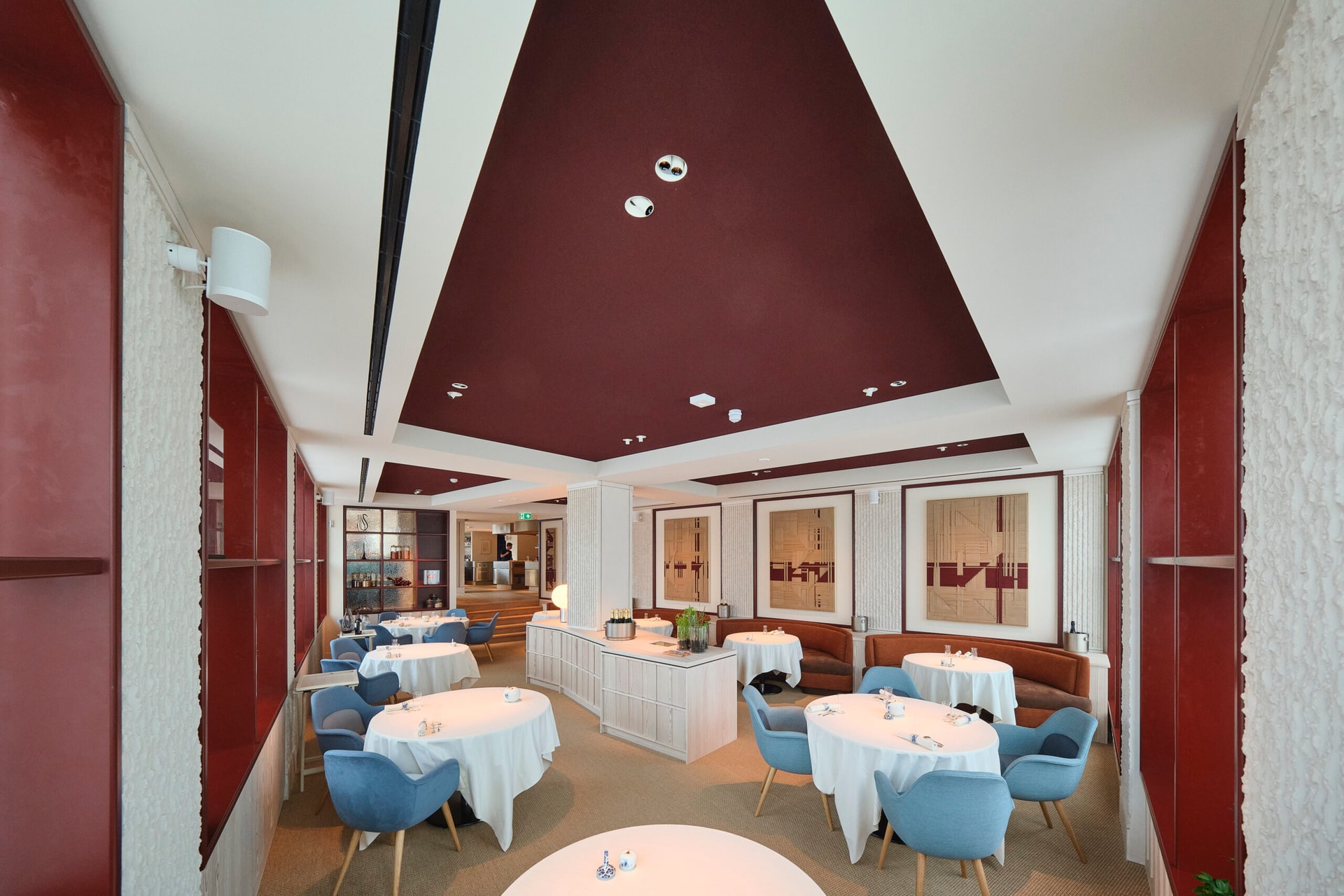
“My previous establishments had pronounced, almost 'in-your-face' interiors. Here, I wanted the opposite: complete restraint, everything subordinate to the plate. The plate must set the music here, determine the atmosphere. The interior must never compete with what happens on the table. That translated into a minimalist design, using stainless steel, concrete, and wood, making it look calm yet remain warm and layered.”
A visit to Hamburg unexpectedly determined the choices I made here. Tell me about it.
“My wife and I had to rush to Hamburg because my father-in-law had suffered a brain hemorrhage there. Just when those days were approaching, we were in the midst of the decisive phase for this restaurant: crockery, glassware, cutlery – everything was still up for grabs. That evening, we dined at a two-star restaurant in Hamburg. I had a very clear plan beforehand. I wanted to work with Hering Berlin crockery and had a detailed idea of what the table setting should look like. But when I sat there, I looked at the table… and literally saw my own plan. The glassware, the plates, the cutlery, the table arrangement, the candle: everything was exactly as I had envisioned it. I thought: if they have this, then soon three other restaurants will have it too. I don’t want that. So I called everything off. When we were back in Delft, I drove to De Koninklijke Porceleyne Fles and said: ‘I want to work with you. What can we do for each other?’”
That became Delft Blue.
Hand-painted Delft Blue is outrageously expensive. So we created a combination: a number of pieces made especially for us, a number of items from their existing collection, and a number of components that we adapted together. And that is now reflected on our tables. Everything. Even the napkin rings were custom-made, with the A of Azurite in them. Ultimately, that makes the table just as personal as the kitchen.
Every detail has been considered.
“And every detail contributes to the story we want to tell. For us, that starts with the amuse-bouches. They are an ode to Dutch heritage. Dutch ingredients, prepared our way, served on Delft Blue. We start fresh and spicy and end salty. Everything is just a tad too much, so that it sharpens your focus. This is followed by a plate of herring topped with a Delft Blue sturgeon. Every dish takes you into our story. And that whole story rings true. It is rock solid…”
…the House of Delft!
“In an ideal world, the Azurite experience begins on the other side of the building. There stands an artwork by Studio Job that tells the story of Delft’s past, present, and future. We could serve the first dish drawing from that past. And the future? We are working on something involving Calvé peanut butter, developed here in Delft in 1948. How wonderful would it be to reinterpret such an icon in a gastronomic way? After that, you proceed to the Innovation Gallery in the building (where parties such as the Municipality of Delft, TU Delft, Royal Delft, TNO, and the Reinier de Graaf Hospital present themselves, ed.), where you enjoy an innovative bite prepared using a new technique. Only then do you come here, to the bar, where the story unfolds further. If we manage to pull this off, together with the building owner, the restaurant visit will become truly unique. But for now, that is still a long way off.”
Back to the present. Dishes like the 'Likkepot 2.0' give classic flavors a fresh look. Does that fit the philosophy of 'always getting better'?
“Everything we do here is simply of a higher standard than before. In fact, I think this is the highest level I have ever cooked at. That starts with the products. Where I once worked with Canadian lobster, here we work exclusively with European lobster. It is more beautiful, more refined – and considerably more expensive. It is not just about the sourcing, but also about the handling. Take roe deer. At Parkheuvel, we bought ten at a time, filleted them, vacuum-sealed everything, and worked with them for days. Vacuum-sealing always means that moisture, blood, or meat juices are released. Now we wrap the roe deer saddles in fiber cloths so that the meat remains completely dry and can cook perfectly. These kinds of seemingly small adjustments make a huge difference on the plate. The same applies to sauces. At De Zwethheul, we sometimes used the same champagne sauce for a whole week. Here, we make it fresh every day. Period. Improvement never stops. The moment you think something has reached its limit in terms of improvement, you stand still. Then you start cooking on autopilot, and that is always a level lower. You have to constantly Looking to the next step. Constantly reviewing where improvements can be made. That is how you keep growing.
Great passion, large collection
Where did your passion for wine begin and how has it developed?
“That passion originated during my studies. For a project, we had to delve into a wine region in Bordeaux. I chose Saint-Émilion and became fascinated by the entire classification system, the hierarchy, and the stories behind the winemakers. I wrote an extensive paper and received a 9,5 for it. That was the moment the seed was definitively planted. From then on, I started collecting wine. When I was fourteen or fifteen, I worked as a dishwasher in the hospitality industry. All the money I earned went straight to wine. I wasn't drinking it yet—which, of course, wasn't allowed—so everything just sat there. By the time I turned eighteen, I had built up a collection of well over a hundred or a hundred and fifty bottles. My mother regularly had to accompany me to the wholesaler in Amsterdam. I could wander endlessly through the wine cellar there: should I take that eighty-guilder bottle or the eighty-five-guilder one? It was enough to drive my mother crazy, haha.”
That passion has now grown into a collection of some twelve thousand bottles.
“When I sold my businesses, I never sold the wine collection along with them. Wine was not inventory, but identity. Even back in school, when Hubert H. Duijker’s books on the great wines of Bordeaux and Burgundy were published, I knew for sure: if I ever had my own restaurant, I wanted all the Grands Crus from those books on my wine list. By now, I own them all and they can actually be served.”
What does a wine list say about a restaurant?
Everything. As a guest, you can see how much passion goes into a business and how much effort is put into acquiring those wines in the first place. And anyone who puts so much effort into wine does the same for the food, the interior, and the overall picture.
To what extent does a specific wine inspire you when creating or refining a dish?
No. And perhaps this is a dangerous statement, but every now and then I am a bit fed up with young sommeliers who talk endlessly about *the* perfect food and wine pairing. Add this, add that, and together it becomes magical. I think: I have eaten and drunk *so* much in my life, just let me choose a dish I’m in the mood for, and pair it with a wine I want to drink at that moment. Having to drink a wine I don’t actually like, just because it supposedly pairs so well… sometimes I get really tired of that. So with red meat, I happily drink a great white Burgundy.
You call yourself a 'Bourgogne man'. Is there one bottle that sums up a feeling or memory for you?
“Yes, that is Domaine d'Auvenay by Lalou Bize-Leroy, 'the Grande Dame of Burgundy'. Both my dog and my brasserie are named after her. When you taste her wines, you immediately recognize the DNA. Whether it is a Bourgogne Aligoté or a Chevalier-Montrachet. I have had the privilege of drinking a few of those wines on very special occasions. One of them remains crystal clear in my memory. With my partner, at the bar, in my own restaurant. It was shortly after we had bought De Zwethheul. We had brought a bottle of Criots-Bâtard-Montrachet from Domaine d'Auvenay and opened it there. A wine that is worth fifteen to twenty thousand euros today. We were sitting there, just the two of us, eating a few meat starters, and drinking that wine. That Criots-Bâtard, at the bar, with my partner, that is a memory that remains. The kind of bottle you don't just taste, but remember.”
You also have a whisky bar upstairs. Do guests like to hang out?
That doesn't happen very often yet. But the whisky bar certainly contributes to the overall experience. We take all guests on a tour of the company, and that is how they end up in the whisky bar. No one leaves that room without having tasted whisky. Not as a shot, but as a dish: infused apples, a hint of whisky, Dutch shrimp, and a sauce featuring that whisky. And then you see it happen: people smile.
You turn a dinner into an incredible experience.
You don't come in here to sit at the same table for three hours. You start at the bar, go upstairs, move through the building… You are taken into another world. And that world *is* Azurite.
Grand finale
You say that Azurite feels like a finale, but also like a new beginning. What do you hope this restaurant leaves behind for Dutch gastronomy?
I hope it gets the appreciation it deserves. That people say: it was incredibly good. That they feel they have had the ultimate dining experience. Jesus, it's been a long time since I've eaten so well, since I've had such a fun evening. That is what I hope for. I will never say that people have eaten the best meal of their lives here. I find that too grand, too absolute. People travel the world, eat in the best restaurants. I don’t want to compare myself to three-star establishments that I look up to so much. But what I do dare to say is: you eat really well here. In fact, I am certain of it. And if people can place what we do here, if it finds a meaningful place for them, then my mission is accomplished.”