
Power
Living Between Champions League and Carnival
FotografieKároly Effenberger
TekstBart-Jan Brouwer
FotografieKároly Effenberger
TekstBart-Jan Brouwer
He became champion with PSV and lived for years in the adrenaline rush of professional football. But Björn van der Doelen (Goirle, 1976) chose a different pace early on. Today he is a musician, podcast maker, family man and above all someone who rejects grandstanding for its own sake. In a candid conversation about dressing room humour, carnival, music and the relativity of success, Van der Doelen shows that rock-'n-roll sometimes sits surprisingly close to a terry cloth pyjama and a kitchen table full of family.
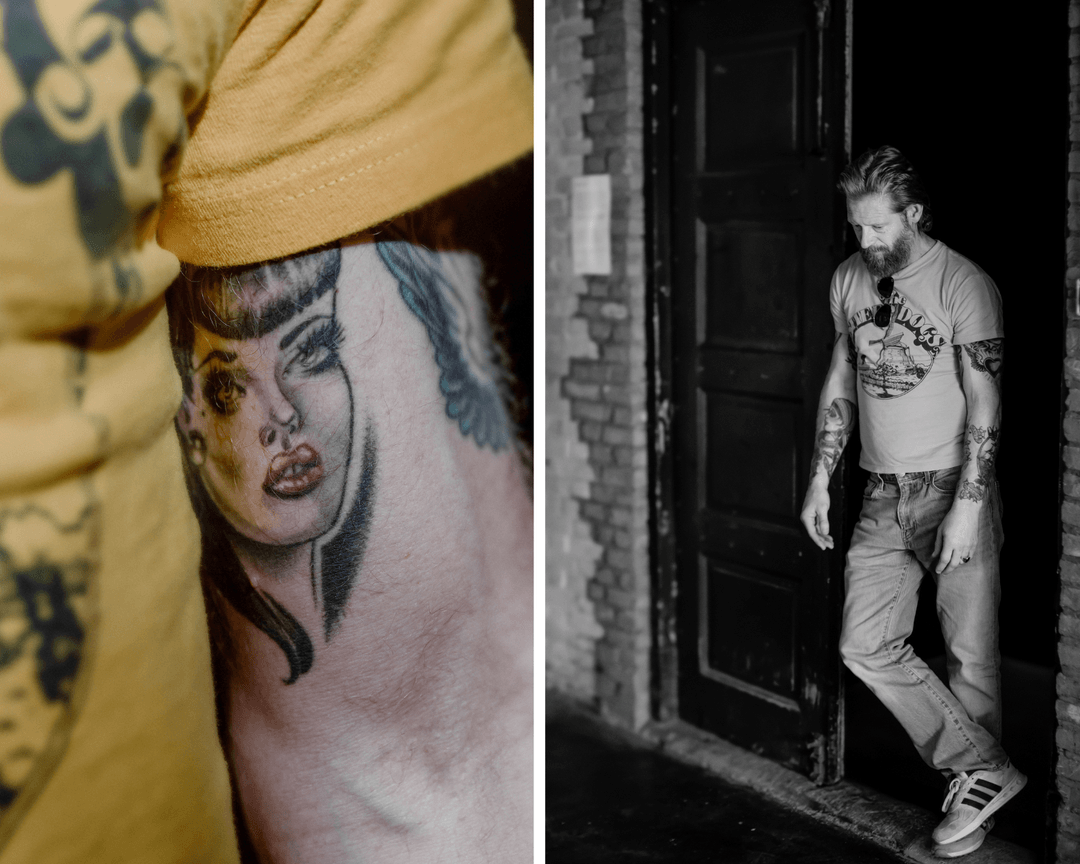
We meet the former PSV player, podcast maker, singer-songwriter and current frontman and guitarist of Björn van der Doelen en de Huursoldaten in the leafy courtyard of Hotel, Restaurant and House of Design Kazerne, housed in a restored monumental warehouse in the vibrant Bergen neighbourhood in central Eindhoven. It is the hot spot where the worlds of wine, dine and design come together. And today, MASTERS and Björn as well. At a long wooden table, over a cup of green tea and a glass of sparkling water, we go back to the time when Björn had no beard and tattoos yet.
FROM PSV TO N.E.C.
You were brought into PSV as a boy. Was that a dream come true?
"Yes, I wanted to become a professional footballer from childhood. Back then I was still with Ajax. The club organised an open day every year at De Meer, where boys from all over the country played matches while scouts stood on the sideline. I was picked out by Tonny Bruins Slot. Only: Amsterdam was too far for us. Our dad ran a flower shop in Den Bosch and couldn't drive back and forth every day. So he called the youth department of PSV himself: 'My son can play football quite well, can he come and train once?' He could. 'Let him come on Thursday.' That's how it worked back then. They saw enough at that training. I was allowed to stay and train every Thursday for the rest of the season and officially joined the following year. PSV was just starting to take youth development seriously in that period."
Who was your idol back then?
"My room used to be full of posters of Ajax and players like Marco van Basten and John van 't Schip, who later became my trainer. But ultimately I had more in common with boys like Sören Lerby and later Jan Wouters."
Did you have that same character: fighting spirit, giving it everything?
"I could play football well too, but that was true for everyone in PSV's youth. As we progressed, you naturally saw what set players apart. One stood out for technique, I more for winning the ball. Early on, the casual side fell away. At fourteen I was selected for the national youth team and PSV offered me my first contract. That didn't amount to much back then. But at nineteen I signed for five years, and that was a serious contract. We're talking about two million guilders for that entire period."
Who did you laugh hardest with in the dressing room or at training camp?
"In youth I spent a lot of time with Tommie van der Leegte. Our families even went on holiday together, so he was a real good friend. I was also close with Jürgen Dirkx and later with Wilfred Bouma. We had a fantastic group at one point anyway, with boys like Theo Lucius, Ruud van Nistelrooij, André Ooijer, John de Jong, Arnoud Bruggink and Ronald Waterreus. Later, at FC Twente and N.E.C., I had especially good laughs with Patrick Pothuizen. I really laughed a lot with him."
"I don't need a book about my football life at all"
Can you give an example of dressing room humour?
"Do you really want to know? At N.E.C. we got a box of painted eggs to take home at Easter. Patrick had hidden his box in my car. After a few days I didn't know what I was smelling – it stank terribly. Of course I got him back. After a team outing I stayed at his place once. The next morning he had to go into town and left me alone in his house. 'Just close the door behind you', he said. So I took a newspaper, did my business on it and slid it under his bed. Later that day he called: 'I smell shit.' He went crazy, but couldn't find where it came from. Only after a few hours did I tell him to look under his bed. Shit was anyway a recurring theme in the dressing room. We once emptied the first aid kit of club physiotherapist Cees van der Linden, put a turd in it and closed it neatly again."
You played in Eindhoven, Liège, Enschede and Nijmegen. What did each city teach you?
"A career like that shapes you. I grew up from my second year onwards in Hintham, near Den Bosch. When I joined PSV's youth academy, I immediately noticed that Eindhoven was a completely different city. Just in terms of language: a Den Bosch native speaks more roughly, with a rolling r, while Eindhoven has an almost Flemish accent. The architectural contrast is also striking: Den Bosch is an old fortified city with a historic heart, while Eindhoven was always much more functional and less distinctly beautiful. You could feel the difference in mentality too. Den Bosch is somewhat more chauvinistic, more inward-looking. Eindhoven was always more open because of Philips, with workers from other parts of the Netherlands and later from Italy, Spain, Morocco and Turkey. Now you see that again with the expats around ASML. At 21, I ended up in Liège. You drive past Maastricht and cross the border into a completely different world. Also a rough city, but with its own energy. You have to learn French, stand on your own feet faster. It's a real student city too, with fantastic food. There I learned to navigate a completely different dynamic."

Where do you thrive best?
"I manage pretty much anywhere, really. Except Amsterdam. It's too big, too busy, too much for me."
Didn't you want to play football in a few more cities: Barcelona, London, Rome?
"No. The abroad never really appealed to me. I always wanted to stay close to my mum and dad. I thought Belgium was far enough."
You stopped playing at 29. Why so early?
"I simply didn't feel like it anymore. Actually, that was already an issue earlier. When my contract at FC Twente ended, I wanted to stop then. I wasn't happy there. John van 't Schip was replaced by René Vandereycken, a new chairman came in, and I had a strong sense, also from what appeared in the press, that they wanted to get rid of the big earners. Guys like Jack de Gier, Tommie van der Leegte and me. That made everything unpleasant. Fortunately, N.E.C. picked me up. I had a fantastic time there. Until I ended up on the bench after two years. Then I called my mum and said: 'I'm quitting.' She was actually relieved. My father said: 'Why don't you go to Japan for another year, earn good money?' But I had no interest in that whatsoever."
Many ex-footballers miss the adrenaline, status or camaraderie after their career. What did you miss?
"I always loved the banter in the dressing room. And of course those big matches against Ajax, Feyenoord, Champions League nights. Recently, N.E.C. organized a match with former players for their 125th anniversary. That was really a flashback to twenty years ago: a beer afterwards, drive home, then out in the city. I look back on that with great pleasure. But it's also so long ago. Almost another life, almost another version of myself. I was 29 when I stopped and I'm 49 now. If you haven't changed in those twenty years, you've done something wrong."
What was the real highlight of your career?
"The championships, the top matches. Only: at the time you often don't realize how special it is. Only now, looking back, do I see that better. You grow into it, it's your life, and you're mainly focused on what isn't going well. Actually a shame. That's also what I'd want to pass on to young players: enjoy it. You're doing exactly what you love most."
Stacks of football biographies appear from players with less to tell than you. What title should your biography have?
"Stop. Someone asked about it once, but I would rather write it myself, the way I write songs. I don't want a book about my football life at all. It would be all about that period again, when that was just something I did once. I find it much more interesting to write about my girlfriend, the children, our dad and our mum. Those seemingly small things are what ultimately define who you are. Being a footballer was a profession I practiced for a time. A book about it would quickly become nothing more than a collection of anecdotes and some name-dropping to boost sales. That doesn't interest me at all."
BJÖRN EN ZIJN HUURSOLDATEN
At home in the Van der Doelen house, everything from Julio Iglesias to Ad de Laat played. When did you first notice that music meant more to you than just background noise?
"I was never really conscious of it. Only when I was at boarding school in Eindhoven and had terrible homesickness did music really start to mean something to me. It helped me through. I wanted to play drums, but our dad didn't think that was a good idea, since we lived in a terraced house. Our mum gave me money and said: 'Buy yourself a guitar then.' It had to be acoustic. But I came home with an electric amplifier too. Then our dad gave me headphones, because he didn't want to listen to that noise all day. At first I just tinkered around on my own, with a book and cassette tapes to play along with. That didn't really get me anywhere. After school I studied Economics for a year and Psychology for a year, but I never saw myself making a living from that, especially once I had signed my contract with PSV. Alongside football I started taking guitar lessons. I loved that: doing something completely different from football for a while."
What was the first record you bought?
"I got a Tracy Chapman album for my birthday. But I was completely obsessed with Queen, so Tracy Chapman didn't stand a chance. When Freddie Mercury died, I found it truly awful. The news came out on Sunday evening and the next morning I had to take the train back to Eindhoven, to boarding school. I remember the other boys thought it was mainly funny how upset I was."
After your football career, music became more serious. Your first single, Bende Mal, ended up in the Op De Camping Top 100 of 2006, alongside names like Jan Smit, John de Bever and Heino. Do you think then: I'm on the right track?
"Hahaha. I thought all sorts of things then. That song was actually meant as a joke. In Nijmegen I had met record label owner Rob Peters. He had heard a little CD I had recorded in a drunken state with some friends: a medley of existing carnival hits, but with the lyrics 'finger in your arse' throughout. So Mien, where is my party nose became: Mien, where is my finger? In your arse! Very crude, of course. But on that same CD was also Bende Mal, and Rob apparently saw something in that. We then went to record in the studio where André Hazes also came. Eventually that song did end up on that camping compilation. And to be honest: it got played quite often. At one point I even received a statement from Buma/Stemra for a thousand euros. I didn't know what was happening. I first thought I had to pay something. But I got that money because the song had been played so often. Well, you have to start somewhere. From there I started a band, which nowadays is called Björn van der Doelen en de Huursoldaten."
You look like a rocker, but you also write small, fragile and narrative. Is your music closer to the pub, the church or the changing room?
"The pub, I think. That's where everything ultimately comes together. The church too, and football just as much. After the match and after mass everyone ends up in the pub anyway."
Why do you sing in dialect? Was that an artistic choice or simply the only language in which you can't lie?
"I find dialect sounds more beautiful and softer than Dutch. Dutch can be quite harsh. And the great advantage of dialect is: it's your own language, there's nothing in between. You can't hide behind it and you can't fool anyone."
But that doesn't exactly open up the American market.
"No. But America is also terribly far away."
8WEEKLY called you 'a rising star in his almost self-created music genre'. How would you describe that genre yourself?
"That genre has existed for much longer, of course. The funny thing is: my musical limitations actually helped me with it. I play a decent guitar and can accompany myself well, but I'm no virtuoso. So I don't have endless resources to work with. The advantage is that you're forced to create something that's truly your own. When I started, I often thought: I want to sing like him. But I can't do that at all. So you have to find something that suits you. Something familiar, something of your own. My youngest son once said: if you could sing like Freddie Mercury, you'd probably have made completely different music."
Your new album was recorded in an Austrian mountain hut. That sounds romantic, but what did that place bring musically that a studio in Brabant couldn't?
"I've been going there my whole life. When I started this record, my girlfriend and I had been together for thirty years. I thought it would be nice to capture that time span in the music somehow. That mountain hut sits at fifteen hundred metres altitude. You have a beautiful view over nature and it naturally calms you down. I thought: if we can record that album there, that would be really great. Fortunately, the rest of the band saw it that way too. There are many warm, cosy songs on it, and that's also because it was simply very pleasant and relaxed to make music there."
Is it one schnapps after another there, or was it manageable?
"There was indeed quite a bit of drinking, yes. But mainly because the recordings went so well and so quickly, haha. We left the Netherlands on Friday, arrived on Saturday, but then had to wait for the bus with equipment. On Sunday we couldn't start until late because of technical problems. Still, we recorded four songs that day, and seven more on Monday."
Is Monday When We're Rich a title with hope, irony or both?
"Both, I think. My girlfriend buys a lottery ticket every winter for the New Year's draw. And every year we assume we're going to win those thirty million. It just hasn't happened yet. But we do fantasise about what we'd do with it. Two years ago that draw fell on a Monday. A couple of days before, we took a walk together through the Austrian landscape. It was beautiful: blue sky, thick snow, the sun slowly sinking behind the mountains. While we were walking there, she said a bit dreamily: 'Monday when we're rich, then we'll do this and that.' I thought that was lovely right away. You always have to keep something to dream about. I thought: this is a sentence that fits perfectly on the cover of the new album."
And what would you do if you were rich on Monday?
"First pay off the mortgage here. And then buy something in Austria. We're very good at going on holiday."
You release your records under your own label Val Allemaal Maar Kapot Ik Doe Het Zelf Wel Records. Is that bold bravado, or does it come from deep distrust of the music industry?
"It's mainly a joke. My first record came out with Continental, the second I released myself, the third through Bastaard Platen, the independent label of Mathijs Leeuwis and Jeroen Kant. When they stopped, I approached Excelsior, but I didn't even get a response. Then I thought: to hell with it, I'll do it myself. Look, an artist of stature can't do without management. Guus Meeuwis can hardly pick up the phone himself and at the same time organise a stadium concert. But in the relative quiet in which I work, I can organise it perfectly well myself. People who want to buy a record can just come pick it up here at home. The lines are short."
"At one point I received a bill from Buma/Stemra for a thousand euros. I had no idea what was happening"
You once said you enjoy tinkering with things. That sounds charming, but it might also protect you from overly ambitious goals.
"That too, yes. And to be honest, I find it mostly very pleasant. It leaves me more time, and I like being at home. As long as we can live the way we do now, I'm satisfied. More performances and a larger audience would be nice, of course, if only because then I could pay my band decently. Because right now there's barely anything left for that."
As a footballer you played for tens of thousands of people, now sometimes for 150. How is that?
"Sometimes there are even fewer. The first time I played my own songs, there were fewer than twenty people in front of me. And I was terrified. That's a completely different discipline from football. Football is ultimately a physical sport."
Do PSV fans not flock to your performances?
"Haha, that's certainly what Bert Pijpers from Continental Record Services was hoping for. But I warned him straight away: 'That's not going to happen. There's no football supporter who automatically comes to see a Björn van der Doelen performance.'"
If Messi were playing a couple of tangos here tomorrow, the place would be packed.
"Yes, but Messi is Messi. Even if he were to defecate on the table here, people would still buy a ticket for it."
You're sitting here nicely with a glass of water and a cup of green tea. How rock-'n-roll is your life really?
"Barely, I think. I still love a good night out, but I also believe strongly in discipline. I always take the stage sober and have never used drugs. But that's not the core of rock-'n-roll for me. Rock-'n-roll is much more about freedom for me, about being able to do what suits you, without worrying too much about what others think of it. And that goes perfectly well with a cup of green tea."
HEROES OF BRABANT
Carnival plays a big role in your work. What is the soul of carnival for you?
"Everyone experiences carnival in their own way, but for me it's mainly about being together with family. We all sleep at my sister's place with her boyfriend. She makes breakfast every morning, and that's where the fun really starts. Meanwhile the women are sewing emblems onto jackets. Put on such a jacket, wrap a scarf around you, and you're set. The soul of carnival for me is in the togetherness. And it's also an excellent excuse to drink for a week straight."
Since 2021 you present Heroes of the South annually at Parktheater in Eindhoven, with guests like Frank Lammers, Gerard van Maasakkers, Leo Alkemade, Bertus Borgers and Guus Meeuwis. Who are the real heroes of the south for you?
"Gerard van Maasakkers, Willy van der Kuijlen, but equally our mum and our dad. The people in the background. The people nobody knows and for whom there's never a trophy waiting."
When is Brabant at its most beautiful: on a misty Monday morning, during carnival, after a PSV victory, or simply somewhere at the kitchen table?
"Simply at the kitchen table. Every Friday we have coffee at Eetcafé Keesje in Den Dungen, and sometimes I grab lunch there too. A corner in a village, cyclists riding past, and at a table two regulars already drinking at eleven in the morning. That's Brabant at its best for me. Unpretentious."
"I always take the stage sober and have never used drugs"
You write a lot about memory and origins. Which sentence, line or verse of your own comes closest to what Brabant is?
"This verse from the song Fantini Farnese: 'We spent a bit of time chatting, lying in the sun, you had brought a bottle of wine. We drank it all, it was an Italian one, the label at the Jumbo said "smooth and soft". Just like you. Smooth and soft, just like you. What a lovely person you are.' Though we shouldn't exaggerate what Brabant really is. It's not heaven, even if De Kazerne where we're sitting now happens to be on Paradijslijn, haha. I sometimes get the impression that especially outside Brabant people like to point out that something is typically Brabant, particularly from the Amsterdam region. I once played in a bar in Amsterdam with two musicians from Tilburg, and the owner said: 'Ah, the boys from Brabant.' Not meant badly, but if two boys from Alkmaar and one from Haarlem walk in, nobody says: 'Ah, the boys from Noord-Holland.' That's striking: some provinces get named immediately as soon as someone comes from there. Limburg has that too, by the way. Though that might have another reason, because generally we're not that fond of Limburgers, haha."
SKIESKIETE WILLY
In the Skiete Willy Podcast you discuss PSV, but also life, humour and the issue of the week. Is it a football podcast for you, or really just a Brabant conversation?
"I try to keep it as little about football as possible, though that doesn't always work. Ultimately it's just a football podcast. But at some point you've said all there is to say about football. At least, I have. For me the challenge is whether you can talk about other things too. I've become a bit more cautious about that, because when I started talking more about the bigger things in life, I got a bit of a telling-off from the publisher. When we came back from Austria, after a week making music in the most beautiful place imaginable with wonderful people around me, I just wasn't ready that Wednesday to talk about football again. It's so often negative talk – I couldn't handle that at that moment."
You surely don't watch every match back to prepare for that podcast?
"No, definitely not. I often miss a match. I usually have to perform at weekends, so at best I watch the highlights. And to be honest, that doesn't make much difference. I'm sometimes asked to appear on football talk shows on television, but talking about football once a week is already more than enough for me."
Do you listen to other football podcasts yourself?
"Absolutely not. If war breaks out and the enemy wants to get me talking, they only need to put on a football podcast – then I'll tell them everything they want to know."
Where were you when PSV became champions?
"We were playing in Nijmegen that evening, while Feyenoord were playing in Volendam. Between songs I kept asking the audience what the score was. Eventually I heard during the performance that it had stayed 0-0 and PSV were therefore champions. But it's not as if I then go from minor to major. I think for a moment: yes. And after that the euphoria fades quite quickly."
What does PSV need to do to stay at the top structurally?
"Just keep going. And not let themselves be rattled."
THE REAL BJÖRN
You're a family man, maker, ex-footballer, musician, actor, podcast maker. Where does the real Björn come closest?
"To the family man. I love doing many things. Like last week, at the release of the new album at Effenaar: sold-out venue, good evening, good sales – fantastic. But I'm truly happy at home, with my girlfriend, the children, our mum and dad, my sister. That chatting among ourselves is ultimately the most beautiful thing there is. A bit of talking about nothing, lovely. I like to join in with that. Nothing nicer than people who feel at ease and can talk about something without purpose. That's perhaps what I do best."
What have you become better at as you've grown older?
"Looking at what does work instead of what doesn't work. Otherwise life becomes one long series of disappointments. If I can move you with my songs or my rambling or make you laugh, that's enough for me. I don't need sixty thousand people for that."
What would the young Björn make of the man he is now?
"Old fool, he would say. Young Björn always wanted to be out and about, always wanted to be there, never wanted to miss a thing. Now I prefer to stay home. I have to go out tonight, but I'm already looking forward to the moment when I'm lying on the sofa in my terry cloth pyjamas and those wool socks that the grandmother of one of our youngest daughter's friends knitted for us."
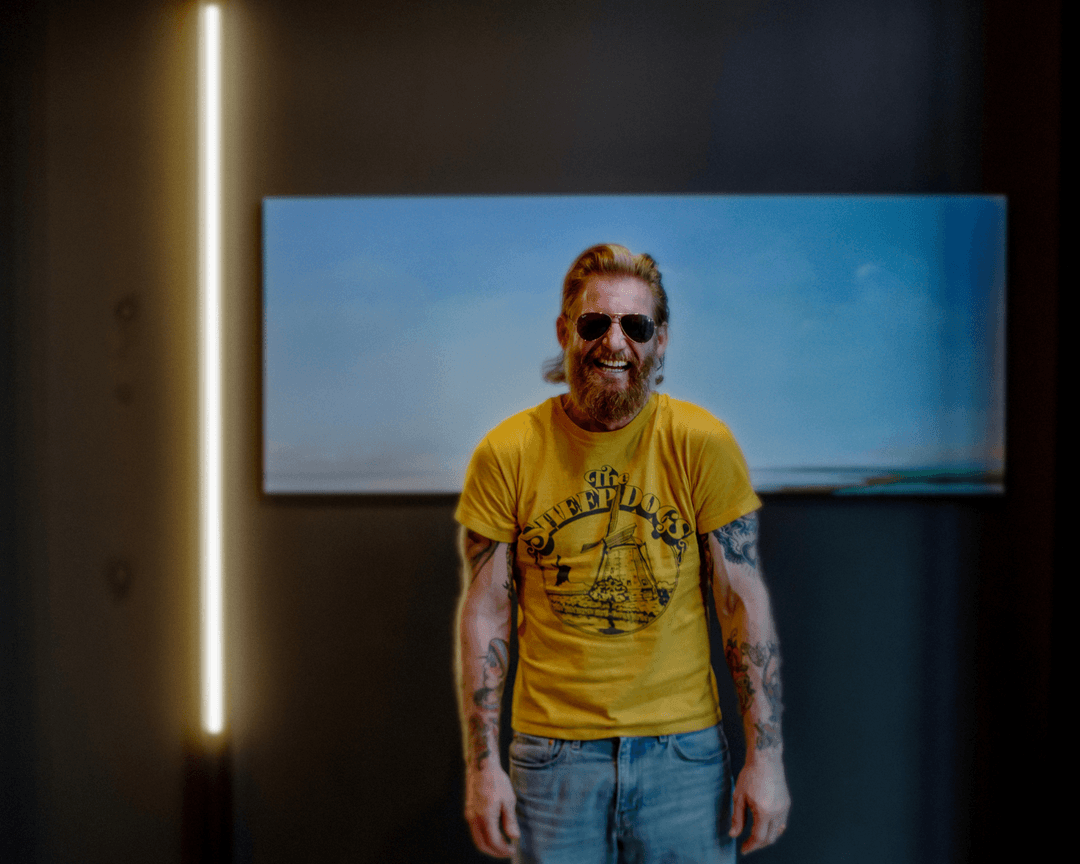
I'm looking at a man with a beard, sunglasses and tattoos. And in the evening he puts on terry cloth pyjamas and wool socks?
"That is the real Björn. That is the new rock-'n'-roll."