Power
LESSONS FROM THE OLD WORLD
As a tribal photographer he has one foot in the 'old world'. What lessons does Jimmy Nelson (1967, Sevenoaks, England) take back from his visits to indigenous cultures? “All that matters is what you can give back to the world. That is the true feeling of wealth, of happiness.”
Text: Bart-Jan Brouwer | Image: Jimmy Nelson
Online editor: Larissa Schaule Jullens
Everyone is talking about the new world, while your field of work is the old world. Are there two worlds?
“There is no old and new world, no past and future. We live in the now on one planet. The essence of what I do is to get the two more in balance. How do we face the future together? How can we combine the wealth and knowledge of the traditional world with the rapidly developing modern world? How do you get a continent like America with its extreme overconsumption and overproduction, one extreme, more in line with Papua New Guinea, the other extreme. I seek to weave the ancient wisdom and deep cultural foundations of Papua New Guinea with the extraordinary intellectual and applied knowledge of the modern world. A knowledge that can only be sustainable if it remains connected to the deepest roots of the natural world. In America, almost everything is completely based on the ego, where the earth is at the service of humanity. In Papua New Guinea there is no ego at all, there you feel the connection with each other and nature - there people serve the earth. Of course, the modern world has produced crazy creations like the smartphone. A great technology, but only if it serves humanity. In Papua New Guinea they don't have smartphones, not yet, but there they know what the essence of being human is. It's about the balance between the two.”
Translate that into your personal story.
“My father traveled around the world for Shell. Sometimes we lived in Nigeria, then again in Sierra Leone. As a result, as a child I came into contact with all kinds of cultures and was connected to nature. When I was seven, my parents sent me to a Catholic boys' boarding school in England. I felt as if I had been uprooted from the natural world in which I grew up. Since then I have been trying to restore that balance. My life is in splits. One leg in America, one leg in Papua New Guinea. I am only in balance in a few rare moments: in the middle of the night on an airplane, when I travel from one world to another. In those dark ten minutes I reflect on the wisdom and richness of the world I have just experienced and the one I am going to. High in the sky, those two worlds come together in me. It's not about them and us, it's about the whole. With my photography I reflect what I see in others. Experience what I experience, feel what I feel and try to see how important that balance is. What I do is neither anthropology nor ethnology; it is subjective, idealistic, romantic, iconographic art. That one captured moment must be rendered grand and sublime and masterful for the message to resonate as clearly as possible.”
Your first book, Before They Pass Away, provoked quite a bit of discussion. Your photos would be fake, staged and photoshopped.
“The photos are real, it just depends on how you look at the world. People with a sense of superiority need an enemy to maintain their ego, and the easiest enemy is someone who is different. That is the origin of racism. Now they see in my photos that that 'other person' is proud, happy and healthy without the material luxury they had to work so hard for. That hurts, they find it difficult to accept, and so they call the photos fake. But it is as much reality as a model on the cover of Vogue. I also want to photograph the indigenous peoples at their best, full of pride. You should not see it as journalism, but as art.”
Did you expect that criticism?
“I didn't expect anything at all. Not even that the book would be such a success. No publisher wanted to burn their fingers. By chance I found someone willing to make two copies and it took off from there. The reason it became so successful is because it is a mirror, because it is confrontational. But I couldn't foresee that. I did not create the book from a scientific or anthropological background, but from an emotional background. I assumed that everyone sees and experiences the world the way I do. I didn't expect so many people to look at it in a different way. Otherwise you and I wouldn't have been sitting here opposite each other, because that caused a lot of fanfare.”
Are the photos also a mirror for the tribes you photographed?
“When I visit the tribes again, which I often do, I give them the book as a gift. In 99 percent of the cases, they are not interested in the photos at all. They like that I'm back, remember me, everywhere you hear 'Jimmy! Jimmy!' But the book… they don't care. Through interpreters that I always bring with me, I understand that they do not see themselves as they are depicted in the photo. 'It's not about the picture, it's about who you are, what you feel.' We live in a world of images and selfies, we judge ourselves by how we look, two-dimensionally. We have no connection with how we feel. Very few feel beautiful, but with some Photoshop and a filter we can look beautiful. In the corners of the world there are no cameras or mirrors, it's all about feelings. For them it is about inner beauty, for us it is often about outer beauty.”
When you visit a tribe, do they even understand what you are doing there?
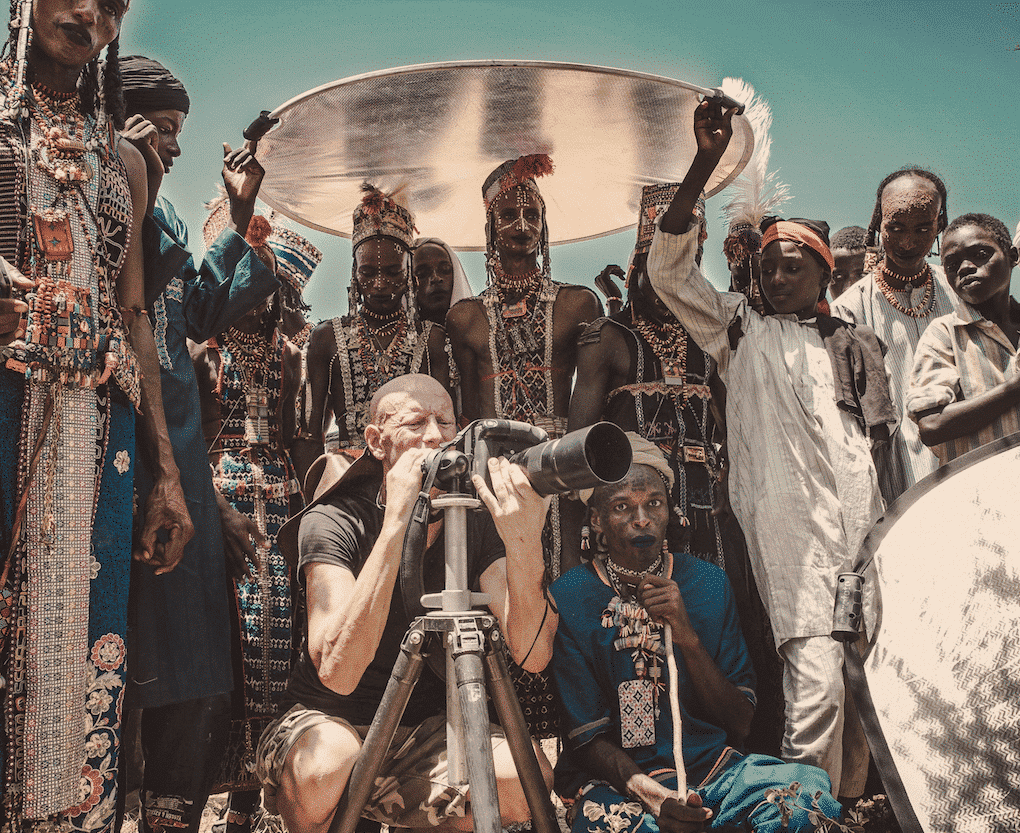
“They have no idea what a camera is. And often they have no idea what I'm doing. At first I never take out my camera, I just show myself in all my vulnerability. My stay is 99 percent about communicating who I am as a person. For a few weeks I do nothing but sit on the floor and make myself vulnerable. The tribe members dance around me and sometimes behave in an intimidating manner – pushing, kicking, spitting. I do nothing and subject myself to them. Eventually they get used to my presence, get bored and walk away. There is always one that remains standing, out of curiosity. I try to make contact with him. I whisper words, make him feel how beautiful he is, make him feel respected. Only then do I grab my camera, an old analogue one with 4×5 inch flat film. The time it takes to set up the camera and the silence that this old-fashioned way of photographing creates keeps you communicating - the connection is maintained. He is not interested in the camera, as he has no association with it whatsoever. What does interest him is that he is the center of my attention. I keep saying how beautiful he is, let him stand up. You see him grow. I take him to a central point in the village and take about fifteen reflection screens with me. The other villagers become curious and stand around us. I involve them, let them hold the screens and create a human studio. They forget who I am and direct the sunlight in the right direction, towards their fellow villager, who stands proudly in the spotlight. In the meantime, I nervously run back and forth to get everything ready for that one photo... The whole time I remain humble, making myself as small as possible, looking upward. I build it up, crescendo, until everything is ready. My model stands motionless, I press the button. The shutter speed is three, four seconds. They crawl by. The silence… Then the climax: I explode, we have the photo! Everyone shouts and cheers along, and they take turns now wanting to be the center of attention. I can go on for weeks shooting portraits. There is no language, it is all about respect.”
And when you leave they still have no idea what you came there to do.
“All they know is that a strange guy has been among them for three weeks and worshiped them. I portrayed the Kaluli in Papua New Guinea. Before I went there, I only found one grainy black and white photo of these people online. The government arranged for me to visit this community. Their settlement is really very remote: we are dropped in the jungle and have to walk for a week before we get there. What you will find there… amazing! On the way there we pass a waterfall – the perfect setting for the photo. Once they have accepted me, I make it clear to seven of them that they must follow me deep into the jungle. When we arrive at the waterfall, I ask them if they want to stand in the water. They refuse that. For two days I look for large branches and tree trunks that I drag to the waterfall, creating a set in the water for them to stand on. The building is ready at three o'clock in the afternoon. The light is too harsh – the waterfall is white, the jungle dark, so the contrast is too great. I use the time to put the seven tribe members in their place. This goes into great detail, from the visibility of a little toe to the perfect balance and composition. At six o'clock, when the light is soft, I take the photo. Four seconds in a deathly still pose, in the waterfall in the middle of the jungle. After that moment, which seems to last much longer, I feel ecstatic. You have been living for this for so long, from that grimy photo on the internet, a time-consuming production and the long journey to the other side of the world, you finally arrive at the result you have had in mind all along.”
MASTERS #43
Pre-order via the button below MASTERS with substantive reports, great photography and unique brands, trends and places in the world.