Power
Art of the Street
Street art is booming. Since October 2020, there has even been a museum dedicated entirely to this art form: STRAAT, on the ND.
Street art is booming. Since October 2020, there is even a museum that focuses entirely on this art form: STRAAT, on the NDSM wharf in Amsterdam North. David Rose (Rotterdam, 1986) is curator and creative director of the largest street art museum in the world. “We want to get rid of the taboo that surrounds it.” Text: Bart-Jan Brouwer
Image: John van Helvert
Online editor: Fleur de JongWhat is your background?
“My background has nothing to do with art: I studied Medicine, after which I continued with the Master's degree in International Health in Berlin. I already had a preference for street art. But when I was in Berlin, it really hit me. I saw the art being made. I shared my passion with my brother via WhatsApp: 'Look what I've seen now!' He advised me to put the photos I took on Instagram so more people could see them. I gradually became better at photography and more adept at social media. I gained more and more followers, which created all kinds of possibilities: I came into contact with artists, a mutual understanding was created with people I didn't know at all. After that year in Berlin, I did another Masters in Rotterdam. On the weekends I went out to look for art. Medicine is all well and good, but art really grabs me. The place where the museum is now located - the former Welding warehouse at the NDSM shipyard, where ship parts were once welded together - used to be part of the largest flea market in Europe, the IJ-Hallen. An enormous building, twice as large as the Turbine Hall of the Tate Modern. Owner Peter Hoogerwerf wanted to brighten up the hall with art. With the network I had, he saw me as a suitable person to help him with this and bring artists to Amsterdam. What started with a few canvases to brighten up the location for the public, grew into the idea of starting a museum around street art. I started here in December 2016. At that time there was no lighting, no heating, there were cracks in the windows... It was freezing, the team sat around a gas heater. Very exciting."
And, were you able to bring artists to Amsterdam?
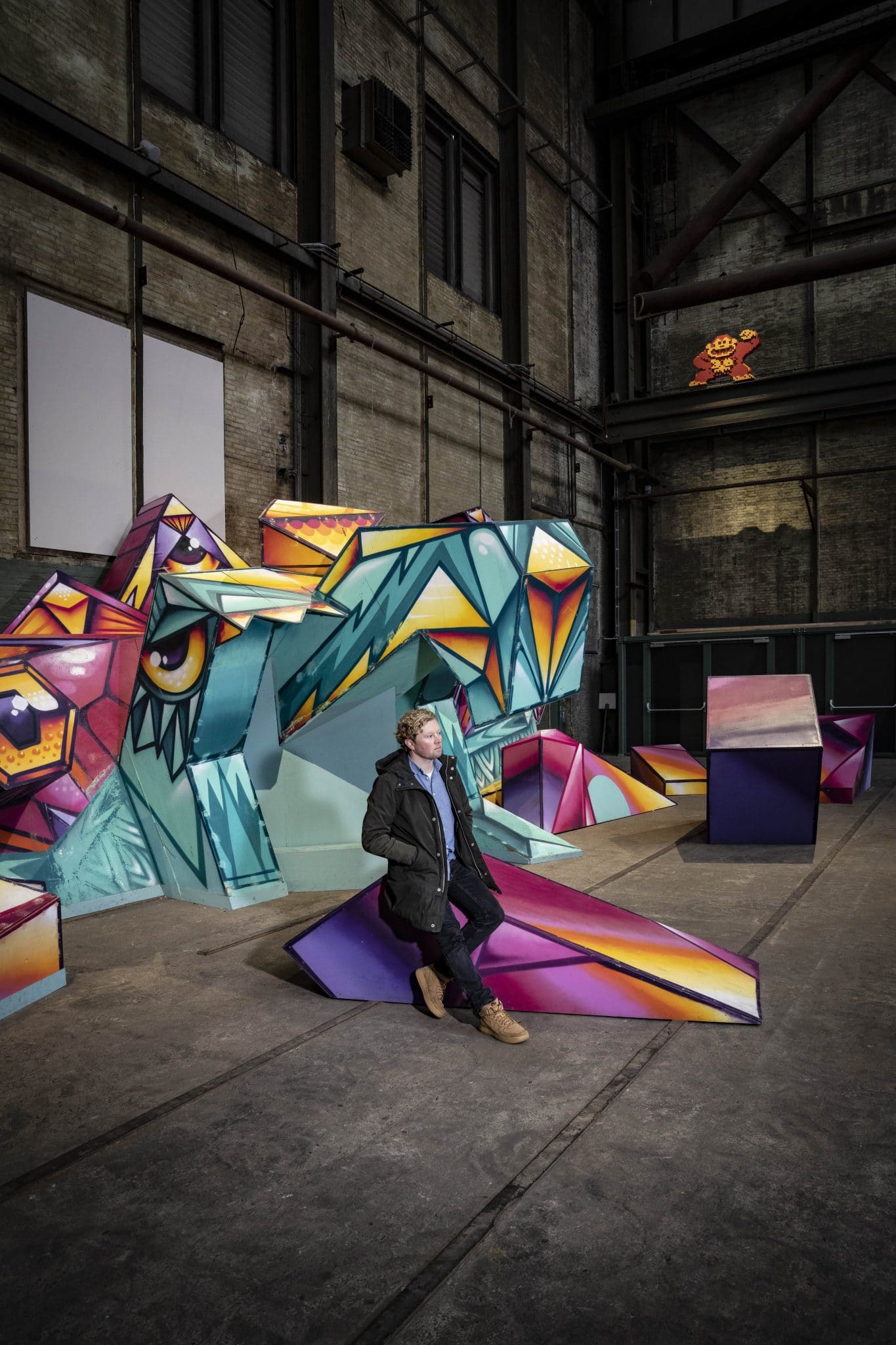
“STREET didn't exist yet, it was just a concept. “We are building the largest street art museum in the world,” I said, showing the photo of the outside of the building with the Anne Frank portrait on it Let me be myself by Eduardo Kobra and a panoramic view of the inside, where a number of works were already hanging. Do you find that interesting? This involved a lot of emailing back and forth before the tickets could be booked.”La Contemplacion (2018) by the Peruvian artist Entes as a backdrop for the portrait of the creative director.Could you make a living from that?
“I also had a job in the pharmaceutical sector, and later in youth protection, to be able to pay my rent. I also started an agency with a good friend: we became an intermediary between artists and clients who wanted street art as art on the walls - hotels, companies, restaurants... And I became manager of artist DOES, who now also hangs here in the museum . It was my dream to work full-time in street art, but for the time being I was dependent on these other activities for my income. Until Peter offered me the opportunity to work as a curator and creative director. So at the beginning of the spring of 2020, I started working full-time for the museum. A lot of art had already been created, a beautiful composition in a great building, but the organization was still inadequate. There had been many hiccups during the project: a leaking roof, disagreements in previous teams, uncertainty about the final destination of the hall... As a result, the overall picture had become somewhat out of focus. To start with, I made decisions, created clarity and added structure.”
On October 9, 2020, the museum opened with the exhibition Quote from the Street: 150 works of art by 140 artists from 27 different countries. How did that selection come about?
“I try to show a diversity in styles, strive to ensure that the proportions between male and female artists are correct - during the construction of the museum there was an imbalance, more men than women, which I am now trying to correct - and preferably I think all continents are represented. At the moment I still miss African and to a lesser extent Asian artists. And the emphasis is more on street art than graffiti; I am working hard to give graffiti artists more of a platform.”
Also read: 'Simonis: The fish king of Scheveningen'
The new MASTERS Magazine
Want to read more about the interview with David Roos and find out what the difference is between graffiti and street art? The spring issue of MASTERS celebrates regained freedom after two years of corona. The value of this is underlined by developments in eastern Europe, where the freedom of an entire people is at stake. We live in a new reality, but we can make plans again, go out for dinner, meet people. The world is turning again! Only: which way? Time for new bridges, new initiatives. What this edition of MASTERS offers inspiration for.


