
Taste
Art in the Archipelago
Suzanne Swarts doesn't let the walls of "her" Voorlinden confine her. She visits unique places around the world where art and the environment intersect. In MASTERS, the museum director shares her experiences from these travels – this time from the Swedish Artipelag.
Every now and then I hear the chatter of a small chorus of great tits in the pines above my head, but otherwise the landscape feels strangely still. Perhaps it's because I've just stepped off the Gustafsberg VII, a former steamboat from 1912 that takes you from the Swedish capital to the Stockholm archipelago in an hour and a half. This collection of 30.000 islands, skerries, and rocks in the Baltic Sea is National Geographic named one of the world's top destinations for 2025. This the archipelago, as the Swedes call it, is the place where the capital's residents seek peace and quiet, have holiday homes, and celebrate summer festivals. Their red wooden houses are found on the larger islands; the others are deserted rocky islets, where perhaps a seal or kayaker pauses. The idyllic archipelago invites you to all sorts of water activities, but you can also enjoy extensive hiking – the Stockholm Archipelago Trail allows you to cover approximately 260 kilometers on foot, passing around twenty islands.
On a windless autumn morning I follow part of that path along the Stockholm archipelago. Just before that I am welcomed by Height By Lars Nilsson, at the Artipelag steamboat pier on the island of Värmdö. This sculpture of a boy in shorts gazes longingly out to sea, as if someone by boat might appear on the horizon at any moment. I leave the expectant boy behind and deliberately choose a detour to the museum, so I can enjoy the permanent outdoor exhibition that surrounds this beautifully situated museum in the dawn light.
From baby brand to museum
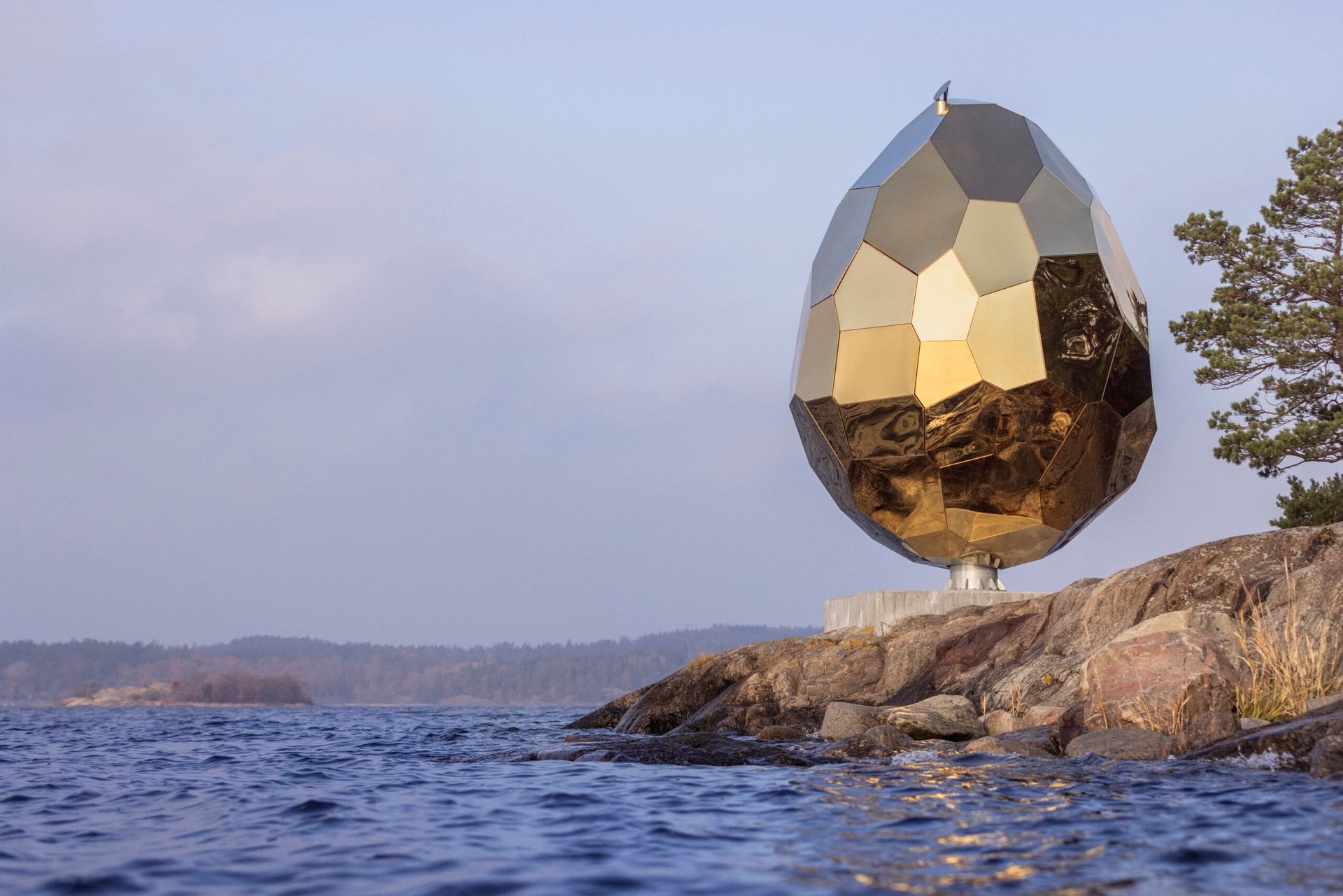
As I follow the path over wooden footbridges, forest paths and gray rocks, I suddenly see something glittering in the distance: Solar Egg by Bigert & Bergström. This enigmatic, egg-shaped sculpture is the landmark for anyone traveling to Artipelag. It stands on a cliff, reflecting its expansive surroundings: the water, the rocks, the sun, the sky, and the forests—precisely the natural beauty that characterizes the archipelago. My walk continues along Ainsa IV by Jaume Plensa, a seated figure of letters and numbers overlooking Baggensfjärden Bay. Above a meadow, I see three figures crouched eleven meters above the ground. It's one of three works with which Maria Miesenberger puts her stamp on Artipelag. A little later, as I pass the pine trees surrounding the museum, I see a similar crouched figure on an angular peak of the roof, and later one leaning against a conifer by the terrace. Once inside, I'm enchanted again. This time by the tranquil presentation, the bright rooms where glass and concrete embrace nature. Here, too, the artworks seem to engage in a conversation with the Swedish landscape. The museum is the final masterpiece of architect Johan Nyrén and was founded in 2012 by Björn Jakobson, the man behind the Swedish baby brand BabyBjörn. Initially, many nature lovers ended up in Artipelag. Here, you can enjoy a panoramic view of the surrounding nature from the beautiful restaurant and terrace. But now the museum is attracting more and more art lovers, partly through fascinating solo exhibitions by artists like Anselm Kiefer and Berlinde De Bruyckere.
As I walk back to the pier later, I hear the distant chorus of great tits again. The landscape glistens softly in the light of the low sun; the rocks, the sea, the pines—everything seems to stand still. For a brief moment, I no longer feel like a passerby, but part of this tranquil, breathtaking archipelago.


