Taste
Art you must experience, feel, almost inhabit
From a concrete tunnel in the desert to a house where even the doorknob breathes art: some works cannot be contained within a museum gallery. This is art you must experience, feel, almost inhabit. MASTERS lists five extraordinary art experiences that take you off the beaten path…
Sun, sand and peace of mind
In the vast desert landscape of the Great Basin Desert in Utah, four concrete cylinders lie seemingly carelessly placed. But those who look closer discover: this is not infrastructure, this is iconic land art. Sun Tunnels (1976), the masterpiece by artist Nancy Holt, is a minimalist monument to the sun. The four enormous tunnels (each nearly 6 meters long and 2,5 meters in diameter) are positioned so that the summer and winter solstices shine through them perfectly. Holes have been drilled into the walls in patterns corresponding to constellations such as Draco and Perseus, giving the work a cosmic connection even at night. Here, you are literally aligned with the sun, the stars, and yourself. The tunnels frame the landscape, capture the light, and make you feel small and grand at the same time. The work asks nothing except that you pause for a moment. In a world full of stimuli, that is perhaps the greatest luxury.
Surrounded by art
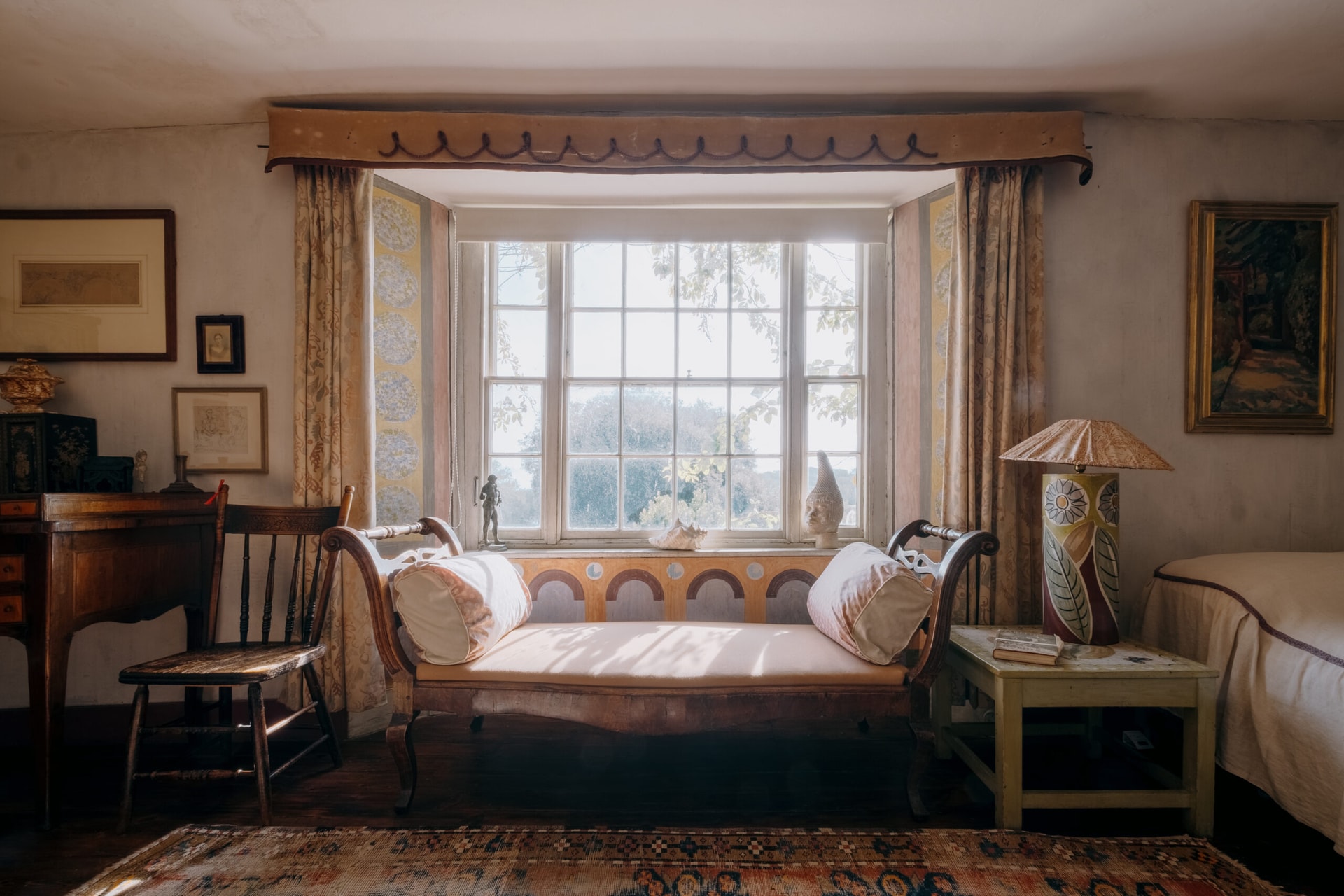
Amidst the rolling landscape of East Sussex, in Firle, lies Charleston: a country house that did not become a museum, but a work of art in itself. From 1916, this was the country retreat of artist Vanessa Bell and her partner Duncan Grant, both key figures in the legendary Bloomsbury Group – a motley collection of free thinkers, artists, and writers including Virginia Woolf, John Maynard Keynes, and E.M. Forster. In Charleston, they lived their art, literally. Walls, doors, furniture, lamps, textiles: everything was painted, modified, and shaped with influences from Post-Impressionism, Picasso, Cézanne, and the Arts and Crafts Movement. Even the garden was transformed into a living painting, with flowers, mosaics, sculptures, and ponds. Here, they did not just live, but constantly created. From the former stable, Bell and Grant worked on commissions, designed wallpaper, ceramics, and furniture, and even painted church interiors. Today, Charleston is open to the public, yet it still feels like you are at the artists' home. Every detail bears traces of their hand: from painted tables and door panels to clever lighting via handmade ceramic lamps. Charleston is no ordinary country house, but an intimate time capsule full of boldness, love, and life. A place where art doesn't hang on the wall, but is everywhere.
Biometrics as an art experience
The Dutch artist duo DRIFT unveiled the installation in collaboration with the Savannah College of Art and Design (SCAD). UnfoldIn the historic Goat Tower by SCAD Lacoste (Provence), visitors become part of a sensory AI experience where body, nature, and technology converge. As soon as you enter the space, your biometric data, such as heart rate and breathing, are translated in real time into moving visuals and a soundscape. Inspired by local flora from Provence, every interaction transforms into a unique audiovisual snapshot of yourself. Unfold embodies DRIFT's mission: making natural rhythms tangible through light and movement, and inviting the visitor to reconnect with their surroundings and inner world.
The focus on transience
Last autumn, the Antwerp gallery IBASHO presented a solo exhibition by photographer Hajime Kimura (1982, Japan). This consisted of Correspondence, a fictional narrative rooted in the historic landscape around Torres Vedras, north of Lisbon. Here, along the lines once intended to hold back Napoleon, Kimura allowed himself to be guided for a month through hills, ruins, and riverbanks. His images, partly literally soaked in the waters of the Atlantic Ocean, form a visual investigation into time, transience, and the traces we humans leave behind. In addition, he also showed Matagi: an intimate portrait of the last traditional mountain hunters of Northern Japan. For centuries they lived in symbiosis with nature and animals, but their culture is in danger of disappearing. Kimura's lens reconstructs their world – not as folklore, but as a tangible reminder of a way of life on the verge of dying out. An exhibition that brought past, present, and future together in one breath.
Freedom transformed
Amy Sherald (Columbus, Georgia, 1973) works primarily as a portrait painter and depicts African Americans in everyday situations. Her style is a form of simplified realism, in which she works with staged photographs of her models. In 2024, she painted an image of the Statue of Liberty, modeled after the Black, transgender artist Arewa Basit, titled Transforming LibertyIn July 2025, Sherald pulled her solo exhibition American Sublime back from the Smithsonian National Portrait Gallery, after the museum considered removing the portrait from the exhibition due to internal concerns about possible tensions with President Donald Trump. It viewed it as a concession to political pressure. The magazine The New Yorker used Transforming Liberty subsequently as a cover.Transforming Liberty “It calls into question who we allow to embody our national symbols and who we erase,” says Sherald. “The work demands a more complete vision of freedom, one that accommodates the dignity of all bodies, all identities. Freedom is not static. It changes, and we must change with it. This portrait confronts us with that truth.”


