Taste
Kamran Ullah: "Without humor, there is no good news day"
In the Business Lunch series, Floris Kappelle and Rijk de Gooijer sit down with a renowned entrepreneur. Anecdotes and success stories alternate with clinking glasses and poking forks. In this episode, Kamran Ullah, editor-in-chief of De Telegraaf, joins them at the table. "We are still looking for a columnist from the radical center." […]
In the Business Lunch series, Floris Kappelle and his partner Rijk de Gooijer sit down with a renowned entrepreneur. Anecdotes and success stories alternate with clinking glasses and jabbing forks. In this episode, the napkin goes on the lap of Kamran Ullah, editor-in-chief of The Telegraph“We are still looking for a columnist from the radical center.”
Quite late, but just in the nick of time, former petrolhead Rijk de Gooijer storms into the restaurant. “The skeleton course ran over.” A strange story, but not really unexpected. Fortunately, our guest of honor Kamran Ullah is already seated for lunch. The likable editor-in-chief of The Telegraph We ran into them earlier at MASTERS EXPO, so a lunch date for this series was quickly arranged.
Gastronomic adventure
This time, our star lunch takes place in the rustic village of Noordeloos, between Utrecht and Gorkum—closer than you think, specifically in the antique manor farm that has housed restaurant De Gieser Wildeman* for decades. Recently acquired by patron-chef Marco van der Wijngaard, who, together with his team, has breathed new life into the gastronomic adventure of this special haven. Time for a culinary exploration at the highest level, enlivened by the fantasy world of De Gooijer, who shamelessly assures us he is fully prepared for the Winter Olympics. “This daredevil is ready to roll... full throttle down the track… head first“,” our partially educated sidekick blurts out as he breathlessly ties his napkin around himself.
Six million readers
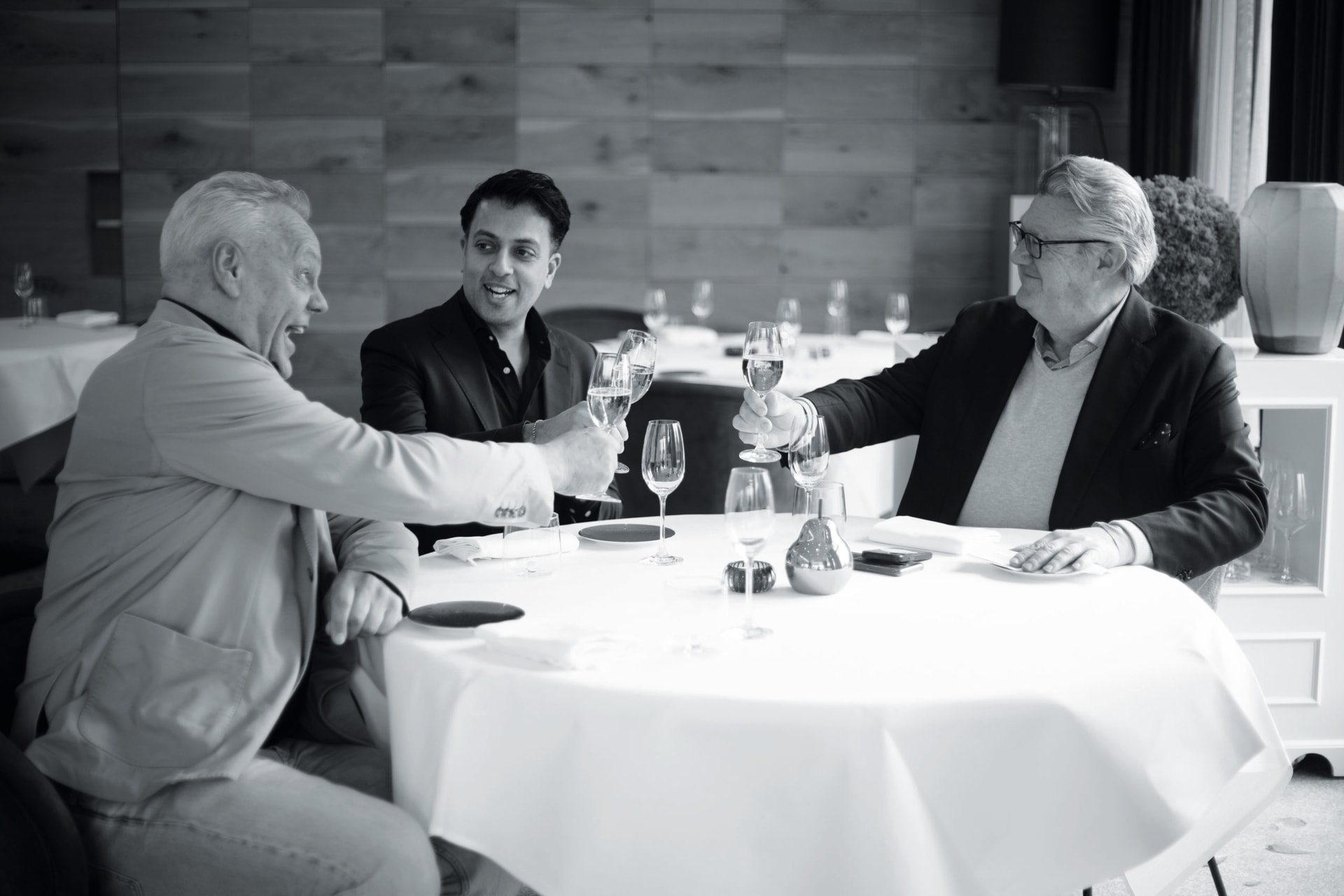
To process this surprising starter, we begin with a lovely sip of De Nit Extra Brut Organic. “Fine mousse with a broad nose. A touch of smoke with a hint of Mediterranean herbs,” notes Rijk. The three of us toast to an afternoon full of tall tales and true facts. Kamran has worked at De Telegraaf for twelve years, the last three as editor-in-chief. A position that takes him to many interesting places. At the table with ministers, entrepreneurs, and politicians alongside countless events, from film premieres to Jumping Amsterdam and Ajax matches. “The pile of invitations grows daily.” Well, who wouldn't want to sit at the table with the man whose medium reaches some six million readers and viewers every day? It is therefore an honor that Kamran chose the Business Lunch today at this fine restaurant, named after the famous stewed pear and the Giessen river that meanders loosely through the village. The sleekly furnished dining room offers a Giethoorn-esque view of greenery and water. The terrace of De Gieser Wildeman looks like a postcard that hasn't needed to prove itself for years.
The biggest misunderstanding? That we engage in right-wing activist journalism.
Man with an opinion
“I’m looking forward to it,” reveals the popular media personality. Kamran regularly appears as a commentator on radio and television programs as good morning Netherlands, as a commentator on NPO Radio 1, and in podcasts Kamran's Newspaper in which he discusses the news weekly with an unvarnished tone. A man with an opinion. And now also a man with an amuse-bouche: Chawanmushi, a Japanese flan, with Jerusalem artichoke ice cream, mussel mushroom, dashi vinaigrette, and pickled radish. “Earthy and honest,” we hear someone murmur. Chef Marco, as he says, “always puts one vegetable in the spotlight.” This time it is the Jerusalem artichoke. The whole thing star-shaped, artistic, almost too beautiful to eat. Three Amsterdammers are sitting at the table. That immediately creates a bond. Today, Kamran is the protagonist. The accompanying leaflet is rich. And Chef Marco is the silent force that elevates this lunch to great heights. A strong start. Kamran looks, smells, tastes. He is sensitive, as will become apparent later. A man who not only preaches nuance but also tastes it.
Pediatrician or hospital clown
Kamran is 42 and has lived in Amsterdam his entire life. He attended Barlaeus Gymnasium. Independent, a smooth talker, and politically active from an early age. The city, which is seen as left-wing, is ingrained in his system. Yet he now leads a newspaper that many label as right-wing. This sometimes leads to peculiar encounters. “I was walking along the Lindengracht the other day,” he recounts, “and someone said: what is that Telegraaf man doing here, in this left-wing neighborhood?” Kamran laughs. He enjoys it. “But that isn't the whole city, of course. Although it has become *very* left-wing.” At one time, he wanted to become a pediatrician. Or a CliniClown. “Then at least the children would have fun with me.” Teachers thought he mostly talked a lot. “Maybe you should do something with that,” was the suggestion. Law? It became Public Administration. Politics. He was chairman of the National Youth Council and knew the current generation of politicians early on. Rutte. Jetten. Paternotte. Ended up in journalism. Via video, via radio, via television. And so, uniquely in 132 years of the Telegraaf, he became editor-in-chief without ever having started out as a writing journalist.
The triangle of the news
Chef Marco appears with the next dish. A small cheese soufflé with eel and lovage cream. On the table is a framed photo of his grandparents with a large cheese and a Frisian cow. “This is also part of Pakistani culture,” says Kamran. “Honoring parents and grandparents.” He beams. “And it is also being proud of the Netherlands.” Rijk takes a sip of bubbly. “Just a drop then,” he says, emptying his glass in one go. Kamran continues speaking stoically, quickly and smoothly. With conviction, but without bombast. Is that why he is asked so often to appear on radio and television? “Why am I there? Firstly, to trash De Telegraaf. They like doing that at the NPO. And secondly, because we have a societal impact.” He says yes because his readers appreciate it. He calls transparency, independence, and reliability the three assets of journalism. Especially in AI times. He outlines the news triangle: classic journalism, social media, and talk shows. “The problem is that they are constantly being mixed up. You see the same people in the newspaper in the morning and at the bar at VI in the evening. That really puts me off. Talk shows are dismissed as mainstream media, while it is a different genre.” Rijk nods. “Meanwhile, the average Dutchman is still an insult to television,” he mutters.
Stirring remains fun
A beautifully presented langoustine appears at the table, with a langoustine cappuccino, citrus, carrot, ginger, crispy rind and carrot preparations, and a frothy sauce. For dipping, lovely bread with orange langoustine butter. “That sauce!” Rijk exclaims delightedly. Greedily, he licks his chin clean. Table manners are still important to him. Work in progressThings are heading in the right direction. “Jeez, that’s tasty, man,” he says. “Fantastic,” shouts Kamran, who also enjoys cooking himself. Although with young children and this job, he rarely gets around to it. “But stirring a pot is still fun.” Just like tasting the orange wine Rubicone Bianco Nespoli made from Trebbiano and Pinot Bianco. Rijk notes: “Generous roundness, fresh spice, I taste apricot and honey.” Despite Rijk’s rustic appearance, he certainly knows his way around winemaking.
Sensitive type
Back to Kamran and his work. The public’s image of a newspaper newsroom: stress, ringing telephones, noise, nervous rushing, Hollywood scenes. Kamran shakes his head. “When people come to see us, they always say: how quiet it is here.” And with real breaking news“Then it is dead silent. Everyone knows what they have to do. Those are the moments I enjoy.” His own role? “Do as little as possible. Be present. And ensure that speed does not come at the expense of meticulousness.” We see that attention reflected in the next dish: crayfish with pumpkin, coriander, ginger, and pepper. comfort food with an Eastern hint. “Beautiful,” says Kamran. “A bit colder than expected.” “I’m a sensitive type,” he adds. Editor-in-chief of De Telegraaf: a sensitive type. Rijk muses about sauces. “I love really good French sauces. Often I just want the sauce.” That often pairs well with wine too. Rijk focuses on wine number 3, the Nasco di Cagliari DOC 'Iselis' from Sardinia: “Oh yes, local grape, the Nasco, with a drop of Vermentino. Balanced, grapey on the nose, fresh aroma, a hint of vanilla, and yet exciting. Plus: a fruit basket full of apricots, quince, and flowers. For the man with a thirst.”
From influencers to faces
Kamran sees how journalism is changing. People no longer follow brands, but faces. Saskia Belleman, Wouter de Winter, Valentijn Driessen, Martin Visser. “We have our own influencers.” And he realizes: the sixty-somethings are retiring. New faces are needed. New voices. “We started with News of the Day“Also to showcase talent. The next Saskia. The next John van de Heuvel. By the way, we are still looking for a columnist from the radical center.” A new movement? Musing, we mention a few names—Marcel Levi perhaps, who is widely appreciated. Suddenly, skrei appears on the coast. It is the season for this cousin of the cod. The delicate meat is glazed, with lardo, yellow curry, kataifi, sweet potato, and cockles. All in one bite. “That’s how it should be,” says Rijk, “maybe I’ll start an etiquette column.” The new Beatrijs Ritsema. Given his eating habits, we fear the worst. Kamran sits in silence for a moment, enjoying the moment. No editors, no children, no media. “Thursday afternoon could be worse,” he says. Sheer bliss.
Misunderstandings and misconceptions
We return to De Telegraaf, still the largest daily newspaper in the Netherlands. What is the biggest misconception, we wonder? “That we engage in right-wing activist journalism,” says Kamran. “But everyone who reads the newspaper knows better. We reach six million Dutch people. That is the breadth of society. Columnists are allowed to add their own colors. Journalism is based on facts. That distinction remains crucial.” Also essential is the piece Marco is now serving: an artistically presented piece of beef tenderloin with Grandma’s braised beef and a rich gravy. We detect fresh truffle and preparations of portobello, Pommes Anna, leek, and carrot with a parsnip cream. A dish full of warm memories of the past, of grandmothers and regions where little happened. Meanwhile, a lot is happening in our glass. The Saperavi Taoba from Georgia, the world’s oldest wine-producing country, originating from the famous Kakheti wine region. This ancient grape is planted in earthen jars, bunch and all, ensuring exceptional aging of the wine. Rijk tastes it: “A heavy hitter, yet with violets, spicy and firm, a fine meat companion.” The beef tenderloin glides smoothly down to the stomach. This dish could hardly be more classic; personal yet modern.
Ironclad minds
The dessert arrives. Dark chocolate, almond, pear, amaretto, tonka bean, almond milk ice cream. Accompanied by Tokaj wine with notes of honey, apricot again, and zest. Rijk dips chocolates into his tea. Lapsang Souchong. “Now that’s tea.” Kamran looks satisfied. “What shouldn’t be missing for me on a good news day? Humor. We forget that too often. That’s why we like to make those rock-solid headlines.” Some hits from the past are dredged up while the snow outside melts gently. Inside it is warm and lunch is drawing to a close. The conversations ebb away, from amuse-bouche to dessert, from Jerusalem artichoke to the radical middle ground. A more than fine lunch. With an editor-in-chief who understands exactly that sometimes you can only truly understand the news… if you eat well with it. An afternoon that lingers, as good conversations and fine lunches are meant to do. Here in peaceful Noordeloos, where the landscape is defined by ditches, meadows, and a wide sky, time seems to stand still. Perfect setting for fine dining at De Gieser Wildeman, where the culinary craft is fully experienced. Both at the table and behind the stove. Noordeloos here we come.