Power
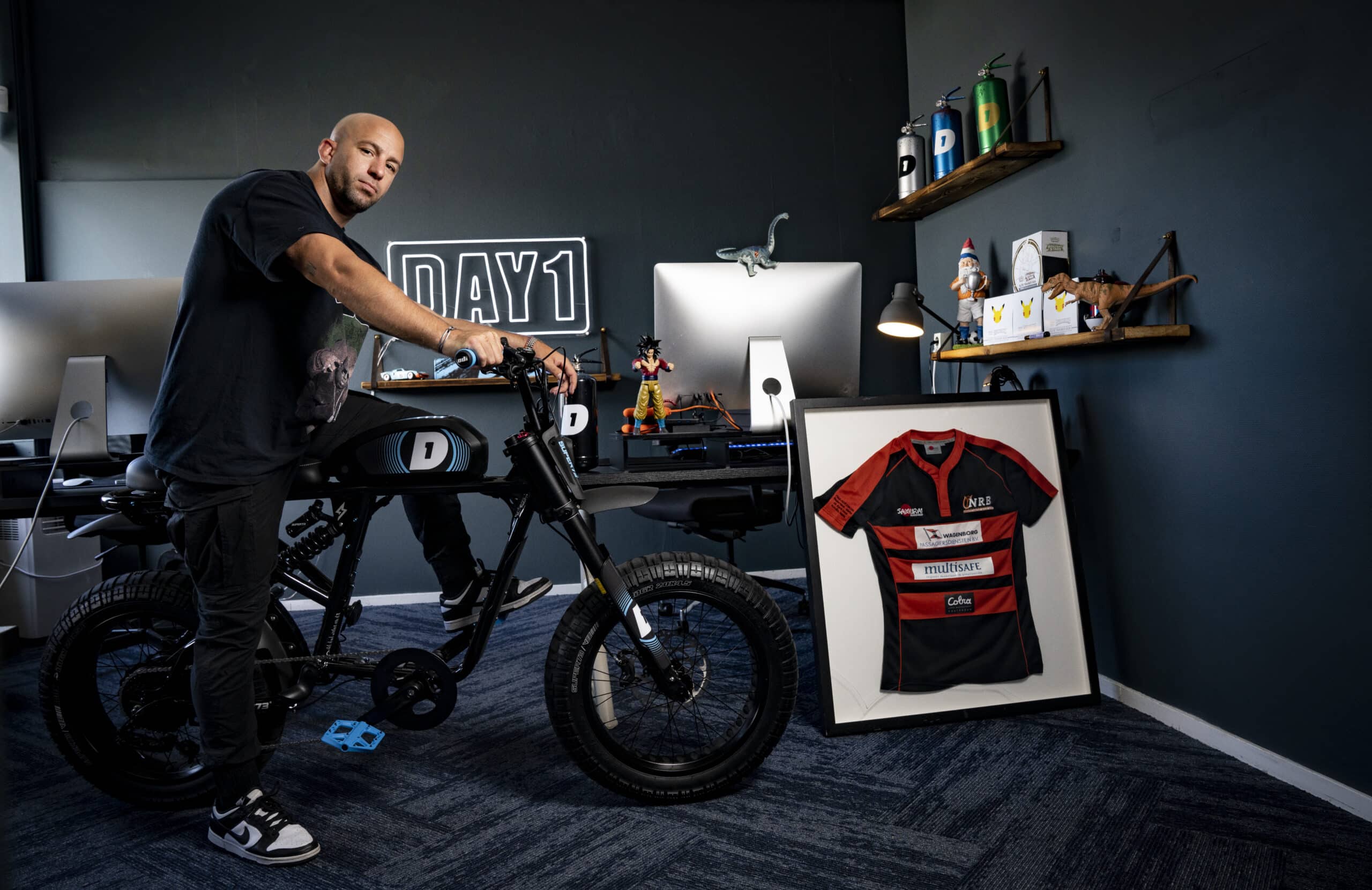
Jay-Jay Boske: "Content is gold!"
As a professional rugby player, Jay-Jay Boske (Utrecht, 1986) did not get the most out of it. As a YouTuber and entrepreneur, he does. “I think we are now the largest men's platform in the Netherlands.”
When you were born in 1986 you immediately had a record to your name.
“Smallest child ever born in the Utrecht hospital! My mother had miscarried twins the year before. Although there was a good chance that the next child would be born either stillborn or disabled, my parents tried again. I arrived seven weeks early. I wasn't dead, they haven't fully figured out about disability yet, haha. I was so small that my father could hold me in one hand. I wasn't eating and you could see right through me. Still, I survived.”
How spoiled you must have been in your youth.
“No, not spoiled, but my mother has always been very protective and sweet.”
You weren't a sweetheart. Did you make things difficult for her?
“Well, I was a sweetheart, but one with a strict sense of justice, which often got me into trouble on the street. Fight. This in combination with a drive to make everything successful. To give you an example: My mother once put me on a bicycle at playgroup, but I couldn't reach the pedals. When she came back an hour later, I was still trying to get my feet on the pedals – I just kept trying. My mother couldn't get me off the bike, I was so persistent. Maybe I have that fire in me because I had to survive as a baby. I want to get the most out of everything. As a boy of about fifteen, I was the smallest and had to fight against everything. I felt what it was like to walk behind. That wasn't going to happen to me, I decided. I would help anyone who was being bullied. I always picked on those who preyed on the weak. That caused a lot of hassle. When I was sixteen I almost got stuck. Purely because I was trying to protect others.”
That fire in you has brought you great benefits in sports.
“I once started as a football player, at Victoria in Loosdrecht. But I hated schwalbes. Opponents who out of nowhere started rolling and groaning in pain. I couldn't stand that. The football field just wasn't the right stage for me. A little boy from my street, Guido, once came in wearing an Argentinian rugby shirt. Such a cool shirt! Light blue with white stripes and a jaguar on it. “What is that, rugby?” I asked him. He told me all about it. I accompanied him one evening to a training session at Rugby Club Hilversum. There were a lot of guys there who knew me. 'Hey Jay, how nice,' I heard everywhere. The trainer, a friend of my father, let me train with him. It was only then that I heard about my family's rugby history and that my father had been an international player. The first time I was allowed to tackle someone, I knew: this is it for me!”
You were talented.
“It wasn't that difficult in rugby at that time - in the land of the blind, one eye is king. From the time I was 12, we became undefeated champions every year. We really had a talent team. At the age of sixteen I was already playing in the first team and came on the radar of the national coach, a New Zealander who had played for the All Blacks. That same year he let me make my debut in the Dutch team. Sixteen years and against only giants! My first match was against Ukraine, fighting for your life! So yes, I did have some talent. Although I didn't really realize that until later.”
At the age of 17 you moved to Newcastle to work as a professional rugby player for the Newcastle Falcons.
“I went with Tim Visser, the best rugby player the Netherlands has ever known. Tim has played for Scotland. That's like coming from the Faroe Islands as a footballer and becoming the top scorer at Manchester United. People couldn't believe we came from the Netherlands, we made such an impression. If you had been born in England, you would have been among the top here, they said. There we were able to test ourselves against the best players in the world and only discovered that we were really good. I never had any idea of how my future should unfold, and I struggled with that. But then the dream of becoming a professional rugby player began. I finally had control over my future.”
And yet here you are in your studio in Hilversum and you are not on a rugby field...
“For that dream to come true, several pieces of the puzzle have to fall together. It is important that you end up at the right club and that you have a good coach who sees potential in you. That was the case, but I had trouble adapting. Tim went to a private school. That wasn't an option for me, because I was a year older. From one day to the next I had to take care of myself. I was put in an apartment with another rugby player – do it. "
And that wasn't easy...
“Newcastle is a tough city. English, pub culture, rain, cold… And not my style of rugby at all. Things are getting tough in the north of England. I like ramming and pounding, but I am 1,68 meters tall and weighed 73 kilos at the time. I'm good in small spaces, but when you're up to your ankles in mud, you can't get away and you have to play physical rugby… Give me a little sun, a hard pitch and I can do anything. But here in England, circumstances were different. I had two coaches. One was for my long-term development: he didn't want me to play so physical rugby. The other was on the field with me almost every day and trained me to ram and pound. My style changed because of that, I had a disagreement with the coaches because one wanted to go left and the other wanted to go right, and I got injured. But that wasn't the reason: my own behavior cost me my head. I behaved like a stubborn idiot and then it was ready for a coach, because there were ten English boys ready to do what he said.”
When you finally have control over your future, you are bothering yourself!
“Yes, maybe because of the fear that you don't know how to deal with it. And then you fall back on what you know: being stubborn.”
After three years your dream came to an end and you returned to Hilversum. And then?
“I finished high school at the Alberdingk Thijm College at the age of twenty-one. But I had no idea what to do next. That was very difficult. I was brought back by Rugby Club Hilversum. And was even offered a contract in New Zealand. Looking back, I regret turning that down, that would have been fantastic. But I was tired of rugby. I had given everything in Newcastle and now I had to go to the other side of the world to do it again. While… that is the rugby Mecca, I should have gone there. I tried to study Management Economics & Law for a year, but I discovered that a school or university is more of an institution that keeps you in line and possibly teaches you some basic skills than it helps you in real life. At least that's my feeling.”
How did you get into the radio and television world?
“I saw an advertisement from BNN, looking for people to work behind the scenes. That seemed like a lot of fun. As an intake I had to make a voicemail recording in which I did something cool. What did I do: I had just had surgery and with one leg in a cast I jumped over the gates at Hilversum station, ran across the platform with the security behind me and jumped into the train, where I hopped down the aisle. tried to stay out of the hands of security. At BNN they thought it was so cool that they chose me from six thousand entries and offered me a one-year internship in the radio department. Coen Swijnenberg and Sander Lantinga were there, they were also at the beginning of their careers; it was such a nice place to work back then. Everything was possible, everything was allowed. Just do it, it can't be crazy enough. I helped behind the scenes and was sometimes allowed to present something online. That's how I came into contact with 101TV, BNN's digital TV channel at the time. That was just around the corner and they needed a presenter. "Don't you want to come and do that?" Even though only my grandparents watched that channel, I thought it was cool to do. That's how I acquired my place there. I started working behind the scenes at 101Barz, the largest hip-hop platform in the Netherlands. I learned how to film, edit, direct... everything that comes with making television. If we had five hundred views over the weekend, it was a party on Monday. Then we would be drinking shots of Jägermeister at eight in the morning.”
MASTERS MAGAZINE
Curious about the rest of the interview? The winter issue of MASTERS was created in collaboration with Jordi van den Bussche. Many will know him as YouTuber Kwebbelkop, but he has been working hard as an entrepreneur for some time, as he explains in the Great Interview. What is new is that his company JVDB Studios offers to do social media marketing and short format content marketing for other companies. “They can also figure it out themselves, but we cracked the code.” Jordi gives a platform to like-minded entrepreneurs such as Jay-Jay Boske, Demy de Zeeuw, Chahid Charrak and Marcella de Bie, and discusses developments surrounding games, crypto and NFT: “Just as bitcoin turned the financial system upside down, will that also happen with gaming.” This extra thick winter issue also focuses on Lengers' first own ship, an interview with Corendon CEO Atilay Uslu, specials about the new BMW 7 Series and Samsung foldables, and - exclusively for MASTERS! – an interview with Max Verstappen.


