
Taste
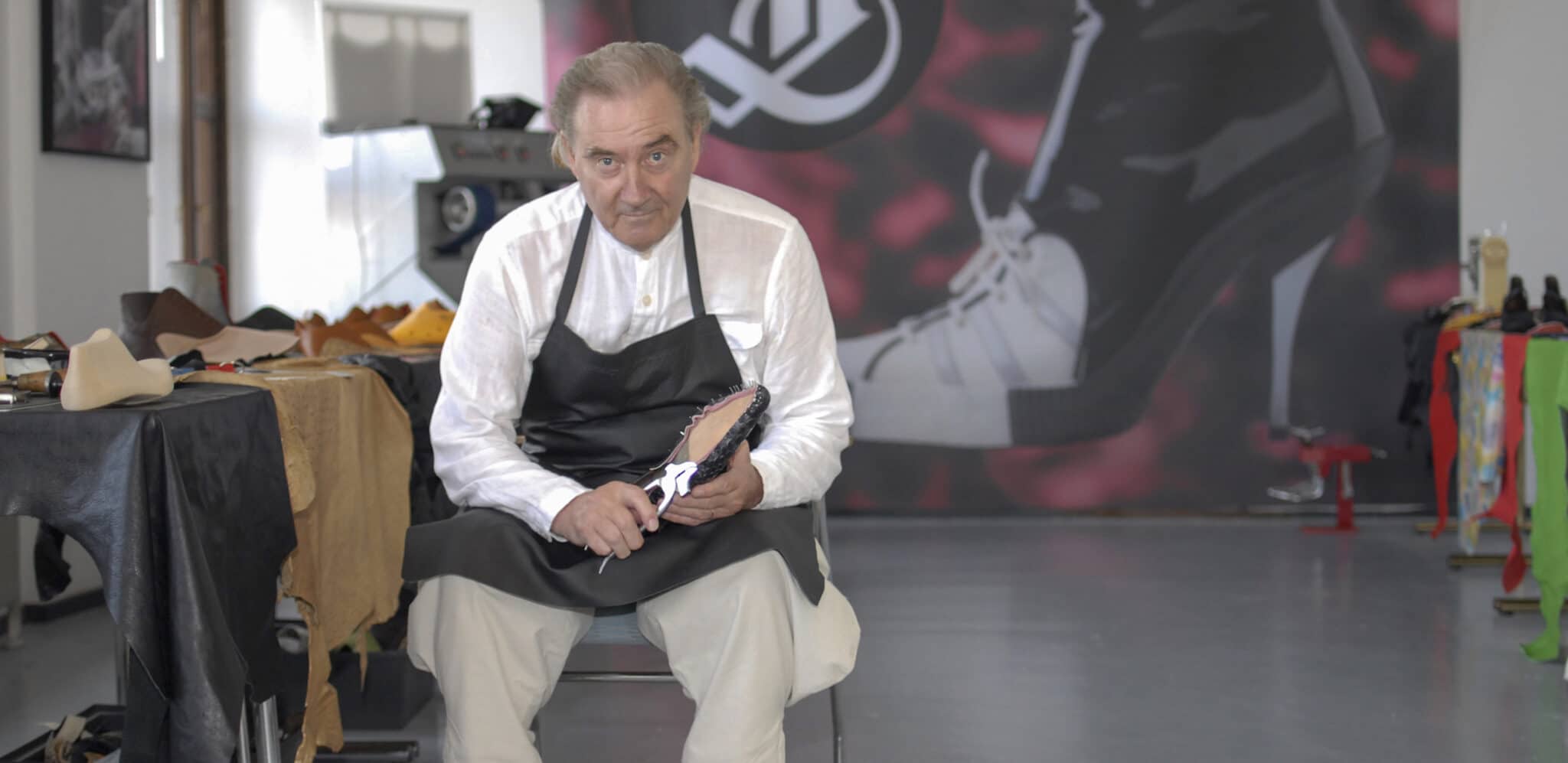
JAN JANSEN, SHOE DESIGNER
In MASTERS GALLERY, only creative and prominent masters are featured, the ones that truly stand out. Shoe designer Jan Jansen is such a master: a household name in the Dutch haute couture scene, known for his most impressive and striking shoe creations. In the gallery, Jan presents three masterpieces that move, inspire and intrigue him.
In MASTERS GALLERY there are only creative and prominent masters that you can admire. Shoe designer Jan Jansen is such a master: a household name in the Dutch haute couture scene with the most impressive and striking shoe creations. In the gallery, Jan highlights his three masterpieces that move, inspire and intrigue him… Text: Mical Joseph
Image: Joost van Manen
The orchid shoe (in the header)
“An orchid nursery approached me with the question if I could design a shoe inspired by the orchid. I immediately thought this would be too difficult. The nursery sent orchids and after a few days these flowers began to come alive for me. I was intrigued by the velvety look. It became not only 'that shoe for special occasions', but also for sensitive people. I made petals out of suede, putting wires between the overleather and the lining so I could shape and knead it. I raised the petals so that the petals hugged the beautiful woman's leg. Et Voilà: here was the orchid shoe that I never thought I could make. The shoe was worshiped in Moscow and St. Petersburg, where we had a show during Queen's Day. I didn't think the compliments I received were deserved, because I had only designed after a request from the client.”
WHAT IS THIS?
“This shoe has a strange lump on the instep. This strange thing is because I sometimes make a shoe for which I do not first draw a pattern, but where I try something out with a piece of leather with a knife (in this case with a knife and thread). It's just an experiment and I don't know in advance what the outcome will be, but with pattern drawing it's different. The round piece of leather has 39 holes of 1 millimeter, the thread that is pulled through causes the folds, creating an organic lump that looks like everything, but at the same time nothing. I'm often asked, 'What do you mean by that?' or 'Is that supposed to mean something?'. I find it intriguing because when I looked at the shoe I asked myself: 'What do you want and did I make this?' hence the name WHAT IS THIS?. To get a better look at the shoe, the heel on the back has two vicious-looking eyes. WHAT IS THIS? I still wonder.”
The X-RAY
“Rem D. Koolhaas Jr. is the nephew of world-famous architect Rem Koolhaas. He was a fellow student of my son Lok in Delft. At the time we lived above our shop on Rokin. Rem and a few more friends, Barend and Jeroen Koolhaas, often came by to have a drink before the men went out. They had to go through the store with all the shoes to get to the refrigerator. Rem was heartbroken at the time and wanted to make a shoe for his lost love. When he started the United Nude brand, I helped him with the first lasts and his paper prototypes. I saw something in it and United Nude has now grown into a global brand. Because I had done my bit, Rem thanked me by making a 'collaboration shoe'. A shoe based on my bamboo shoe from 1973. He based the prototype on a 70s design with iron. No sooner said than done: the X-RAY was born. An ingenious example of creativity from Rem and his technicians from China.”
The bamboo shoe
“In 1973 I designed the bamboo shoe for the Paris fair, the Semaine du Cuir. We were on holiday in the south of France and it was only after three weeks that I noticed that I was sitting on a rattan chair. This chair gave me the idea to turn it into a platform shoe. After several failed attempts to make a sole, I found Jan Zuil in Amsterdam, a rattan weaver, through Jan des Bouvrie. Jan made six pairs of perfect soles exactly according to my designs. I braided the tops on myself and had my samples ready.
During the Paris fair, people flocked to the shoe. Through the Dutch importer Jack de Lange, the major shoe manufacturer Charles Jourdan, who made shoes for Christian Dior and Yves St. Laurent, came to me and said: 'This is not commercial, but if you can think of this you can also do something simpler. devise'. After our meeting, I worked for Charles Jourdan as a freelance designer for years, in addition to my own Jan Jansen label. Among all the interest at the fair, an American came who had said the same thing as Roland Jourdan and he wanted one pair per store. Initially the shoe was not for sale, but for the office as decoration. The American wanted to know what the model cost, but I had not come up with a price at all, because I had no production. Since I wasn't going to deliver anyway, I just quoted a very high price, a hundred dollars at the time, and then he would drop out. But nothing could be further from the truth, the man agreed.
I asked how many stores were involved and it turned out to be the Edison Brothers: a thousand stores. So that was a thousand pairs of bamboo shoes and a hundred thousand dollars in turnover. In the end I was unable to deliver the shoes. Two years later I had only found a producer in Italy. This was thanks to the mediation of the Dutch importer Cees Oomens. In the Netherlands, De Bijenkorf was the first to buy the shoe and in 1975 they introduced it in their department store, after which I received the Golden Klomp on the occasion of selling the 100.000e wooden shoe. On October 4, 1973, The New York Daily News wrote: “Dutch designer Jan Jansen, currently taking Paris by storm. Star of the recent French Leather Fair, Jansen is likely to become an international household word by next spring.”


