Power
MOST INTERNATIONAL MUSEUM IN THE NETHERLANDS
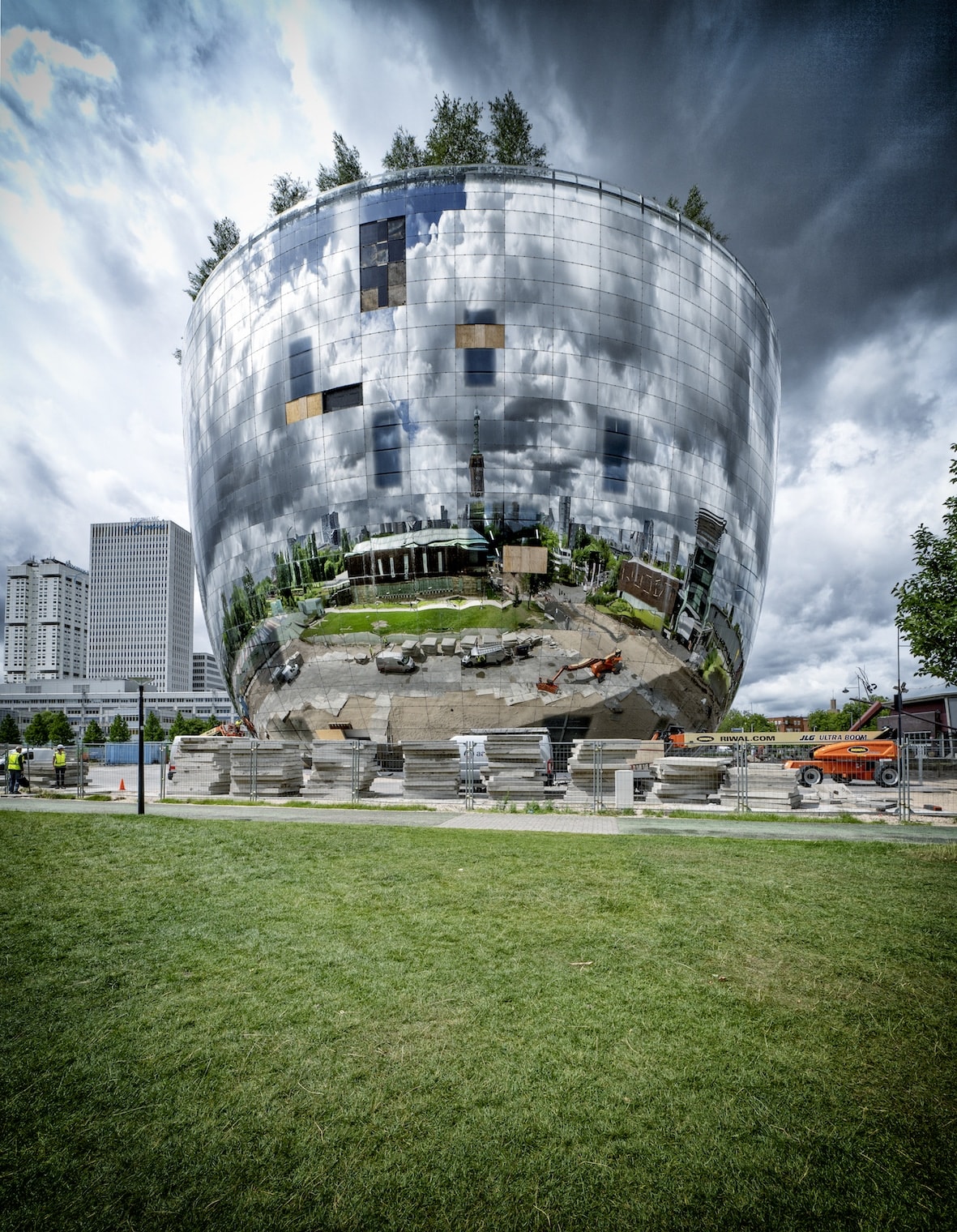
Since 2004, Sjarel Ex (Terwinselen, 1957) has been director of Museum Boijmans Van Beuningen in Rotterdam. One of his first achievements: an adjacent depot, which he put on track three weeks after his appointment. The building is now under construction and will be a real eye-catcher. In the meantime, the museum has been undergoing a major renovation since last year, which will take seven years to complete. The life of a museum director between construction site and demolition hammer.
Text: Bart-Jan Brouwer | Online editor: Natasha Hendriks
Image: John van Helvert
On May 26, 2019, Museum Boijmans Van Beuningen closed its doors for a period of seven years for thorough asbestos removal and subsequent renovation. How did that feel for you?
“Very surreal. As time passed on that day, things got crazier and crazier. A procession of hardcore fans of the museum walked through the building with a camera and photographed the most unsightly parts: light switches, grilles, toilet bowls, door knobs... 'Yes sir, we don't know if you'll leave that alone and we love this so much museum. Because...' – and then a story came, from people who had already been here with their grandfather or father. Many elderly people literally came to say goodbye. “Sir, it's my last time. I love coming here, but I probably won't make it to the opening of the new museum.' That was very moving. Others walked about in a hurry, I still have to see that. If we saw someone who was clearly not ready yet, we would take them with us after closing time and secretly show them works of art one-on-one. Everyone was like 'don't take it away, don't take it away!' I had that too. It felt like a total lockdown. The next day we left our office and left the museum. It was only at that moment that I felt what it was like, not just bad Titus at the lectern of Rembrandt, not to be able to see a painting by Jim Shaw or Chris Martin around the corner. The luxury of working so close to an instrument like a museum, with its beautiful sound and color, only became clear at that moment. Our secondary employment conditions were actually the primary condition for doing well. Now all art is stored in seven depots in the Netherlands and Flanders.”
How was the architect selected and what assignment was he given?
“The municipality acted as organizer for an international registration. Ultimately, 24 teams signed up, each consisting of two or three architects and a whole bunch of consultants. Based on the documentation, that number was reduced to three: KAAN Architecten, David Chipperfield Architects and Mecanoo. In four months, we entered into three dialogues with each firm for one day, during which we delved very deeply into the question: how can the museum maintain the quality of previous architects such as Adriaan van der Steur, Alexander Bodon and Hubert? -Jan Henket, fifty years ahead in the area where it is located, in the park where it is located, in the city it is for, in the country that is proud of it. Each architect was given an impossible challenge: whether three thousand square meters could be added. While the park is monumental, its edge is privately owned and all sight lines here are a protected cityscape. You had to be Houdini to solve that. Ultimately, after enormous deliberations, the jury unanimously chose Mecanoo. Architects from the Delft architectural firm had spent a week in the park - field work. They developed their plan with the knowledge of how the public used the park. So no form follows function of function follows formbut architecture follows audience. They have created a building that facilitates the movement of the public. Their plan opens up the museum in many ways and at the same time extends into the garden without violating the red lines. The park now consists of small private and public areas. We want the experience to become one whole, so that the entire park immediately breathes with it. The quality of Kröller-Müller, moving with nature, only in urban nature. With the addition of a glass corridor that meanders between the Van der Steur and Bodon buildings, as a catalyst and connector, the museum is transformed into a complex with good logistics for both visitors and residents. back of house. All museum rooms are easily accessible from this 'Mecanoo passage'. We throw out our arms and nestle like a cat in the most beautiful spot, without disturbing it. The winding corridor ends in a newly built pavilion, a wing for contemporary art. That is a longing for the future. Because we then have the beautiful Van der Steur building from 1935, a fantastic reconstruction building from 1972, the Bodon wing, and the new wing for the 21e century."
You had a lockdown within a lockdown. Do you think that this time brings new impulses for art? Are we going to get art about corona, like Francesco Traini's 'Triumph of Death', which was inspired by the plague in Florence?
"Absolute. The brilliant curator Okwui Enwezor, who died last year, proved this with an exhibition in the Haus der Kunst in Munich, where he was director for a long time. For that exhibition he had set a number of objective dates in time: the assassination of Kennedy, the atomic bomb on Hiroshima, the Intifada, 9/11... With a team he went to all countries of the world to see whether those moments in the art changed something. Art is permeable to time; art always has to do with time, but is not always about it. Because art is its own world, its own medium, its own language. Enwezor showed that at the moment of the sledgehammer blow, art immediately changed in color, material, temperament and activity. Corona is also such a blow and has an enormous influence on art. Perhaps because we are starting to appreciate art better again and experience and live it more intensively. The first time after the lockdown that I saw works of art again, live, material from our collection, was in the Cobra Museum in Amstelveen, where a very beautiful exhibition of our surreal collection opened last June. It was so moving, so beautiful! I couldn't keep it dry, even though they were paintings that I had already seen a hundred times. Art is more than just a mirror, art is more than just made beautiful, art is more than just something you hope for. Art is something that is extremely comforting and at the same time very exciting. You need that yourself and you have to see that for yourself, and you also see that in times of corona. This time is an intensification of what the senses really need for a full human being.”
What is the budget for the renovation of the museum?
“We have made a plan for the renovation for 223,5 million euros. The municipality of Rotterdam, which manages the building, is making 168,5 million available. The remainder must come from private parties. That amount is not very large at the moment - we are busy. We ourselves are as poor as a church rat: we have no equity, only intangible assets.”
To what extent does the municipality contribute to the annual budget?
“Normally we receive a subsidy of 9 million annually and spend about 21 million. We deserve that 12 million. When the museum and the depot are open, we anticipate that the museum's budget will increase to approximately 30 million per year.”
The museum takes its name from two important art collectors: Frans Boijmans and Daniël George van Beuningen, who bequeathed their collection to the city of Rotterdam in 1849 and 1958 respectively. How important is the role of private individuals in the creation of a collection?
“For us it is huge. That also makes the museum very exciting. If you search in the archives, you will see that we are half dealing with the government and half with the giving public. This varies from entire collections to a single Mondriaan or Israëls. It was a credit to every family who worked in the port of Rotterdam that they could give something back to the city. This often involved gifts in the field of art. Those families, even generations later when they have spread out, form a strong side of Rotterdam. If you don't give enough, 'you don't have it in your giving gland yet', that's what they call it here.”
Does the continuous expansion of the collection have to do with the fact that the audience grew from approximately 185.000 visitors in 2006 to approximately 300.000 in recent years?
"Of course. We have challenged people more, involved people much more in the museum, and it is more fun to be in the museum. On the other hand, I must say – I am also open about this – that the exponential growth that has taken place in a number of other museums has not affected Boijmans. In Assen and Utrecht, for example, it is occasionally busier than in our museum. Now the Centraal Museum Utrecht is an easy example, because I laid the foundation for it myself when I acquired the Dick Bruna House (Ex was museum director there from 1988 to 2004; ed.). But at one point we deliberately stopped with 300.000 people. I thought that was a good number for the Boijmans, because a museum visit is also about attention, peace, concentration and contemplation.”
You must have a very good museum shop here…
“Hahaha, I'm not saying that. What you can correct from someone else is different from what you can correct yourself from the same mould do it right in one go. It is also very difficult to know exactly your own talent in this regard, because one thing is very important: museums are not hierarchical, a museum is a team. There was an article in it recently de Volkskrant about 'the white men in the major art museums in the Netherlands'. I was also approached for that. I did not participate, mainly because of one question that I found very guiding: 'How many art-related people does the museum have?' And then I had to note how many of them were white and how many were colored. But we have no difference between people with art content and people who work in the museum. When you work in a museum, you are always involved in art. Every link in the museum is essential. If even one link does not function properly, you will see it immediately. Then something goes wrong, someone gets angry, a child stumbles. Everything is about that experience that you create six hours a day. The museum is a kind of combined work of art, in which the collection, the people and the building are essential. Those three should be about the same level. And we are now making up for a lot of what has become overdue in the architectural sphere.”