Amsterdam 750
In conversation with pickle king Oos Kesbeke
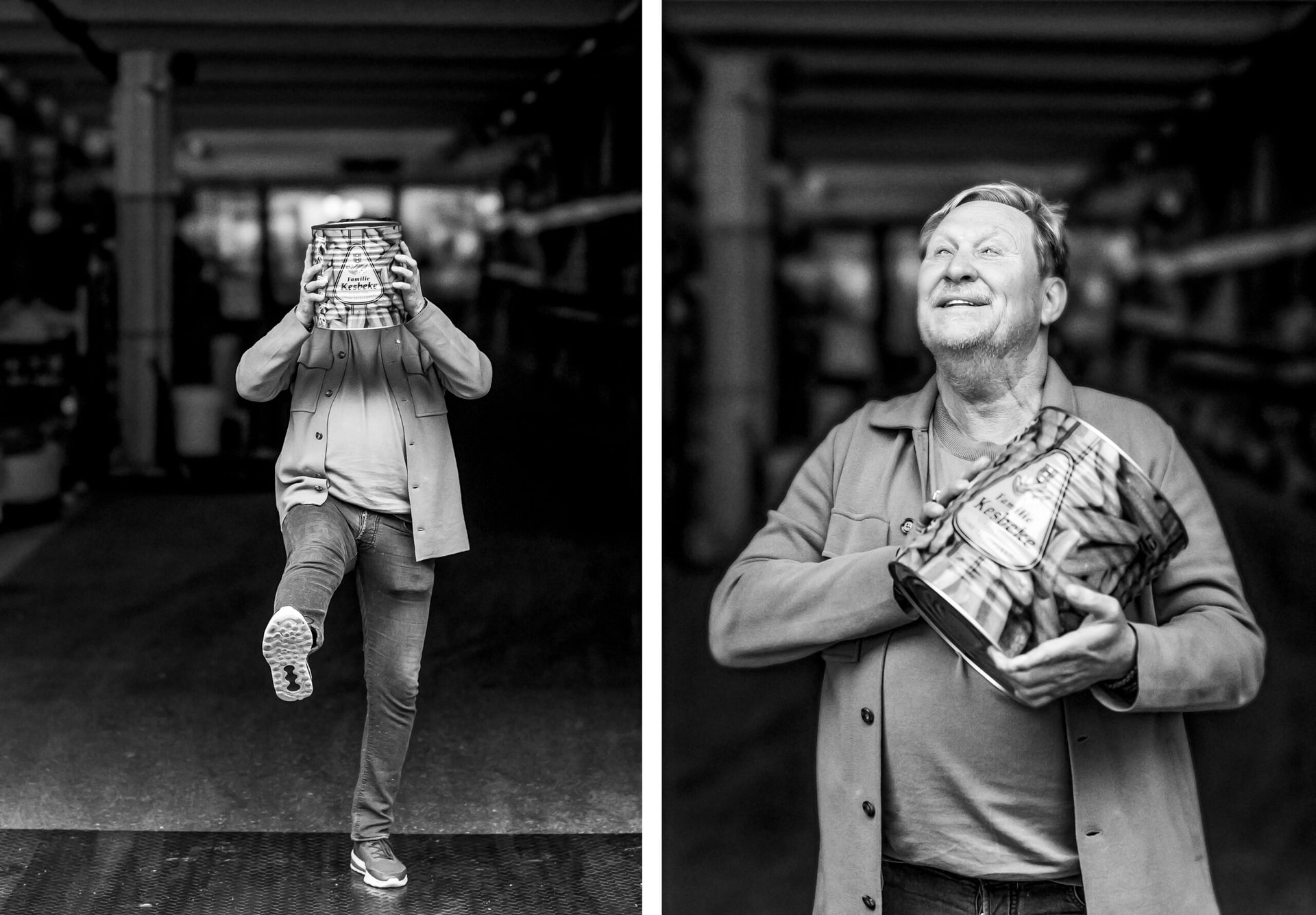
Oos Kesbeke, born and raised in Amsterdam, has been at the helm of the family business Kesbeke Fijne Tafelzuren since 1999, whose main activity is pickling gherkins, Amsterdam onions and silver onions. Kesbeke has grown into a rock-solid and innovative brand. In his own reality series De Augurkenkoning (The Pickle King), Oos gives a unique insight into his empire: a celebration of family, hard work and the Amsterdam spirit. MASTERS the temperamental entrepreneur/pickle king who managed to make gherkins boom.
Kesbeke has been a true family business since 1948. How is that reflected in your corporate culture?
“In my opinion, there is much more solidarity in a family business. I see people who work for us as family, because you share the good and the bad. You see each other more often than your partner. We are only a small club, so the 'love' feeling quickly develops. When it comes to the involvement of the staff? Employees become part of the family and that simply radiates through. In my opinion, the involvement is much greater than with corporate, which pays off in atmosphere and quality. And for those very young guests I am a kind of father figure.”
You are the third generation Kesbeke, and you took over the company from your father. What was your relationship like?
“Dad was very important to me. He taught me how to work. He was my best friend, but we fought several wars with each other. I am a stubborn bastard and he had the same character. That often clashed. He was strict, not to the boys in the company, but to me. Oh well, I am no worse off for it. When I took over the company, the bickering was fortunately over and he supported me with advice and action. I still miss him enormously: not a day goes by that I don't think of him. His soul is still in this company.”
What would Papa Kesbeke have said about you?
"I did so many things that he said I was crazy about, but I did everything I believed in. My father was more likely to tell someone else I was doing well than to tell me. I secretly think he would be very proud."
What makes the Kesbeke cucumber so iconic?
“We are the only pickle company that still makes everything in a traditional way. From cleaning to preserving: we do it all ourselves, and you can taste that. Ultimately, it is a combination of factors: the striking jar that is very recognizable, the taste, everything that has been written about it. A pickle like that then gets an image. What do I like best? I like a sweet and sour pickle.”
The Pickle King, the reality series about the ins and outs of your company, is a great success. What was the deciding factor for your cooperation?
“I came to the producers in the picture when I was seen on the program Above Water, which followed five family businesses. They said: 'You should have your own reality series.' That appealed to me, because with the series I could introduce everyone to my profession. A jar of pickles like that doesn't just appear in the supermarket: people don't realize how labor-intensive the process is that precedes it. We are not an average company and it is nice that people get a glimpse behind the scenes. I also wanted to have a kind of legacy leave behind for my sons who will soon take over the company. Wouldn't it be fantastic if everyone knew who Kesbeke is?"
What do you do as an entrepreneur when your product suddenly becomes a hype?
“The exposure we got thanks to The Pickle King was overwhelming and the demand for our products increased enormously. We had a period where we could not cope with the production. That is the worst thing there is, and the guys in the warehouse were running on empty. Everything was gone in one go. I was awake for weeks. Do you know what it is? A series like that and its popularity pass, but you want to keep the customers. If my customers have to suffer because of the success of a TV series, then we are going in the wrong direction. The business is always number one, no matter what happens. I got nervous because we were following the cart. It is now running smoothly again.”
Why do viewers like The Pickle King so much?
“I think the spontaneity. The Amsterdam thing, saying it like it is and how it is: good is good and shit is shit. I am averse to pretend stuff. The camera crew just films whatever is available. And you can see that in the series. I have to get used to that fame, you know. Who am I? I can't sing, dance or act. I'm just a pickle seller.”
And then suddenly you are a celebrity…
“Well, great. I was recently asked to come to a garden centre for a promotion. There were people standing in line for two hours for a photo! Who am I that these people do that? At first I thought: they must be a bunch of idiots. But they all turned out to be nice people. They were just fans. That's really weird, believe me.”
You were also present at the Televizier-Ring. What did you think of that atmosphere among all the media people?
“People who would normally walk right past me, came to contact me. Just because your series is doing well. Those look-at-me types. I don't have anything to do with them. Just act normal, man.”
You are grumbling quite a bit at work now and then, Oos. Doesn't that cause problems?
“I am a boy from Amsterdam with a nice company. I built it up with hard work and hard work. You don't think I can do that without ever saying something nasty? If I tell someone that he is a dick because he forgot to put away a pallet, I don't mean that he is necessarily no good. I just say: 'You idiot! How ken you do that now? It costs a few thousand euros if something happens to it. If you can't handle that, you shouldn't come to work here.' Yeah, if something stupid happens, I'll shoot out of my pantyhose. But anyway, it's like Amsterdam: I'm angry for five minutes, then we have a cup of coffee together. Those guys know I'd go through fire for them.”
Describe yourself as a manager?
"I am just myself, and without my employees I am nothing. My people are the real capital of the company. My door is always open. If you have a problem with something, come to me and we will solve it. It is a matter of give and take. That is how I am in the game."
What characterizes you as an Amsterdammer?
“My directness is typically Amsterdam, I don’t mince my words. I may be a big mouth sometimes, but a small heart. I really feel like an Amsterdammer, I think it’s the most beautiful city in the world. I love Ajax and I have a fascination for the Westertoren. I can’t explain it, but that tower has something magical for me. To be honest, I prefer not to go outside the city limits. And when I’m traveling, I get homesick very quickly.”
What is crucial for Kesbeke's success?
“An important part of the success is the mountain of love that goes into our products. Nothing leaves Kesbeke that we as a team are not proud of. We do our utmost to always bring new things to the market and to keep the quality high. You have to distinguish yourself as a small family business, otherwise you are at the back. I want to be at the forefront.”
You are also a supplier of top chefs. What does this collaboration entail?
“We stand for tradition, quality and innovation. Top chefs like to choose our products: quality is the heart of every culinary creation. We often talk to top chefs and know that variation ensures unique dishes. We come up with tailor-made solutions and this enables them to experiment and give free rein to their creativity. Together with Jonnie Boer I launched Jonnie & Oos, a collection of products with authentic flavours for every gourmet.”
Kesbeke helps people with a distance to the labor market. Why is this so important?
“I think that you should also give people who have a harder time a chance. I have people from all walks of life working for me: in terms of origin, background, with or without a disability. Everyone is welcome here. That creates a pleasant and positive working atmosphere. It is talked about a lot, but due to all kinds of prejudices, companies still do too little. It is a misconception that employees with a distance to the labor market cause a lot of hassle or that it takes a lot of time.”
Your sons, Camiel and Silvian, are being groomed to take over the company. What do you teach them?
“I try to teach them everything I know, sometimes to extremes. If they want me to work less or even stop altogether, I have to be sure that they can take over the company seamlessly. That takes time. They are both driven and have made the choice to come on board the family business themselves. That is the big difference between my sons and me: it was expected of me, it was a glorified 'must'. However, I never put pressure on their choices and I am extremely happy that they want to succeed me.”
Do you think you can ever let go of Kesbeke?
“No. My sons are developing very well, but I am still the boss. At some point I have to stop interfering, because having multiple captains on board doesn’t work. But letting go? That will never work. It’s my life.”
What do you say to someone who doesn't like pickles?
“Every fool has his flaw.”
Do you have any valuable tips for young entrepreneurs?
“Success doesn’t come by itself. If you really want something and you gather the right people around you, then I believe you will succeed. But your drive is incredibly important. If you want to achieve something, you don’t work from eight to five. You have to be constantly working to improve your business. That also means that you have to make sacrifices.”
What makes you proud?
“I never dared to dream that my sons would come and work for me. They did it out of love. Love for the profession and for the brand. If I go to a supermarket and there is a jar backwards, I always turn it around, with the label facing forward. They do the same. They are proud, just like me. I think that is great. I want to pass the family business on to them, just like my father did. The company is our life.”