
Amsterdam 750
Iconic buildings: the face of the city
1. Koninklijk Theater Carré The story of Koninklijk Theater Carré begins in 1830 in Rotterdam. A single mother, Adriana de Gast, entrusts her six-year-old daughter Cornelia to the director of a traveling circus, who promises to provide her with a good education. The girl becomes one of Europe's finest circus horsewomen. On […]
1. Royal Theatre Carré
The story of the Royal Theatre Carré begins in 1830 in Rotterdam. Poor single woman Adriana de Gast gives her six-year-old daughter, Cornelia, to the director of a traveling circus, who promises to give her a good education. The girl develops into one of the best circus riders in Europe. At eighteen, she marries the Prussian horse whisperer Wilhelm Carré. They have two sons, Oscar and Adolf, with whom they eventually form their own traveling circus. Circus Carré has a grandeur unparalleled in the Netherlands. The family thrives in Amsterdam and moves into a house on Middenlaan (currently number 112). In 1868, Oscar takes over from his father. Constantly setting up and taking down the wooden tent proves too much effort and expense. In 1879, Oscar manages to acquire a plot of land on the Binnen-Amstel, where he has a wooden building with a stone facade built. The opening performance is on January 10, 1880. Throngs of visitors enjoy the equestrian arts, juggling acts, and a parade of exotic animals, which are staying at the nearby Artis zoo. Oscar has been negotiating with the city for some time about the construction of a new building, but without success. When a fire in a wooden theater in Vienna kills over 400 visitors, the city relents. The "Stone Circus of Carré" opens on December 3, 1887. New Rotterdam Courant writes about it: "It is a palace that, not only by its dimensions, but also by its furnishings, reminds you of something princely. Wide entrances, easy staircases, beautiful coffee rooms and foyers – and then the main thing: a colorfully decorated hall, imposing in its width and height." From 1893 onwards, the theater was also used for theatrical productions. Beautiful details include the Logefoyer, where the Carré family lived part-time, and The Fire Screen by Siet Zuyderland: the largest single-piece painting in the Netherlands. The musical was performed at the centenary in 1987. Cats brought to Carré. The enormous success heralded the beginning of a heyday for musicals in the Netherlands. The awarding of the Royal designation crowned the centenary celebrations.
Which place in Carré does General Director Madeleine van der Zwaan have a special feeling about? The few steps between dressing room 3, the star dressing room, and the stage. That magical moment just before or after the performance.
2. The Maritime Museum
The National Maritime Museum is housed in the former 's Lands Zeemagazijn (National Maritime Warehouse), designed in 1656 by Daniel Stalpaert as a warehouse for the Admiralty of Amsterdam. At that time, Amsterdam was the largest port in the world. Naval ships would come alongside and be supplied with sails, cannonballs, and water. Rainwater was collected in the courtyard and seeped through the floor into large barrels, which, once full (they held 40.000 liters of rainwater), were then loaded onto the ship. In 1972, the building began a new life as a warehouse for the National Maritime Museum's masterpieces. A major renovation was undertaken in 2007. The cost, including refurbishment, was over 75 million euros. The highlight is the courtyard's roof, which consists of 1.200 pieces of glass in a metal frame. A total of 40.000 kilograms of glass and 160.000 kilograms of steel were used, making the roof weigh 33 elephants. The design is inspired by the compass lines of old nautical charts. With over 400.000 objects, the National Maritime Museum boasts the second-largest maritime collection in the world. One of the highlights is a full-size replica of the VOC ship Amsterdam, which sank in 1749 on its maiden voyage to Batavia.
Which place in the Maritime Museum gives General Director Michael Huijser a special feeling? “When I look at our glass roof from the Open Square, which is inspired by old sea charts, I can lose myself in the infinity of the stars.”
3. Rijksmuseum
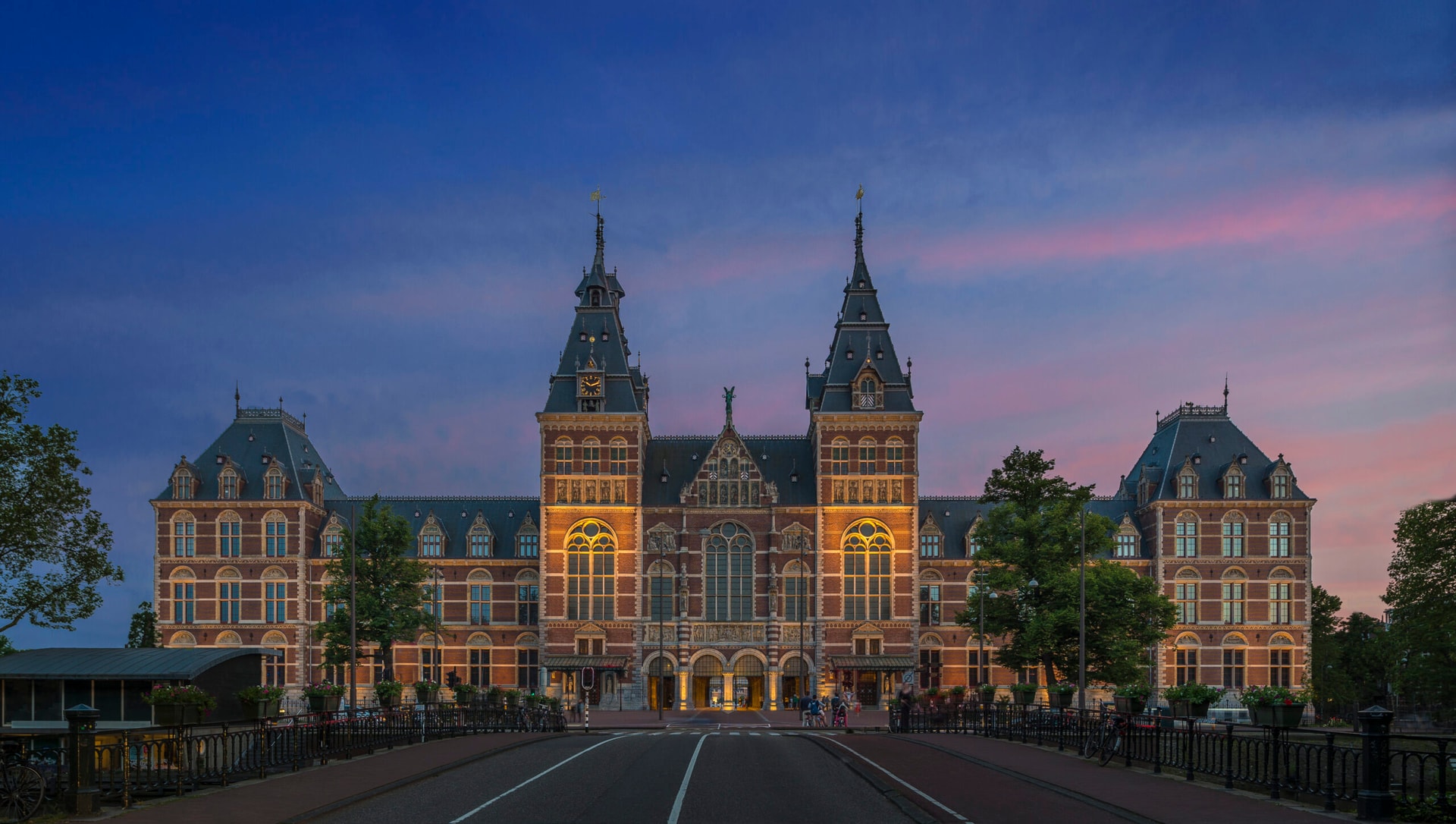
The museum has its origins in The Hague, where the art collection that the stadtholder family had built up over the centuries was housed in 1800 as National Art Gallery in Huis ten Bosch. When Louis Napoleon ascended to the throne in 1806, he ordered the collection to be moved to Amsterdam, where it was housed on the upper floor of the Royal Palace on Dam Square. In 1817, the collection of the Rijksmuseum, as it was now known after the accession of William I, moved to the Trippenhuis, a 17th-century city palace on Kloveniersburgwal. Beautiful museums were being built all over Europe, and the Netherlands also deserved a truly national museum building. This resulted in the Rijksmuseum, designed by architect Pierre Cuypers (after whom the passage that runs through the museum is named). It officially opened in 1885. Over the years, the building was renovated many times. Due in part to increasing visitor numbers, the museum no longer met the needs of a leading international museum. In 2003, a major renovation began, lasting over nine years. The cost was 375 million euros. Many original elements from Cuypers's era are being restored or reconstructed, restoring the building to much of its former glory. During the renovations, a hidden time capsule was discovered in one of the walls, containing documents and artifacts from the late 19th century. The Rijksmuseum's collection comprises over a million objects, but only 8.000 of them are on display, less than 1 percent of the total collection. The 2023 exhibition Vermeer With over 650.000 visitors, is the museum's most visited exhibition. More than 200.000 tickets were sold on opening day.
Which place in the Rijksmuseum gives General Director Taco Dibbits a special feeling? “In room 2.24, because that is currently A sprig of gooseberries on a stone plinth en Three peaches on a stone plinth are on display by Adriaen Coorte. In these paintings, he impressively captured the beauty of nature. Strawberries, apricots, asparagus, gooseberries, and peaches: his 17th-century still lifes are not well-known, but they are incredibly beautiful.
4. Eye Film Museum
Like a shining beacon, the Eye museum building sits on the northern bank of the IJ River. The Viennese firm Delugan Meissl Associated Architects (DMAA) designed it as a jagged crystal, its faceted shape reflecting the light differently throughout the day. The design is a tribute to film itself. A play of light and dark, designed for the power of the image. Once seen, always on the retina. The lines are straight, but the angles rarely 90 degrees. This gives the walls, floors, and ceilings dynamism: a suggestion of movement. DMAA has expressed the cinematic experience in the architecture. The architects conceived the building as a series of scenes in a film: the experience changes from space to space. The Arena at the heart of the building makes Eye more than just a museum. Here is the café-restaurant with a terrace and panoramic views of the IJ River. Stairs ascend on the other side of the space. They form a grandstand where you can sit with a view of the glass facade, like a movie screen on which the story of the IJ and the city unfolds. "We're not hoping for a miracle, we're creating one," were the words of then-Eye director Sandra den Hamer three months before the opening in 2012.
Which place in EYE Film Museum does Director of Collection & Knowledge Sharing Maral Mohsenin have a special feeling about?
The staircase in the museum building is where I feel most special, thanks to the view—not only of the bar, where visitors relax before or after exploring EYE, but also of the majestic IJ River in the background and the ferries that connect Noord with the rest of Amsterdam. It feels like a movie unfolding in real time before our eyes. This glorious yet cozy perspective perfectly embodies how EYE strives to bring people together through culture and emotion.
5. Valley
Three towers with spectacularly cantilevered apartments on the Zuidas axis together form the plant-covered Valley, which also houses offices, shops, restaurants, and cultural facilities. Below, at a height of 104 meters, lies the TWENTYSIX restaurant with a sky bar, where you can enjoy delicious dishes and a stunning 360° view of the Zuidas. There is also the exclusive gentlemen's club DOMÍN, where the top segments of sports, entertainment, and business are luxuriously catered to. The residential floors begin on the eighth floor. Valley comprises a total of 198 apartments. One of them is home to former lawyer Oscar Hammerstein: he calls his location "an eagle's crag," with a perfect view of the city. The design by Winy Maas of MVRDV has several facets: on the exterior, a shell of smooth, reflective glass, which fits into the context of the Zuidas business community. Inside, the building has a much softer, natural side, replete with natural stone (40.000 Catalan tiles!) and greenery. Piet Oudolf designed all the greenery – over 200 trees and shrubs and approximately 13.000 plants. Valley combines the latest insights in sustainability, technology, and health. It has received a BREEAM-NL Excellent certificate for its commercial spaces, and the residential section scored an 8 out of 10 on the GPR Building Scale, a Dutch measurement tool that rates buildings on five themes: energy, environment, health, quality of use, and future value.
6. Pontoon pier
An iconic residential building on the IJ River—that was the municipality's ambition when it issued the contract for the site of the ferry landing stage in the IJ River, which has served as the departure point for the ferry between Amsterdam and North Holland since the 1950s. A landmark for the new Houthaven neighborhood was to be built here. Arons and Gelauff architects won the contract and added several additional ambitions. For example, they envisioned Pontsteiger, as they called their proposal, to be situated not on the water, but in it, thus creating optimal contact with the IJ. A special glaze was developed for the facades in collaboration with Royal Tichelaar from Makkum, allowing the building to feature six different shades of stone. The building's colors will change with the weather: light when the clouds are gray, glowing golden at a clear sunset. Closer up, the green copper tones are striking, beautifully complementing the water of the IJ. Hospitality entrepreneur Won Yip purchased the entire top floor in 2016. He paid around €16 million for 1.440 square meters, making it the most expensive penthouse in Amsterdam. Yip then splits it three ways: he keeps a quarter for himself, a quarter goes to Messagebird founder Adriaan Mol, and half to Daniel Grieder, CEO of Tommy Hilfiger. Mol immediately puts his home up for sale, without ever having lived in it. Grieder also splits his share in two and sells half to Marcel Boekhoorn. The pace at which the apartments are selling is staggering, as is the increase in value and the profits earned.
7. Infinity
The former ING House, also known as Poenschoen, Klapschaats, Strijkijzer, or Kruimeldief, was designed by architects Roberto Meyer and Jeroen van Schooten for the ING Group. ING wanted a building that exuded openness, transparency, and modernity. They achieved this: a futuristic glass structure supported by tall steel legs. The design is characteristic of an era when banks sought to demonstrate their success through impressive architecture. Meyer notes that "money was not an issue" at the time. Although the exact construction costs have never been made public, it is estimated to have cost around 100 million euros. During the opening of the new headquarters on September 16, 2002, Chairman of the Board Ewald Kist welcomed those present, including Crown Prince Willem-Alexander, "to the lion's den." This proved to be true: in a video presentation, a real lion, the symbol of ING, visits the building, including the roof terrace and the board meeting room. During the filming, the lion sinks its teeth into one of the boardroom chairs, which is now preserved as a memento of the opening. In his speech, Kist briefly touched on the unique design of ING House. "We used twenty square meters of glass per employee, because we want to be crystal clear." Twelve years after its opening, ING was forced to vacate the building due to the consequences of the global financial crisis. Today, it houses a multi-tenant office building.


