Power
Simonis: The fish king of Scheveningen
Family businesses form the backbone of the economy. They show how knowledge and craft pass from one generation to the next, rooted in the past.
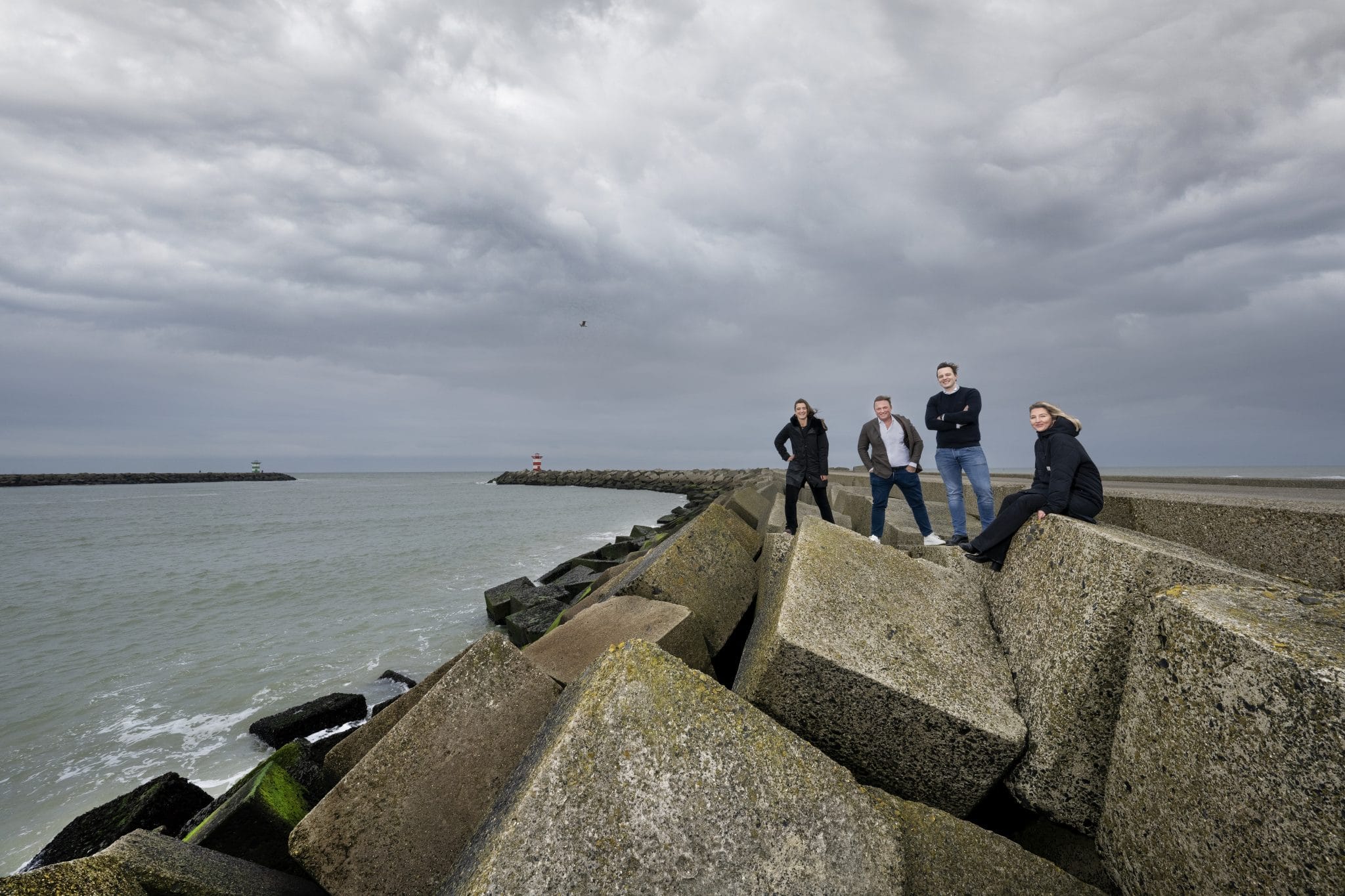
Family businesses are the cornerstone of the economy. They show the development from the past from parent to child. At the same time, as long-term companies, they look far ahead. In this series, MASTERS portrays family businesses with a story. This episode focuses on Simonis, which started as an eel smokehouse in 1880 and has since grown into the largest fish seller in the royal city, with freshness, good price-quality and a varied offering as pillars: from kibbeling in the fish snack bar on the boulevard to sea bass fillet with truffle in the trendy Still at the marina. MASTERS vis-a-vis with the fourth generation: brothers Alain (1983) and Giovanni (1989) and sisters Naomi (1996) and Joëlle Simonis (1986).Text: Bart-Jan Brouwer
Online editor: Fleur de Jong
Image: John van HelvertSimonis is a household name in The Hague and surrounding areas. A family business with a love for fish, generation after generation. It starts in 1880, when Albert Simonis opens a café and smokehouse on Westeinde in The Hague. His son Albert junior and his wife Geer took over from him and from 1935 onwards they became an indispensable part of the Hague market. They sell thousands of pounds of eel a week. The season runs from May to September. During the rest of the year they do other trade, such as textiles. When the eel population slowed down, partly due to catch limits, the third generation – Wil, Herman and Allie – started a fish shop on the Gedempte Gracht in 1966. It still exists, with a restaurant area attached to it. In 1980, for environmental reasons, the eel smokehouse had to be removed from the city center and moved to the port. There, on the Visafslagweg, Simonis aan de Haven is opened, which initially started as a smokehouse (there is no inconvenience to the neighbors). Because the boys who smoke eel are constantly interrupted by people who want to buy this delicacy, the location is expanded with a small shop and later also with seating areas for guests who want to eat their portion on the spot. Payment is made immediately and customers are given a number. When their food is ready, for example a portion of kibbeling, plaice, shrimp or squid rings, the restaurant announces the number in plain Hague. That's how it still goes today. After several renovations, Simonis aan de Haven is now an ultra-modern combination of fish shop and fish restaurant. Several locations followed: with beach tent Simonis aan Zee, the family has also been present on Scheveningen beach since 2001, after the market, the city and the port; a fish snack bar followed in 2002 on the boulevard, opposite the Scheveningen pier; In 2013, the classic fish restaurant Catch by Simonis opened at the second inland harbour, followed four years later - a hundred meters away - by the trendy Encore by Simonis. What started as an eel smokehouse at the end of the nineteenth century has grown into a multi-million dollar company that consists of several fish specialty shops: currently seven permanent locations and three locations on the market. For all, fish is the basis of everything. It is in the blood of the Simonis family, it flows through the veins. Simonis is led by the now fourth generation, consisting of brothers Alain and Giovanni and sisters Naomi and Joëlle, the children of Allie and Joyce, who has also always worked in the company. The children of Allie's brother Herman are also in the business. “We are actually the fifth generation, because my great-great-grandfather already sold eel door to door and to cafes. But the company itself really started with the smokehouse and in the market.”What are your first memories of the company?
Alain: “I didn't consciously experience my grandfather, he died when I was three. When I could just walk, we had the fish shop at the Fish Auction and our place on the Hague Market. Ever since I was eleven or twelve, I went to the market with my father on Saturdays, where it also started for my grandfather and grandmother. Throwing away garbage, cutting off pieces of fish to proportion it, those kinds of jobs. In addition to my school, sports and studies, I tried to participate as often as possible. I have been in all places, from the stall to the shop to the restaurant. Simonis grew and grew. Over the years, our knowledge became broader and during our travels we came into contact with new products. Take Simonis aan de Haven. When it turned out that people who came to shop there preferred to eat fish straight away, a few tables were set up. That's how it happened. Currently, between 30.000 and 35.000 diners visit the restaurant area every week.”Was it expected that you would also join the company?
Alan: “Our father always said: 'You should do what you like.' But he did show that we could do our part and possibly carry the company on to the next generation. That came more and more to life. The moment I went to Rotterdam to study at Erasmus University, I already knew that I wanted to play a role in the family business one day. Partly because I could work for myself and do business myself. When I used to go to the market with my father, we first picked up merchandise from our shop on the Visafslagweg and from a salmon smokehouse a little further away. In those years, there were already many immigrants on the Hague Market, for whom the trimmings of smoked salmon, such as bones and stomach walls, were very popular - they made soup from them. My father offered me a choice one day: I would either get my paycheck at the end of the day, or I could make my own money by trying to sell the boxes of salmon. I then opted for my salary, which provided a guarantee. But I saw that salmon was sold easily. That's how my father taught me the principles of entrepreneurship.”
John: “I always wanted to become a doctor and I went to study medicine in Leiden. Once I completed my internship, I discovered that hospital life did not suit me at all. I had always enjoyed helping out in the family business as a part-time job and knew: this is it. The blood creeps where it can't go. I had every opportunity and took them, but in the end I chose to enter the family business. I have been there full-time since 2017 and am manager of Simonis aan de Haven.”
Naomi: “For me it started with clearing and washing dishes in Simonis aan de Haven, and I also worked at the market. When I was sixteen, Catch started. That really became my side job. From the first day the restaurant was open, I knew: I wanted to do this later! After pre-university education, I first went to the Hotel School for a year and a half, but that wasn't for me. That's why I switched to Marketing Communications. I completed that training at the end of 2021. At that time I was already in the management of Catch together with Joëlle.” Photo: Interieur Catch by SimonisWhat changes in consumer behavior have you observed over the years?
John: “We sell far fewer whole fish in the store. The consumer no longer wants bones in his fish, everything must be filleted.”
Alan: “And the consumer has become lazier. They would rather press a button to have it delivered than go get something somewhere. This was particularly noticeable over the past two years, during corona.”
What impact has corona had on Simonis?
Alan: “It's a matter of running or standing still for us, and the past two years it has been standing still. That brings uncertainty. Where do we go from here? Should we stop for a moment? But I think we handled it okay. It was a lot of moving and switching quickly.”
John: “We had to go into survival mode: cut costs, try to do as much as possible ourselves…”
Naomi: “…and stay creative, don't give up.”
Alan: “It had the biggest impact on Catch and Encore, because we have a full restaurant there. At least Simonis aan de Haven still has the store, which has only started to run better. The first lockdown was a bit of a shock, but it didn't last long. During the second lockdown we started delivering nationally, and we have not stopped doing so. This way we have been able to keep staff busy. Because that was the focus: that our permanent employees could keep their jobs. These boxes also kept us in the picture and attracted a different audience. After the second lockdown, many people who had ordered a box came to Catch or Encore for the first time.”
Naomi: “And when the third lockdown arrived, we knew what we had to do: put boxes together again, order stickers... Everything we also did in the second lockdown. So we were able to switch quickly.”
Alan: “And we were lucky that MASTERS EXPO could still go ahead at the beginning of the third lockdown. We had three locations at the fair, which meant we could employ fifty people for five days. We made many good contacts at the fair for meetings, company drinks and events. Now we have to wait until everything is allowed again.”
The new MASTERS Magazine
Want to read the entire interview with Alain, Giovanni, Naomi and Joëlle Simonis? The spring issue of MASTERS celebrates regained freedom after two years of corona. The value of this is underlined by developments in eastern Europe, where the freedom of an entire people is at stake. We live in a new reality, but we can make plans again, go out for dinner, meet people. The world is turning again! Only: which way? Time for new bridges, new initiatives. What this edition of MASTERS offers inspiration for.