Power
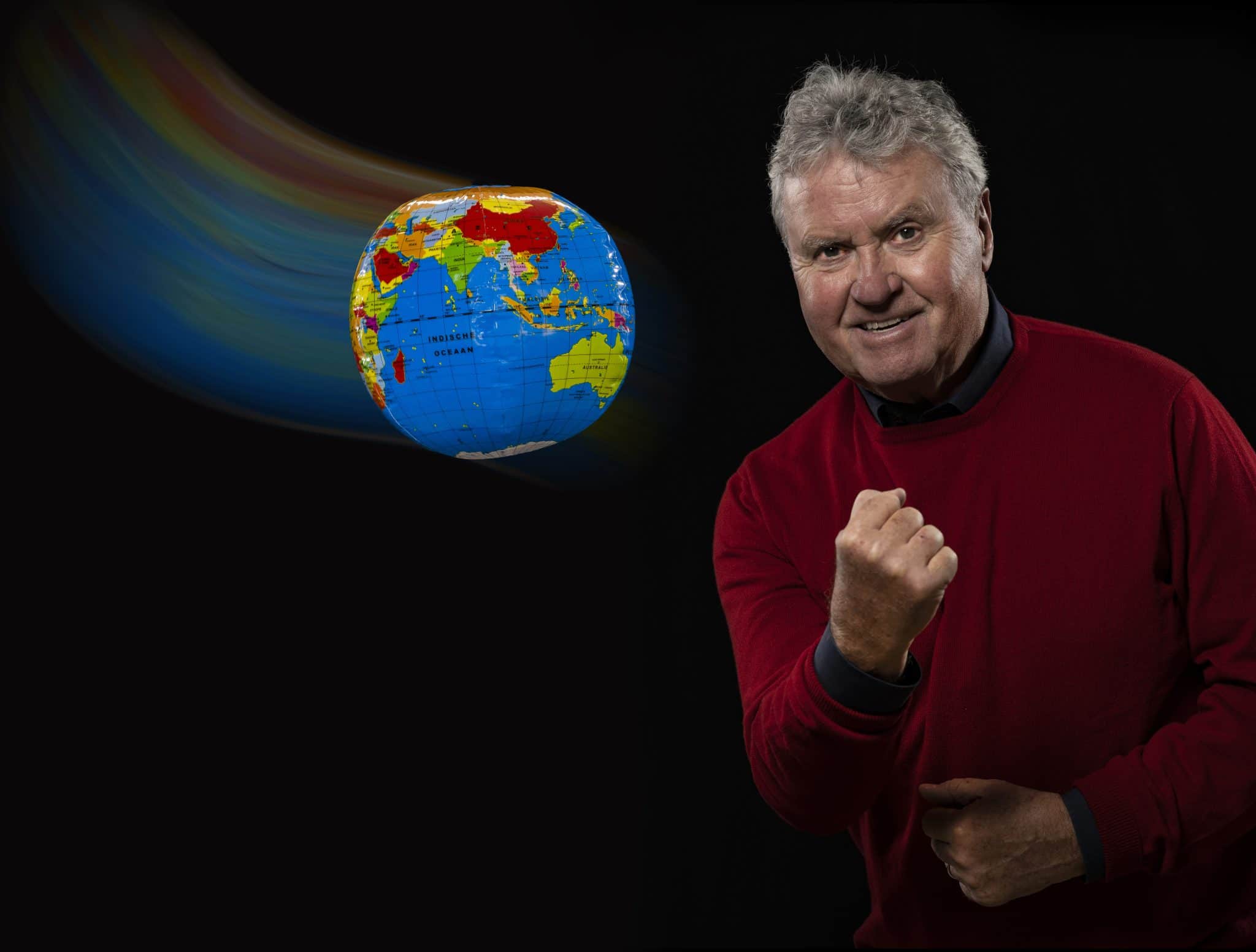
Guus Hiddink: the world as a playing field
He played football in the Netherlands and America, trained clubs in Turkey, Spain and England and was national coach of the Netherlands, South Korea, Australia, Russia, China (under 21) and Curaçao. Growing up in the Achterhoek, Guus Hiddink has become a world citizen in 75 years. He has put an end to his coaching career, but he remains active in sharing his knowledge. In a conversation with Jaap de Groot, Guus Hiddink therefore discusses the future of top football in detail. And that of trainers and coaches in particular. Text: Jaap de Groot
Online editing: Mical Joseph
Image: John van HelvertJust after you decided to stop as a trainer/coach, you became chairman of the interest group Coaches Paid Football (CBV) in November. Did the geraniums wither so quickly?
“That request indeed came quickly. Because doubt can sometimes be a good thing, I thought about it for a long time. I don't see myself as a director. But when I see that colleagues such as Theo Vonk, Leo Beenhakker, Louis van Gaal, Foppe de Haan, Han Berger, Ronald Koeman and Frank de Boer have been my predecessors, then it is a special position. Only I don't want to paint it as an honorary job, but have input. Especially given the current developments within top football. But then it has to be about things that I know what I'm talking about, and those are clearly not legal and legal issues. Agreements have now been made about this and I will be looking at it for a year, although I have been formally appointed for three years. If at the end of the year I notice that I cannot make a relevant contribution, I will stop again.”
Isn't this immediately a signal that you can send? Because why don't coaches have indefinite employment contracts, as in normal society? If it doesn't work, say goodbye to each other in a decent way. Now, just like with the players, long-term contracts are concluded and trainers and clubs have to decide in a decisive phase of the season whether they will continue with each other. This encourages distortion of competition.
“You have a point here. In the Eredivisie, five clubs have already announced that the current coach will leave and everyone knows that Frank Wormuth will soon move from Heracles to FC Groningen, while those clubs will still play against each other at the end of April. I've never been very sure. If it doesn't work, it doesn't work. I worked at PSV for six years and we always checked each year whether both parties felt good about continuing another season. I even know a club that has set aside a special fund to pay buyout payments for trainers, while that money should simply be invested in youth training. That is why this is indeed an interesting case for the CBV to see how this should be tackled.”What is the most important thing you did not learn on the trainer course?
“Interesting question. I think it is the adjustment between coach and club or country. It must always be in balance. That is why I have never taken a colony of Dutch people abroad and have always included a former player with coaching experience from the country in question in my staff. To get relevant information about football culture, outside influences and other matters. I have benefited greatly from former international players such as Bum Kun Cha, Graeme Arnold, Igor Korneev and Alexander Borodjuk. I mainly wanted to prevent myself from becoming an island in the big picture with too many Dutch people. The priority was to deliver what I was brought in for, but that is only possible if you know the environment in which you have ended up. Whether this is a club in the Netherlands or a foreign organization. And no matter how extreme the differences sometimes seem. Ultimately, my Korean assistants even joined in the Dutch card game toepen in the evening. In that respect, my first period at PSV was also very educational. I'm talking about the team that won the European Cup in 1988. A very conflicted group, with players not meeting on their birthdays. But as soon as they stepped onto the field together, they collectively had only one goal: to win! I hardly had to coach that process, but mainly had to manage it.”
In 2006, a state photo was taken with you, Johan Neeskens, Dick Advocaat, Pim Verbeek, Leo Beenhakker, Wim Rijsbergen, Marco van Basten and John van 't Schip. Four national coaches and their assistants who were active at the World Cup in Germany on behalf of Australia, South Korea, Trinidad & Tobago and the Netherlands. A huge contrast with the Dutch contribution later during the World Cup in Qatar.
“So nothing else outside the Dutch national team. One more reason to carefully analyze our training. Also bearing in mind that the World Cup will be expanded from 2026 to 32 participants in 48. It would be nice if the Dutch coaches were so well marketed that some of them could gain the wonderful and special experience of a World Cup.”
As for expanding the World Cup, isn't it worrying that FIFA and UEFA are organizing more and more tournaments and claiming unlimited players owned by the clubs? Isn't this how the Super League is promoted?
"Agree. The traditional associations must be careful not to overplay their hand. That the top clubs say: this far and no further. There are more and more owners and shareholders who feel that the value of their organization is being damaged. Due to this World Cup, even the Premier League will be shut down for two months in the autumn and after two corona years, this will cost the clubs a lot of money again. It will end at some point.”We can't ignore it. You have been active in Russia for a total of five years as national coach and technical director. How do you experience the current situation around Ukraine?
“I have almost daily contact with players and coaches I have worked with and everyone is ashamed. Everyone! Some have also expressed this on Instagram. A former player has already had people at his door, after which his account has also been blocked. I hate to hear such people apologizing to me for what a clique in Moscow is doing to the world. That's why when they say to me in the Netherlands: 'There are the Russians again', I immediately shout 'ho, ho, ho'. There is a big difference in Russia between a small political elite and the ordinary people. Putin and his clique live so far away from there, they have completely lost touch with what is going on among the people. They need to hear from me that bombings have taken place in Ukraine and that young Russian soldiers have been killed. They are all denied that. That's why I thought it was great that Roman Abramovich's daughter was the first to publicly criticize Putin. Abramovich then decided to sell Chelsea and use the proceeds to support the victims in Ukraine. Some have their doubts about that, but I see it as the first crack in Putin's untouchability. And now let's hope that more cracks will appear soon.”
The new MASTERS Magazine
Want to read the entire interview with Hiddink? The spring issue of MASTERS celebrates regained freedom after two years of corona. The value of this is underlined by developments in eastern Europe, where the freedom of an entire people is at stake. We live in a new reality, but we can make plans again, go out for dinner, meet people. The world is turning again! Only: which way? Time for new bridges, new initiatives. What this edition of MASTERS offers inspiration for.


