Amsterdam 750
Centuries of Thirst
Over the years, Amsterdam has become one of the world's most successful port and trading cities. Some companies have been around for a long time and are still active and successful. Amsterdam expert Bas Kok outlines a timeline of these pillars of the capital's economy.
1. Tasting room The Three Bottles (1619)
Behind the Nieuwe Kerk, where the echo of hymns still drifts through the alleyways, lies a time capsule of the Golden Age: De Drie Fleschjes (The Three Bottles). The "oldest documented pub in Amsterdam," originally a liquor store, is an altar to life's pleasures, where the sounds of an authentic organ create a symphony for all who listen. The organ, one of three in Amsterdam, consists of fifty barrels of distilled spirits, each fuller than the last, so they all make a different sound when tapped (hence the name "organ"). "Before you wanted to buy something from a barrel, you could taste it. That's why, historically speaking, we are a tasting room and not just a pub," says owner Johannes Bulthuis. He wants to preserve that authenticity – 60 percent of the clientele are regulars. With every kopstootje (headbutt) – the house specialty: a flute of pilsner with a tulip glass of their own jenever, made at the time by Distilleerderij Bootz (established in 1880), which was acquired by Lucas Bols in 1955 – you travel further back in time. Suddenly, you find yourself standing next to a merchant just returning from the East, spices in his wake and storms in his eyes. The display case, filled with mayoral bottles, harbors whispering ghosts: a toast to the past is never far away here.
2. Karpershoek (1606 or 1641)
A door that creaks like an old sailor's, a floor where the echo of boots and clogs mingles with stories that transcend generations. Karpershoek, at Martelaarsgracht 2, is more than a café: it's a haven for lost souls and stories waiting to be told. The walls bear centuries of secrets, etched in wood carvings and gilded proverbs. No loud music tears the night apart here, only voices, interspersed with the taste of a well-drafted pilsner and the melancholy of a past that never quite fades. If you listen closely, you might hear a soft lapping: an echo from the time when sailors raised their last glass here before the sea swallowed them up.
3. Café Chris (1624)
The Westertoren rose, brick by brick, and with it the thirst of the construction workers. At Café Chris at Bloemstraat 42, their wages were often paid in cash. As a souvenir, one of the glass beads from the imperial crown that crowns the tower is displayed under a bell jar. "After last year's restoration, we managed to acquire one," says the owner. The café exudes history: stained-glass Bols advertising, a yellowed portrait of Willy Alberti, pints hanging from the ceiling, and a billiard table that has been resonating with the sound of bouncing balls for generations. But the biggest attraction is the flushing tank for the men's toilet in the middle of the café – a testament to a time when thirst was more important than decorum. Can I join you for a moment? I want to flush.House specialty: lemon jenever from the Distillery and Tasting Room 't Nieuwe Diep.
4. The Grape (1863)
According to tradition, this charming neighborhood pub at Rapenburgerplein 83 attracted sailors as early as 1585 as a "sign-on café." Other sources believe that De Druif actually only began as a drinking establishment in 1863. Who knows? De Druif isn't captured in numbers, but in the aroma of jenever and the aftertaste of a well-told story. Here, time stands still amidst "kopstootjes," ossenworst (beef sausage) with Amsterdam pickles, and a bowl of hard-boiled eggs on the bar, where sailors once signed their names to sail to unknown lands. They left with hope, returned with homesickness—or not. The bar remained.
5. Papeneiland (1642)
In this traditional Dutch café at Prinsengracht 2, memories hang like copper bedpans on the walls, in an interior that, with its pendulum clock, pen drawings of the canals, and two porcelain beer pumps, exudes history. Tucked deep in the cellars is the entrance to a (now bricked-up) tunnel leading to a hidden Catholic church at Prinsengracht 7. The café's name refers to the time when Catholics practiced their faith in secret. But beyond that? A café where tables are scrubbed, Delftware tiles sparkle, the antique stove has hummed faithfully for centuries, and the specialty is aged jenevers from the A. van Wees distillery De Ooievaar, the only remaining artisanal distillery in Amsterdam. A café that suddenly became world news when Bill Clinton visited the city and sampled the homemade apple pie.
6.Café Hoppe (1670)
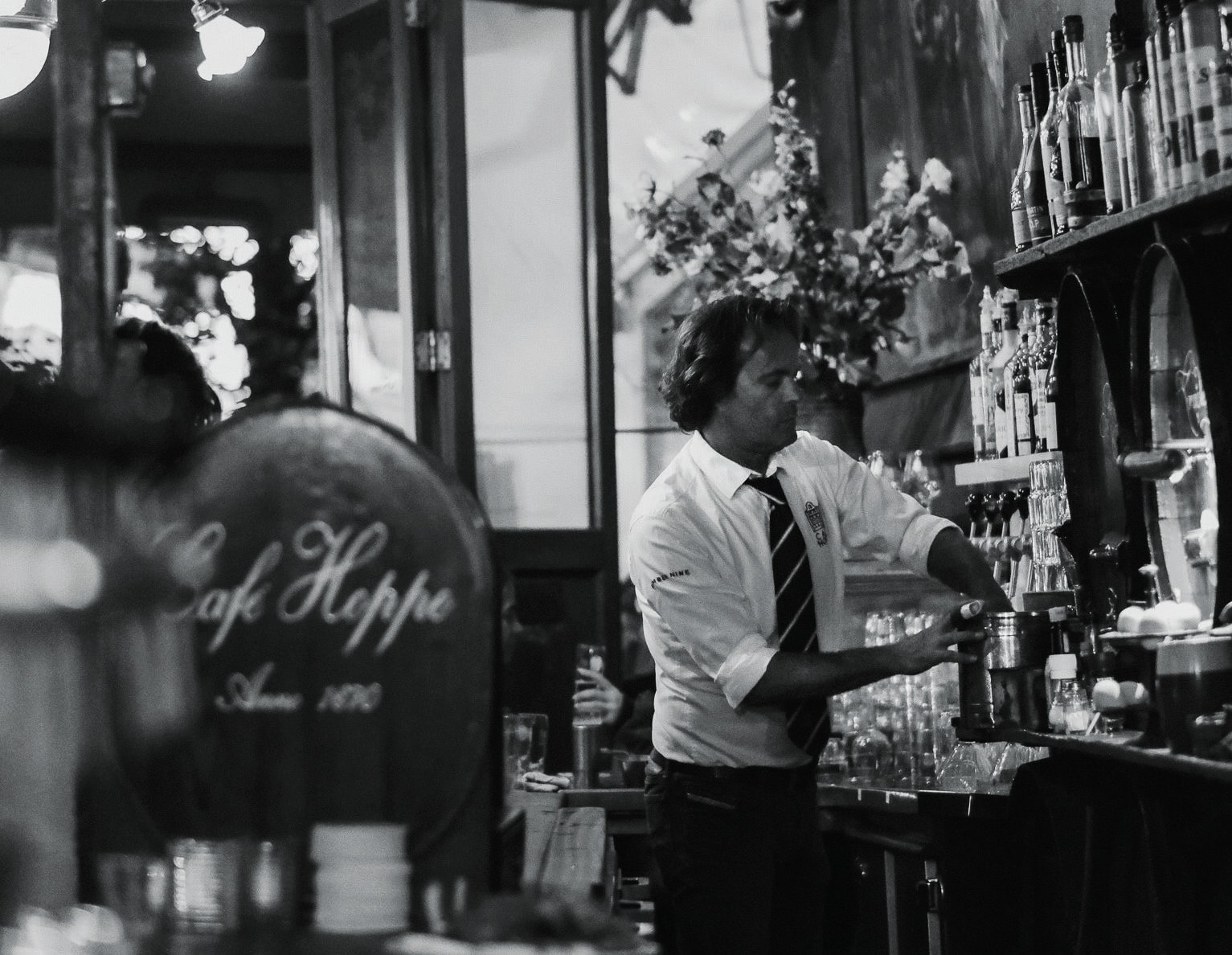
On the Spui, where the city lives, writes, and debates, there once stood a gin distillery that underwent a transformation. What began as a place for quiet connoisseurs became home to journalists, politicians, and thinkers. Here, Hans van Mierlo laid the foundation for D66, and Princess Beatrix—as a playful gesture—sold out together with Major Bosshardt The Battle Cry, while couturier Max Heijmans found inspiration in his "second living room." Drinks are still served standing at the wooden bar – because sitting down misses the dynamism of a pub where every glass carries a thought.
7.The Doctor (1798)
This café at Rozenboomsteeg 4 is also known as "the Little Doctor" because, at 18 square meters, it's the smallest café in Amsterdam. A pocket-sized universe, filled with eternity. While time speeds on around the corner on Kalverstraat, here it stands still: with its antique trinkets and oil lamps, covered in dust, it still exudes the atmosphere of the 18th century. The café originated when the Binnengasthuis was still a hospital. A doctor started a meeting place for doctors and medical students, and that's how it grew into Café De Dokter (The Doctor). Hence the old medical paraphernalia on the ceiling, receipts that look like referrals, and a wall of pharmacists behind the bar. According to Maria Elout, the seventh generation (!) who has run the pub since 1798, together with her husband Henny Beems, the Berlin silver bar and tap are also authentic. Jazz is the heartbeat here, with more than a thousand LPs. Chet Baker knew it, and so did everyone who opened the door and briefly stepped into another world. The heroin-addicted trumpeter wasn't always the easiest customer. "My father-in-law threw him out of the pub a few times," Henny recalls. Even the little house gin called 'Doctor's Recipe,' the Doctor's specialty, which cures just about everything, couldn't help Chet Baker.