Power
Masters Top Chef Dick Middelweerd
From zero at Ciel Bleu, Dick Middelweerd (Harmelen, 1963) developed into a star chef at De Treeswijkhoeve. Not without the necessary setbacks, such as a recent fire in the kitchen. But he tackles every crisis to emerge stronger. “That keeps the energy in your company, that good vibe.”
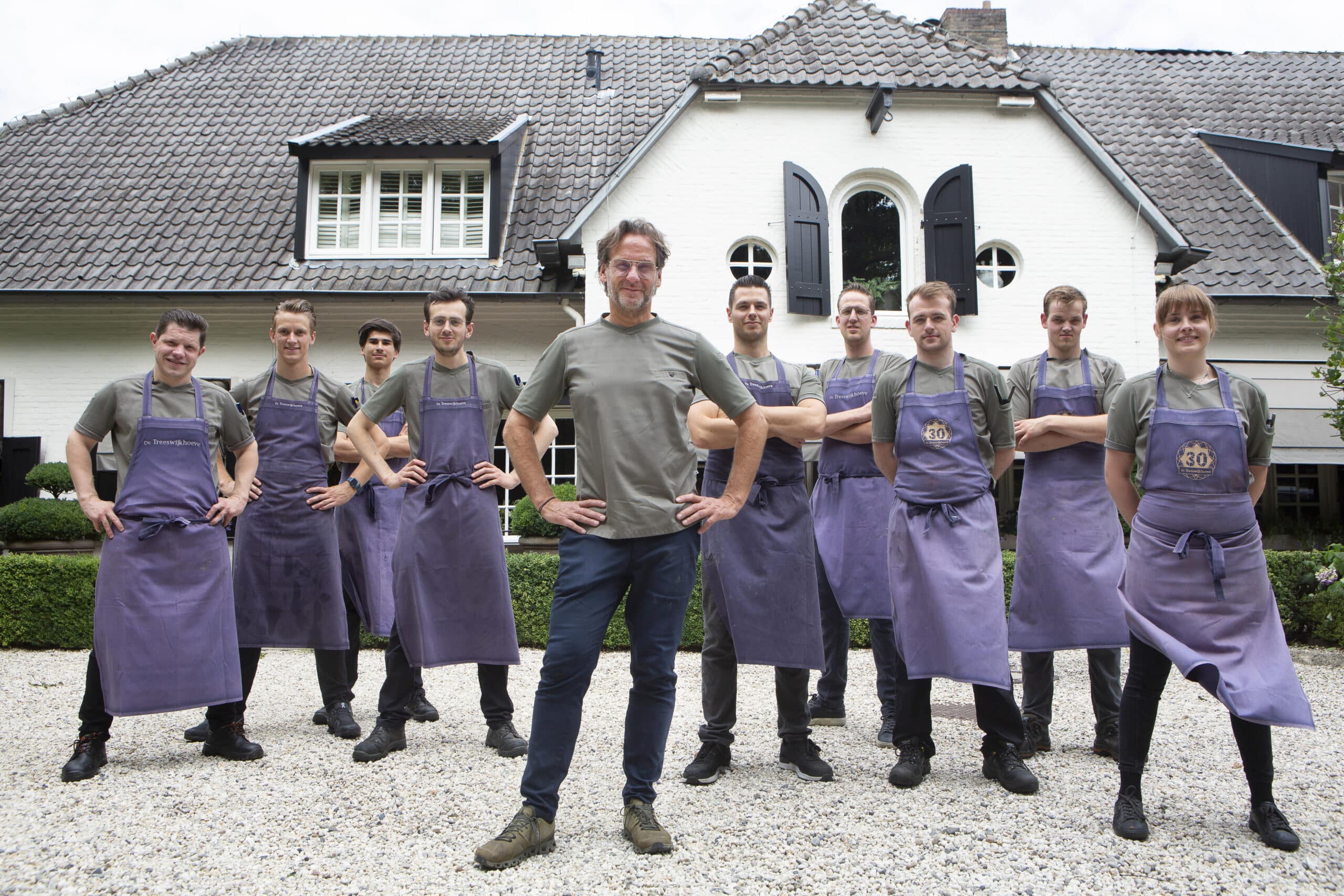
In the village of Waalre, the 'green fountain' close to Eindhoven, Dick Middelweerd and his wife Anne-Laura have been running De Treeswijkhoeve for 22 years. The restaurant is located in a farmhouse dating from 1916, which previously belonged to the Treeswijkhoeve Estate. A classic white farm with a gigantic terrace and a large herb garden where chamomile, sorrel, fennel and strawberries grow and where there are three beehouses, good for ninety kilos of honey annually. Upon entering, you immediately notice the special portrait that photographer Marie Cécile Thijs has shot of the chef: bowler hat on, cone of fries in hand. Two man-sized works by Marc Lagrange also testify to Middelweerd's preference for photography. In the private dining room there is a huge collection of Michelin guides from various countries piled up. Some examples date back to the XNUMXs. “The neighbor who lived on the Treeswijkhoeve Estate collected the guides. When she died, she transferred the collection to us,” Dick explains.
In the interior, dominated by predominantly soft brown tones, two imperceptible selenite crystals also stand out. These seem to stimulate, among other things, a clear mind. That bodes well for the interview! Dick and I sit down at one of the tables for an espresso, where he goes back in time. During his youth, which he spent in Harmelen, there was nothing to indicate that he would ever become a chef. “I had no passion for good food, I didn't help out in the kitchen, I wasn't interested in anything, zero. I had no idea what I wanted to be when I grew up. The only thing I liked was my drive-in show, a mobile disco complete with light organ. From the age of thirteen I provided the music at barn parties in the village. I earned about a hundred guilders with that. My uncle, who had a van rental company, took my things to the party location and picked them up afterwards.
In return, I promoted him by putting his company's name in large letters on my DJ set. At home I used the equipment to make pirate radio. I was interested in working for a channel like Veronica, but my parents were less enthusiastic about it. They were quite traditional and had their own business: they were in the heating oil business. Because at that time not everyone was using gas, certainly not in the farming area where I grew up. Later my father got into horses, originally a hobby of his - we even had a riding school at home.”
Provencal cuisine
Because Dick had no idea what he wanted to be when he grew up, his parents suggested that he take a career test. It turned out that a chef or baker suited him best. “I sometimes whipped meringues at home, I thought that was funny. And on Sundays I always watched with interest how my mother made roulade in one of those Moulinex ovens. But cook? I didn't like that at all. However, I had to decide quickly: I took that test in May and the advanced training for the LTS started in August. So I opted for the Consumptive Techniques course. And what do you think? I really enjoyed it! I learned everything about lemonades, tea and coffee, how to make bread, how to crunch tomatoes... I had never been much of a study person, but now I only got good grades. That made me happy.
After those two wonderful years, the apprenticeship system followed. The first training company was not a success - a party location with bitterballen, schnitzels, meatballs and bouncers on the menu. That chef left me to my fate, he simply disappeared. I stood there alone, at the age of fifteen. My consultant quickly helped me find another place to work: a roadside restaurant with a very classic chef who still made the Russian salad and croquettes himself. Wow, this is cool. I always thought croquettes came from a packet and Russian salad from a bucket. It dawned on me that you can make everything yourself.” That was a big step in the life of the novice chef, who via Hoog Brabant in Utrecht then ended up at La Provence in Driebergen, a star restaurant. “I was a bad eater, but I really liked what they cooked there. It was inspired by the Provencal cuisine of Roger Vergé, a three-star chef from France and one of the biggest names of his time. For example, the menu included 'fleur de zucchini': a zucchini flower with the zucchini stuffed with ratatouille. A very progressive dish at the time. Vergé even came to cook in La Provence sometimes. I still have a beautifully signed book from him. That's where I really became a fan of Provencal cuisine.”
Intruder
During his time at the LTS, Dick worked at the Apollo Hotel on weekends, where Ben van Beurten – an acquaintance of his aunt – was the executive chef. When he left La Provence, he called Van Beurten, who then held a position at Hotel Okura Amsterdam. Could he not go there? “Ben arranged for me to come and work in Ciel Bleu. A challenge, because at the time the restaurant was run only by Japanese. He wanted a Dutchman to get a foot in the door, because he had no control at all over what happened there. The chief of Ciel Bleu sensed this and was not happy with that intruder. On my first day at work he showed a timetable with only Japanese names and at the bottom Zero. “Do you know what that means?” asked the Japanese chef. “Yes,” I replied, “zero means zero.” 'That's you! You are nothing at all. I have worked in three-star establishments in Paris. Compared to me, you are a zero.”
A tough time followed.
For example, I was the only one who had to be there at ten o'clock in the morning to clean all the chefs de petit's refrigerators. Take everything out, scrub and polish, put everything back in. Two hours later the chefs reported on the 23rde floor and had to write down what they needed for that day. Then they use trolleys to take everything out of the cold rooms on the ground floor, where they just came from. I was really the slave there. I had to keep this up for three months, then a Japanese would come and take over my duties. When the time came, I went a step higher, to the entremetier, and I was a slave. From that moment on I was accepted, I was one of the guys. And I also did everything they did. Although the guests were served classic French cuisine, with those heavy Madeira sauces, the staff food was authentically Japanese. They started making katsudon themselves: schnitzel in a broth with onions, omelet on top and into the oven. Not normally so tasty! I still make them myself. And in the summer they played baseball every Saturday morning in the Amsterdamse Bos. 'Are you also there?' Of course I was there! Gathering at five in the morning and drinking beer at seven o'clock. Man oh man!”
Master chef
A third important milestone was De Hoefslag in Bosch en Duin. “There I tasted that southern French thing again. The drive in such a star store! Everyone was keen to make beautiful dishes. The atmosphere there was great, Gerard Fagel really knew how to build a team spirit. He listened to everyone, tried to stimulate everyone, improve things... That was unprecedented at the time. Normally if you did something wrong, you would get your head bashed in, so to speak. In De Hoefslag you were encouraged to get the best out of yourself. During that period I obtained my Master Chef diploma, at a quite young age: twenty-five. And that's where I met Anne-Laura. She started ministry the same day I did. Although she was originally a chef: she worked in the kitchen of Paul Fagel and Roger Souvereyns, among others.
I didn't open up to her right away because I had been dating for seven or eight years and had just bought a house. However, just before I started living with my then girlfriend, he broke up. She didn't really like sharing her life with a cook who had to work from early in the morning until late at night. Suddenly I was stuck with my own house! And I couldn't pay the mortgage on my meager wages on my own. Gerard Fagel came to the rescue. He wanted to know how much I had to earn to keep the house. When I had calculated that, he said: 'I will give you that salary, but you will have to continue working here for at least another year.'” That year, a spark flew between Dick and Anne-Laura.
Her parents were also in the catering industry. After running bistro De Heerlijkheid in Valkenswaard for years, they took on a new challenge in 1988: converting the farm where De Treeswijkhoeve is now located into a neat bistro. Anne-Laura left De Hoefslag to assist her parents in the kitchen. “A vacancy became available there in 1991 because the chef could no longer spend whole days in the kitchen due to a medical reason. Would I like to take his place? I didn't have to think about that for long. But once I was in the kitchen with Anne-Laura… That didn't work at all. My God! There was constant friction and irritation. The solution was simple: I do the kitchen, she does the front. Then it went like clockwork. It was a typical middle-class restaurant, a bit classically French: lobster, asparagus, lamb... I was in charge of the kitchen, but I couldn't really control the menu. I had trouble with that. And also with the decline in the business: if something broke, it was not replaced. My parents-in-law no longer had that drive.”
MASTERS MAGAZINE
Curious about the rest of the interview? In the autumn edition of MASTERS an interview with LVMH boss Bernard Arnault (“being the richest man in the world meant nothing to me”), a driving impression of the electric Audi RS e-tron GT, a report with the 'tree matchmakers' of The Green Contractors , an interview with star chef Dick Middelweerd and a visit to Barcelona with Ronald Koeman. The war, the climate crisis, the energy problem... Leadership and entrepreneurship are being called upon more than ever. With MASTERS EXPO | The Colorful Edition (8 to 12 December, RAI Amsterdam) we want to contribute in our own way and give the world a push in the right direction. In this edition of MASTERS a colorful preview of the most exclusive business fair. Time to think ahead, innovate, connect!