Taste
(De)sign of the Times: boundless creativity
The pull of gravity. Albert Potgieter was born in South Africa as a physiotherapist, but became a furniture designer.
The dissipation of gravitational forces
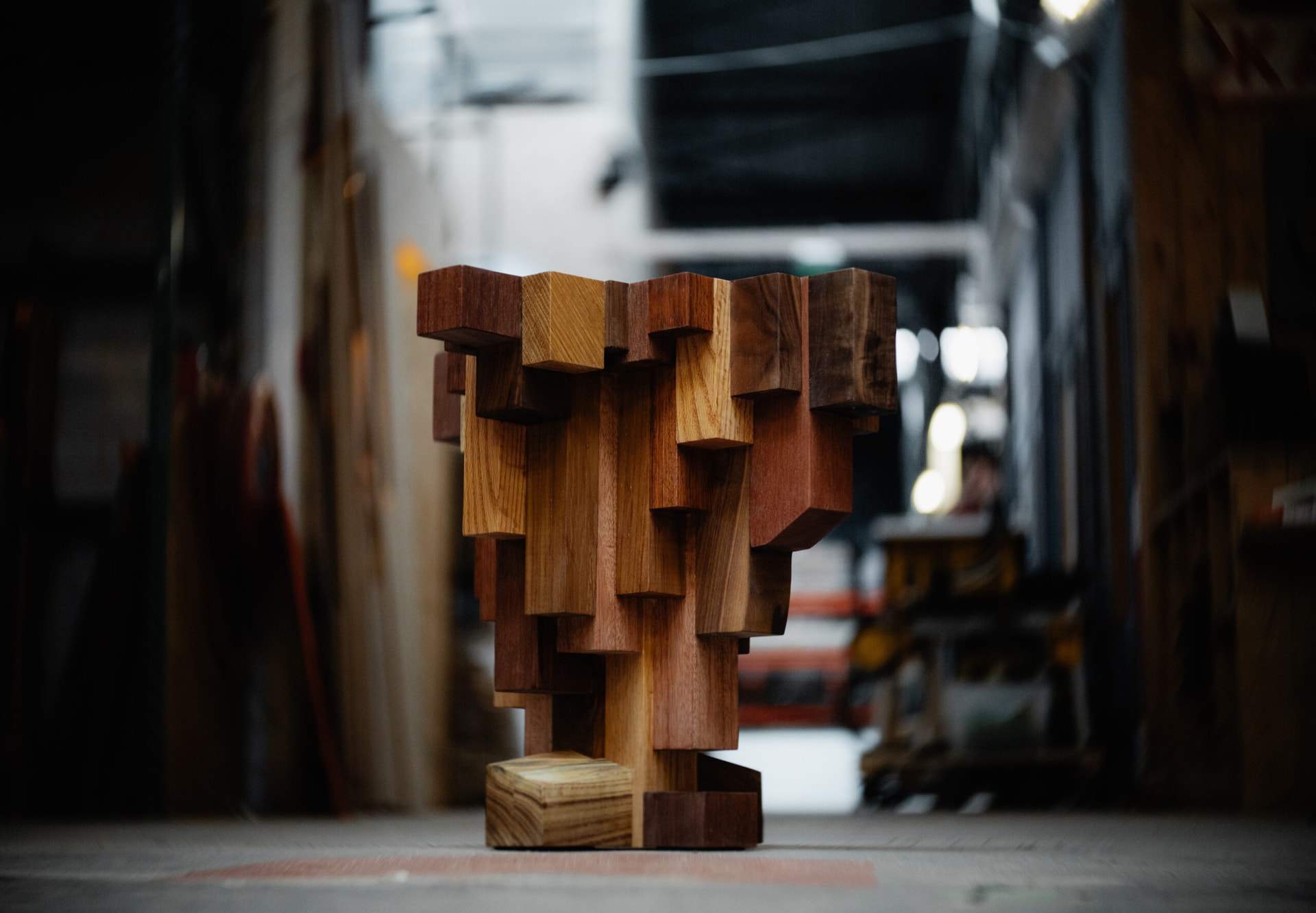
Albert Potgieter, born in South Africa, was a physiotherapist, but became a furniture designer when he settled in Rotterdam in 2017. It was not only his grandmother's wood carvings that inspired him. He also uses his professional experiences with the human body – looking and feeling – in his way of designing. Potgieter exclusively chooses hardwood, the versatility of which continues to surprise him. Be first Ahadi side table he chose varied types of wood with their own grain and color. He sawed and planed each block individually and stacked the elements into a sculptural piece of furniture. Some blocks are bevelled and ensure a 'natural dissipation of (gravitational) forces'. Potgieter likes to be inspired by the structures of leaves and trees and ripples in the water. He is also an idealist who hopes to reach and help people less fortunate than himself with his design and art. He wants to give something back to society with his sustainable, custom-made furniture.
Falling mug
Explores by creating an interactive experience Error, an interactive art installation by Maria Levengarts, the impact of our actions on others. The centerpiece of the installation is a table designed for shared use, but with a twist: when one person removes their mug from the table, a mechanism causes the other mug to unbalance the table. This underlines the importance of being aware of our environment and the potential impact our actions can have on others.
Made of lace
In her research into our relationship with nature, designer Carolijn Slottje has found similarities between the characteristic patterns of lace and the growth patterns of plants, bonsai trees in particular. By combining redundant lacework with the beauty principles of the dwarf tree, she has created a zeitgeist-resistant object. In Lacebark Bonsai the traditional Japanese art form is combined with the revaluation of lace. “During the Dutch Design Week I showed the bonsai trees for the first time. What I hadn't thought of myself, but what I found very nice reactions, was whether I also make trees from inherited lace. It happens that the lace is part of an inheritance, and the heirs do not want to throw it away because of the memory, but do not want to use it as lace in the house themselves. I was asked a few times if I would like to make a 'memory tree' out of it.”
Glass curtains
In the meter-high glass curtains of the Venice collection seems to reflect the water of the Venetian lagoons. Gray, green and blue tones, shimmering in rich variations, create a fairytale effect. The Venezia project that designer Elisa Ossino carried out in collaboration with Wonderglass consists of hanging fields of glass. These are made up of small strips, which are attached to each other with transparent thread. The curtains function as a room divider and are available in straight, wavy or round designs. Shapes and patterns can be varied to size. The relatively young company Wonderglass continues to surprise with creative and distinctive experiments in glass. Using an international arsenal of architects and designers, including the Japanese Nendo, the English architect-designers John Pawson, Tom Dixon and Paul Cocksedge.
Elisaossino.it | Wonderglass.com
Space Invaders
Photographer Hans van Asch presents his new photo series Space Invaders. A portrait of garden birds landing on homemade brutalist birdhouses in his backyard. 'Free as a bird' versus abstract architectural forms raise questions about quality of life.