
Taste
The train of trains – "it doesn't get any better!"
For Avila, it is not just about the destination of the journey, but also about the journey itself. In this case, the Venice Simplon-Orient Express from Amsterdam to Venice. The one and only, the most famous, the train of all trains. Travel journalist Ivo Weyel boards on behalf of MASTERS. He is amazed: luxury everywhere. The world is […]
For Avila, it's not just about the destination, but also about the journey itself. In this case, the Venice Simplon Orient Express from Amsterdam to Venice. The one and only, the most famous, the train of all trains! Travel journalist Ivo Weyel boards on behalf of MASTERS. And he's amazed: luxury everywhere!
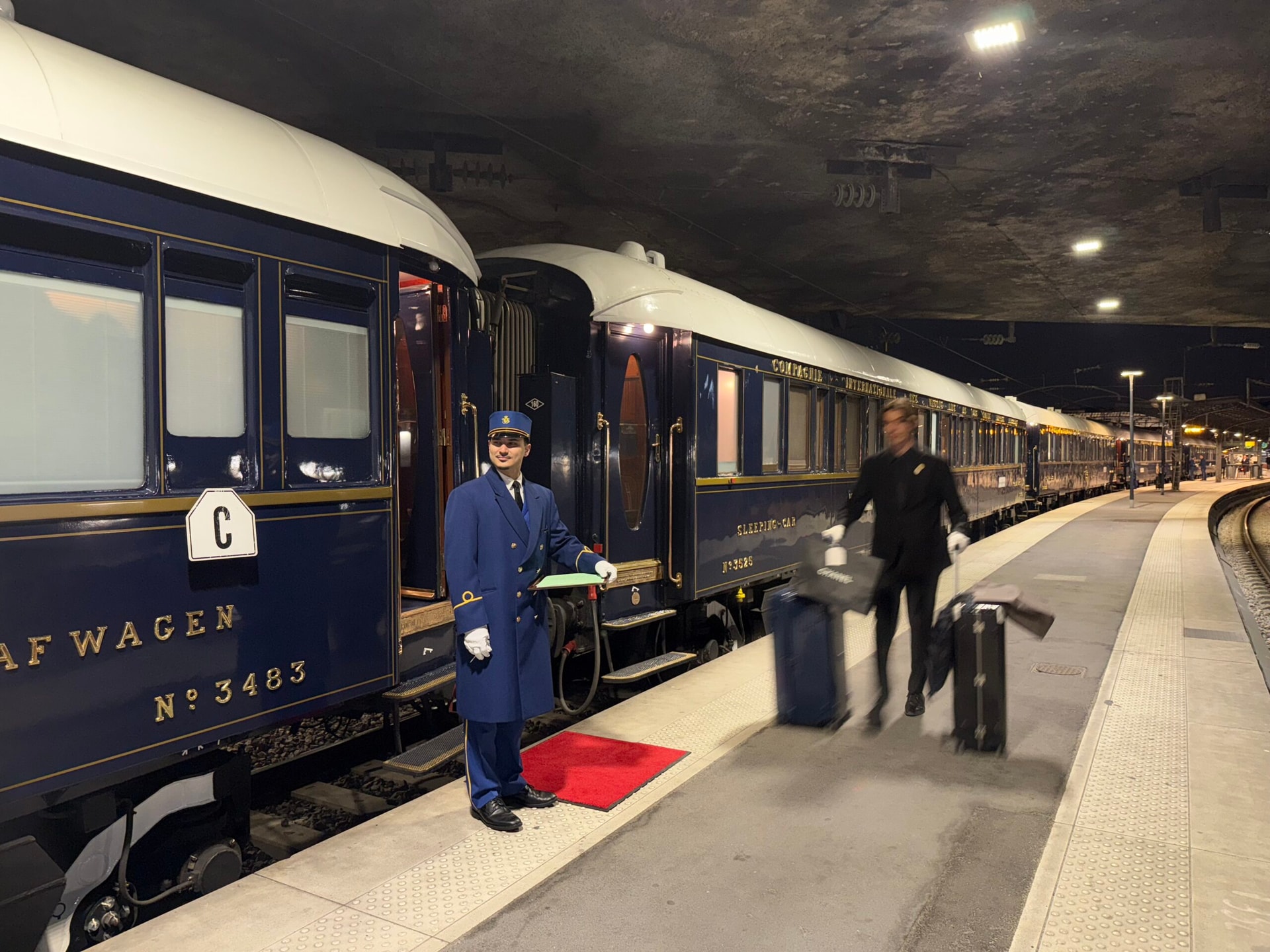
The world is divided into two groups of people: those who like to be the center of attention and the spectators, seen and be seenThey need each other to exist; one is nothing without the other. This was immediately clear in restaurant 1.e Class at Amsterdam Central Station where we gathered early in the morning as travelers on the Venice Simplon Orient Express. The seen They made their entrance unnoticed, in comfortable travel clothes with a simple suitcase or bag without a logo, just as usual, looking around a bit timidly. They sat quietly and waited. And then the be seen: much noisier, with gold LV, CC, or GC stamps on their suitcases, man-sized garment bags hanging from moving trolleys, conspicuously expensively dressed, the men busily chatting on their phones, the women urging the staff to be especially careful with their luggage. "That's a Chanel dress!" someone warned the porter. That's promising.
Agatha Christie
I've traveled on this train before, in 1987, when it was still called the Orient Express. I was in compartment A5 – I've kept all the paperwork. And lo and beholdThirty-eight years later I'm sitting in the exact same compartment again, in the same carriage, that special carriage with that wonderful past, as can be read on a shiny sign in the hallway:Sleeping Car 5544, built in 1929 and first used in the Train Bleu, then in the Rome Express, subsequently serving as a brothel in Limoges (1942-1945) and' – here it comes – 'immediately afterwards (1946-1947) as the Dutch Royal Train.' I don't think the sign was there then, because would Wilhelmina have stepped into a former brothel?
Much is changing in the world, but some things remain the same. Absolutely nothing has changed in my compartment: the Lalique crystal details, the gleaming lacquered wood with inlaid marquetry, the semicircular doors to the bathroom, the tassels on lamps and cushions, the pristine white monogrammed antimacassar... Of course, everything has been meticulously restored and modernized, and I can plug in my iPhone and there's Wi-Fi, but otherwise, it's a trip down memory lane. memory lane, especially the 1920s, the heyday of this train, when Agatha Christie recorded murder and mayhem in it.
Eat, eat and eat again
Trains are popular these days. Some choose to save the environment, others, under the adage "it's not the destination that matters, but the journey" (a quote attributed to the nineteenth-century American philosopher Ralph Waldo Emerson). This Orient Express is the zero plus ultra of the second category, the chief of all chiefs, the train of trains. Due to its popularity, the number of Orient Express-like trains is bewilderingly large. There's the Eastern & Oriental Express, the La Dolce Vita Orient Express, the Orient Express (without the Venice-Simplon), and a few others, but the original, oldest, and most famous is the one I boarded that morning. A one-way ticket from Amsterdam to Venice starts at around four thousand euros per person (in a compartment with two bunk beds), rising to around fourteen thousand euros per person in a luxury suite. But that's a bargain, not to mention the constant flow of champagne and the ubiquitous butlers who fulfill almost every wish instantly. Everything about the train is luxurious, from the velvet seats in the dining cars to the Lalique panels in the bar. The food, the food, and more food (if you're having lunch, the butler will already be placing après-lunch snacks in your compartment, replaced three hours later by divine drinks and snacks, followed by dinner, when the butler is already preparing the après-dinner treats in the compartment where the beds have been made with the softest linens, along with yet another fresh bottle of champagne in a cooler bearing the imposing VSOE crest). However, for those four thousand euros, you don't get a private toilet or shower – the toilet is in the hallway, and showers are only available in the more expensive suites. So no matter how chicly one dresses for dinner (all-night wear is in vogue), passengers in the less expensive compartments can't possibly be completely clean.
Billion-dollar oligarch
"Hello!" calls the little boy running past. In posh English that makes Queen Elizabeth's sound like low Cockney, he says, "What a small room you have." No, he's not from England, but has an English nanny. He lives in Cyprus, where he moved a few years ago with his Russian parents. He wants to be a businessman when he grows up, just like his father. He mentions his father's name; I Google him on the spot: a billion-dollar oligarch who fled Russia after a falling out with Putin and is now suspected—also in the United States—of fraud, embezzlement, and a few other such crimes. "We're going by helicopter later," he calls out as a farewell. "Will you come and see us in a minute?" Naive as we are, we do, but we're stopped in car 1—where the most expensive suites are—by the train butler on duty. "Sorry," he says politely, "but this car is private." Has the boy's daddy rented the whole car, perhaps?
So that's one category that travels on these kinds of trains: the one who isn't satisfied with the house champagne included in the total price, but insists on Louis Roederer Cristal (€510 per bottle) and who, after the "Turbot in Champagne Sauce," would love some Beluga Tsar Imperial Petrossian caviar (€750 per 50 grams). But there's also that other group, the newlyweds ("we don't have any children yet, my wife is pregnant, so we're taking it easy") or other people who have saved up for a long time for their dream trip, like the ostentatious retired professor from The Hague and his wife (a former classical languages teacher) who have wanted to make this trip their whole lives. They're thoroughly enjoying it. "We had saved money for this train journey, and now that we're retired, we could finally realize our dream. Everything is exquisite here, and what a spectacle, isn't it?" We're sitting in the bar, dinner is about to begin, and one glittering gala gown after another is arriving, hair freshly curled, makeup in full filler, jewelry everywhere it can be found. The pianist is playing his obligatory tunes, accompanied by the pop-pop of champagne corks. be seen parading, the seens watch.
Trainspotters
It's the same on the platforms where we stop along the way. Hordes of trainspotters are waiting everywhere, their cameras at the ready, all for a shot of the VSOE. I lean out the window, feeling like a movie star. I'm flashed and questioned, asking if I could just step aside because, "Oh! Is that your compartment? How beautiful!" And magnanimous as I am, I step back and they shoot my humble abode. "Could you hold the champagne a little higher?" Click click. I've been immortalized. All that enthusiasm isn't so surprising. How legendary can a train be? Tsar Nicholas II traveled on it, as did Mata Hari, Marlene Dietrich, Sergei Diaghilev of the Ballets Russes, James Bond (in From Russia, With Love)King Carol of Romania fled his country in 1940 in carriage 3425, taking his mistress with him (it took him ten days). Literary greats such as Graham Greene, A. den Doolaard, and John Dos Passos wrote novels about it, countless films were shot about it and in it, illusionist David Copperfield made the dining car disappear entirely, Jean-Michel Jarre composed a piece about it, and the Teenage Mutant Ninja Turtles made the train their playground in the animated film. Turtles on the Orient Express, just like Paddington Bear. Generations follow one another, but the train has remained a constant source of fascination for over a century in almost every area, for young and old.
On top of the world
There's hardly anyone on the train who doesn't buy a souvenir at the boutique in car 4141. From pens to silk scarves, from chocolates to expensive jewelry and bone china dinnerware, anything bearing the VSOE emblem is in high demand. But not everything is officially purchased. During dinner, I see a crystal flute disappear stealthily into the evening bag of a seemingly pristine lady. The guitarist and singer, weaving troubadours between the tables, provide just the right distraction from her actions.
We boarded in Amsterdam at eleven o'clock and arrived in Venice the next day at seven o'clock in the evening. And what did we do all that time? Eating and drinking, mostly, enjoying the passing landscape and the evening robes streaming past, the fellow passengers (so close together, conversation quickly started), the train-swaying night's sleep, the feeling of being constantly provided by the butlers. on top of the world (don't forget the tip, the butlers work incredibly hard!). Because let's be honest, when does it ever happen that every time you want to step onto the platform, the white-gloved butler first spreads out a red carpet on the platform (no dirty platform on our shoes) with brass poles on either side tied with a rope (to keep unruly riffraff away), and then stands there with a tray full of champagne?
vaporetto
Once you arrive in Venice, the five-star service continues: for all passengers (well, except for the Russian boy who goes by helicopter) there are vaporettos ready to take you to your hotel, anything Which hotel, even if you choose a youth hostel? I'm holding on to that five-star feeling a little longer and booked the Londra Palace Hotel, right next to St. Mark's Square, with a view from the room over the lagoon and surrounding monumental churches and palaces. Nicola Lucatello, the reception manager, welcomes me with a firm handshake. His colleague shows me to my room, a porter carries my suitcase. I don't have to do anything myself for a while; even the bottle of champagne waiting next to my bed is uncorked for me with that typical, soothing, and luxurious soft sigh that open champagne bottles are supposed to make. I slide between the satin sheets and think: I'm never going to fly again in my life.


