
Power
The new Range Rover: test drive on Texel
'The ultimate high-end SUV', 'Sporty luxury redefined'… The new Range Rover is widely praised. MASTERS wanted to experience the car itself and chose the beautiful Texel as a 'training ground', with several artisanal companies of passionate island entrepreneurs as stops.
It is early in the morning, about six o'clock. Code red dominates the news: sliding on the asphalt, 'don't go on the road if you don't have to'. But the ferry to Texel awaits for a road trip with the new Range Rover. The biggest model in that class: the P530 with a twin-turbo V8 petrol engine. Wear a scarf, bring gloves, let's roll! The road surface looks smooth. But in this cool car (5,05 meters long, 2,21 meters wide, 1,82 meters high) with its large tires (23 inches) I immediately feel safe, above the rest of the traffic, resistant to storms. , sleet and snow. I glide across the road, but figuratively: whizzing, soundless, in a mobile trance. Active Road Noise Cancellation dampens driving noises by three to four decibels, which corresponds to turning down the volume of the car audio system four steps. So zen! There are cars that are comfortable, but the new Range Rover sets a new standard: it immediately feels like home, like never wanting to get out again. The comfort! Of course, the seat and steering wheel heating are a welcome luxury in this harsh weather, but the technical highlights also contribute to the wonderful feeling. The car is equipped with a handy refrigerator, head-up display, soft-close doors, you can charge your mobile phone wirelessly and in the back passengers have an 8-inch controller to manage their environment (seats, climate, light) and their own screen. for media. Up front, the superior toy is the Pivi Pro infotainment system, which is another step forward compared to previous systems. As I drive towards Den Helder on the A7, I explore the 13,1-inch floating glass touchscreen. On the other side of the road, drivers are amazed by the endlessness of their traffic jam, while I am enjoying one hot stones-massage of the lower back in an ambiance determined by Sunset Orange interior lighting and the crystal clear playback of the Spotify song by the Meridian Signature sound system (1.600 watts) DriveHome by Steven Wilson. Drive home? Not for a long time!
Miracle in the dunes
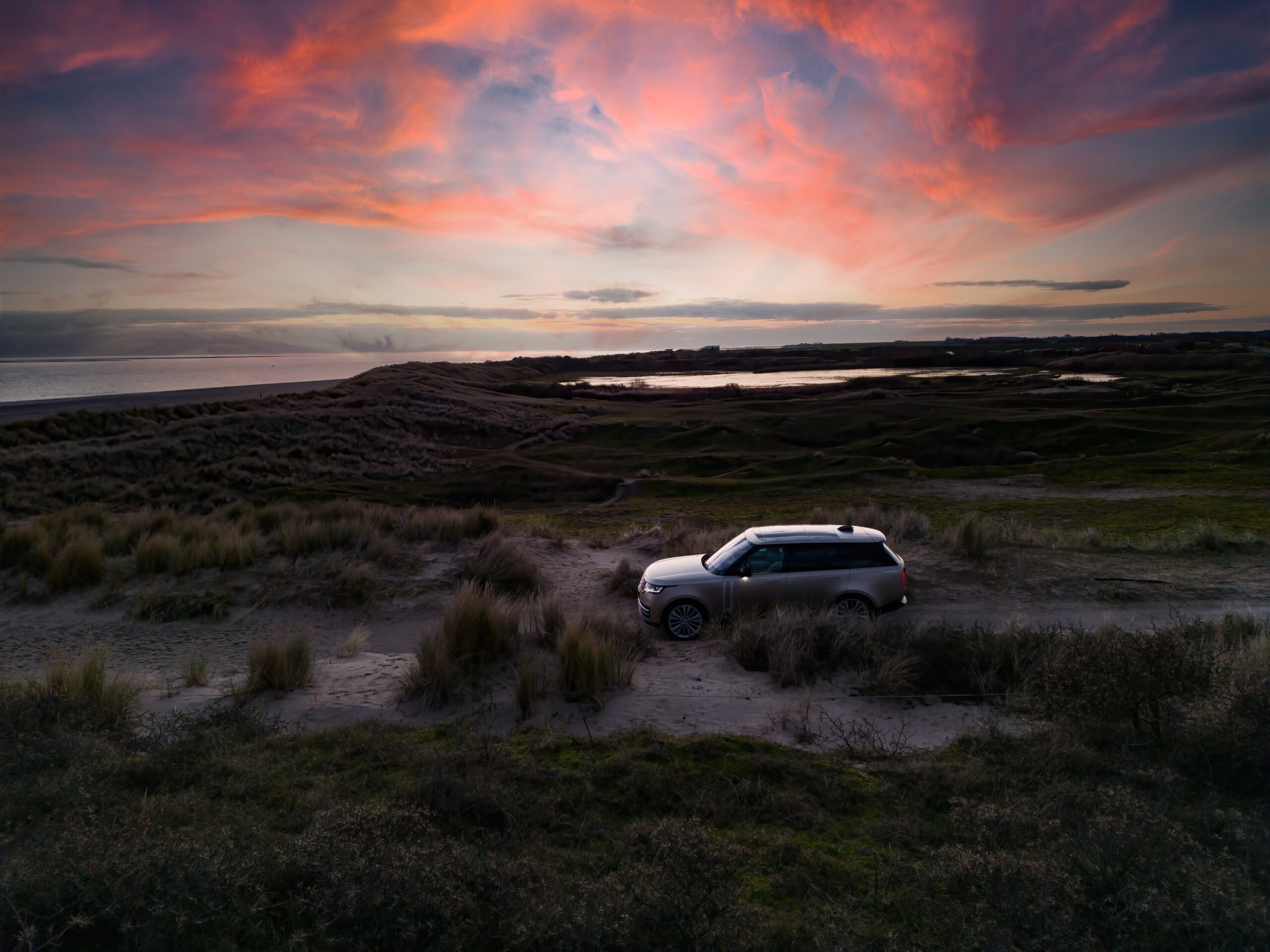
At a quarter past seven I arrive at the house of photographer John van Helvert. Quite tight, because the ferry leaves at half past seven. With the push of a button I open the trunk so that John can load his equipment. And then quickly away, criss-crossing through the built-up area. The navigation indicates that we will arrive at 07.29:07.27 am. Very tight. We take turns sharply like sprint skaters going for gold. The car equipped with four-wheel steering has a turning circle like a MINI, because the rear wheels steer. It couldn't be easier to take a bend. We repair a wrong turn at the entrance to the ferry port by returning to the correct lane, off-road, via a cycle path and sidewalk. At 2 we drive onto the ferry. In the rearview mirror I see the tailgate closing. Phew, just in time! When we drive out of the belly of the boat a little later, it seems as if we arrive in a different country. Without traffic jams, without haste, without code red. Yes, the sky turns red because of the slowly rising sun. We send the Range Rover to the Texel lighthouse and drive it into the dunes there. This car does not use its handbrake on loose sand: thanks to Terrain Response XNUMX, it knows what type of surface it is driving on and adapts accordingly. A few early hikers are disturbed by this strange appearance on their route. One even takes a photo of the license plate. But it could also be that he is so impressed by this miracle in the dunes that he wants to share it with his friends. This version stands out not only because of its special color, Sunset Satin Gold, but also because of the... reduction design. Superfluous lines and frills have been omitted, making the exterior look very sleek and calm. The front is most in line with the previous model, except for the new jewel-like 'Pixel-LED' headlights. The rear really has a completely different look, with a black bar in which the rear lights are incorporated. In addition, the floating roof in the eye: the windows are almost flush with the D-pillars and sills, making it appear as if the roof is floating. And because it overhangs slightly at the rear, it is as if the car is equipped with a subtly sporty roof wing. Of course, this is not just about aesthetics, but also about functionality: this construction makes this model the most aerodynamically efficient luxury SUV in the world.
Birdwatchers
From the lighthouse we set course via the Iron Sea Cape on the Waddendijk to Oosterend, where Texel gin is distilled. We are not only here for the dunes and beautiful views, but also for the local initiatives of island entrepreneurs. Brouwerij TX is named after the name of Texel boats. “Since we have TX as a brand, we see more and more companies in other industries also using TX,” laughs founder Kees Groenewoud. He once started making vodka from potato peels. When the gin hype emerged, he started focusing on that. “We have been world famous on Texel for about seven years with our gin.” Especially the Ocean Age TX Gin is world famous. “A number of boys from Den Helder have the ideal of transporting products across the ocean in an old-fashioned sustainable way, using sailing power. They take a barrel of ours with them when they sail back and forth to the Caribbean to get coffee and rum. That vessel shakes on the waves and is exposed to a higher temperature. As a result, the gin ages faster and you get a matured gin sooner than if you let it mature in a cold cellar.” Beer is also brewed here. When the Texelse Brouwerij, known for Texels Skuumkoppe, was taken over by Heineken in 2020, a number of local entrepreneurs were a bit fed up with big, bigger, biggest. “They then asked us to make a local beer again. Coincidentally we met a brewmaster who lives here on the island and was looking forward to it. We started brewing beer for one of the largest catering companies on the island, Paal 17. First dark blonde, then a number of other variants, including the world's first Steambock. Our beer is now in demand all over the island. Especially ours barrel aged beers are very popular among beer lovers. They're like birdwatchers: as soon as we put a new beer on our site, they dive for it. Sometimes you can find our beers on Marktplaats for triple or quadruple the price. Here, bring a bottle.” We are given a TX Tawny Porter, brewed with lightly roasted malts and matured in old port barrels.
Backstabbing party
We continue our way to the port of Oudeschild, where TX is well represented - on the back of the ships. We stop along the quay. Handy: when you turn off the car, it drops to the entry position so that you can easily get out. Also handy: the electric tailgate consists of two parts, the lower one of which can be used as a seating area, for example to look out over the harbor. If necessary, you can purchase additional leather chairs that you can lean against. You can even opt for lighting and speakers on the inside of the tailgate. Tail party! We drive on again, passing the beautiful maritime museum Kaap Skil and a little further on Fort De Schans. This was built in 1574 by order of William of Orange to control ships entering the Marsdiep. Today there is no control: we slide open the gate and ride into the fortress, which in the Golden Age was also used as a prison and court for mutiny on ships, following the bluff of city people. John also mutinies and demands that he be allowed behind the wheel for a while. He does what I haven't done yet: push the accelerator pedal all the way to the bottom. The twin-turbo V8 petrol engine, good for 530 hp and a maximum torque of 750 Nm, almost launches the Rover. We are pressed into the soft leather, rows of trees pass us by. Fast & furious: we are the fastest on the Wadden. The throttle slows down as we approach the old land of Texel, a rolling strip from east to west whose history goes back much further than William of Orange. This moraine was created by drifting ice during the penultimate ice age, 140.000 years ago. This is not only the oldest part of Texel, but also the highest at fifteen meters above sea level. The Hoge Berg, as the area is called, is an iconic landscape that was created by sheep farmers in the second half of the sixteenth century with small garden walls made of sods, which separate one land from the other. Typical Texel. Just like the sheep sheds, small sheds with a striking construction and their butts in the wind. And just like the gullies: pools with fresh rainwater that does not sink because the subsoil consists of boulder clay. In this typical Texel area you will find many local products, ranging from sweet potatoes and rosehip jam to eggs and hand-felted wool products. And sheep cheese and lamb from sheep company De Waddel.


