Taste
Chengdu: sports city of the future
The globalization of top sport is in full swing. We don't notice much of this in the Netherlands, with Formula 1 in Zandvoort as an exception. This mega event is organized completely privately, under the supervision of entrepreneurs and investors. Not comparable to how a large part of top sport in our country is managed. On the other hand, Jaap de Groot was confronted with the sports city of the future in Chengdu.
Text & photos: Jaap de Groot
From Ajax to the KNVB and from the gymnastics association to NOC*NSF: everywhere there are many traditional professional administrators who mainly look after the shop and who ignore international developments. Processes in which America, the Middle East and Asia are leading. Jaap de Groot noticed this again in the Chinese provincial city of Chengdu, where he was confronted with the Sports City of the Future.
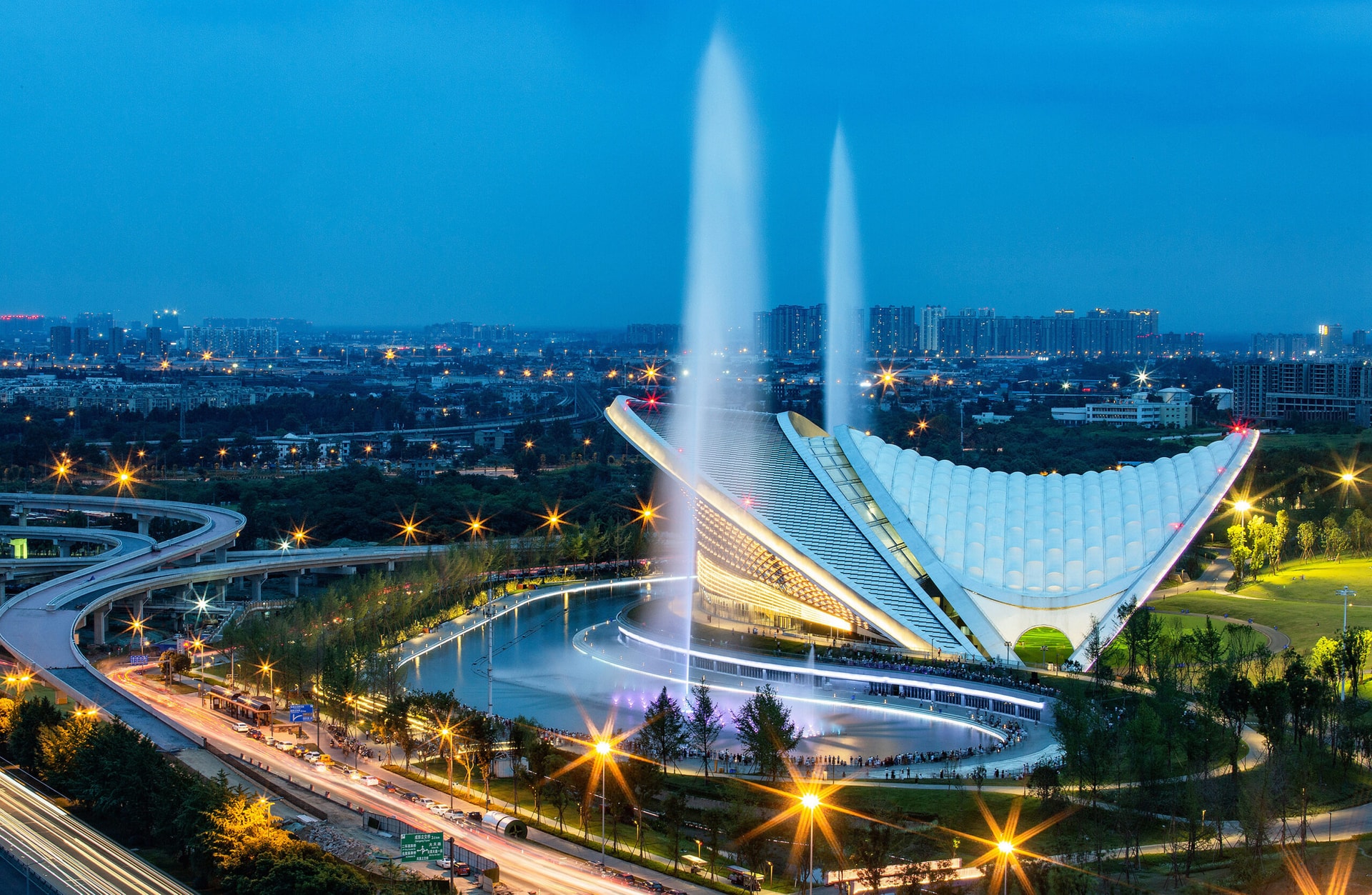
To be honest: flying to Chengdu I take into account a visit to a glorified East Groningen, although 21 million people live in China's fourth city. But that doesn't mean much in this part of the world. So far from Beijing and Shanghai and only a few hours' drive from Tibet, I am ready for a big step back in time. So not… It starts with the brand new airport. Larger than Schiphol and clearly built for the future. From the Chengdu Tianfu International Airport looms a road network that is unparalleled in Europe. When you enter Chengdu, you are immediately overwhelmed by the Century Global Center, the largest building in the world at 1,7 million square meters. Under the roof of this colossus are shopping malls, hotels and a water park including a beach.
Sports and culture as effective assets
In the meantime, all the top hotels in Chengdu are also shining in the abundant sunshine, from Kempinski to InterContinental and from Ritz to Hilton. And it begins to dawn why more than three hundred of the so-called Fortune 500 companies (the ranking of American companies based on their annual turnover, drawn up annually by business magazine Fortune; ed.) have branches in this fourth largest city in China, which means that Chengdu, as an ennobled provincial city, still occupies the 44th position in the Global Financial Centers Index. Now that's where the problem comes in. Because this makes it economically 'only' the seventh Chinese city behind Hong Kong (4), Shanghai (7), Shenzhen (12), Beijing (13), Guangzhou (34) and Qingdao (36).
By the way, New York is still the leading financial center in the world, while Amsterdam is listed 16th in the index. So Chengdu is looking higher and uses the same strategy as other countries and cities that believe that they are still too much under the global radar. Although money is flowing en masse into the city where the world's first banknote was printed in 960, more is needed for international recognition. And as has already been seen in the Middle East, among others, sport and culture are very effective assets to play on. Look at the World Cup in Qatar and the current Saudi Arabian football craze.
New economic miracle
However, Chinese thinking is not so straightforward. Before the power of top sport is harnessed, economic power must first be increased, supported by ultra-modern infrastructure. So Chengdu has started realizing the Tianfu New Area, an immense project that aims to accelerate the city's development into a modern, international and environmentally friendly society. With multiple development zones, such as the Chengdu High-Tech Development Zone and the Southwest Airport Economic Development Zone. The 1.578 square kilometer Tainfu New Area is now seen by many experts as a new technical and economic miracle.
It is clear that this development has not passed us by: more than forty Dutch companies have now established themselves in Chengdu, including multinationals such as Shell, AkzoNobel, Unilever, DSM and Philips. In addition, a growing group of Dutch entrepreneurs is active, mainly in business services and IT & software. That is why the district also has many customers from ASML, the Veldhoven-based market leader that supplies highly advanced chip machines to one hundred and fifty Chinese companies from its second headquarters in Shenzhen. A process that makes American President Joe Biden so nervous that he has begged Mark Rutte whether ASML can do an ounce less in China. Anyone who just looks around Chengdu will understand the reason for Biden's trembling lower lip. China now has more than sixty high-tech industrial development zones spread across the country. This also explains how ASML's China market share increased from 2023 to 8 percent in the second quarter of 24, resulting in a net profit of 1,9 billion euros.
Happy City
Meanwhile, 2.600-year-old Chengdu looks anything but a working city. Nowhere do you get the feeling that the city with 21 million inhabitants is overpopulated. The climate is subtropical and there are restaurants and terraces everywhere. After the uplift of the economy and the realization of an ultra-modern infrastructure, the next step has been taken by giving the city a soul. The spearheads of this policy are sport and culture, but also education and the environment.
Especially with the latter, the city in Asia looks like the exception to the rule. With 1.514 parks, Chengdu is considered the greenest city in China and a beautifully colored bicycle ring of five hundred kilometers ensures that you imagine yourself, cycling through a kind of half-opened cylinder, in the Asian version of Ocean Boulevard. Then the canal belt XL. With beautifully lit performances on the quays in the evening, dancing on pontoons and music on the water. Thanks to architect Min Joa, who devised an irrigation plan 256 years before Christ that ensured that no river in the extremely water-rich area ever again overflowed its banks. Furthermore, other Chinese people live in Beijing and Shanghai. A bit Burgundian and quite open. The Tibetan district is also striking, where monks walk relaxed on the street in their wine-red and yellow robes. So I'm not surprised that Chengdu has been chosen as the city with the happiest people in China for fourteen years in a row. The Happy City now wants to share that with the world. Showing that, as the capital of Sichuan, it has more to offer than just world-famous cuisine and pandas, of which more than eighteen hundred live in the wild in this part of China.
Incidents
No fewer than sixty-five universities and colleges now act as a safety net for the new generation from home and abroad. For those who want to study in an environment full of perspective. A process in which ASML also plays a prominent role. The Brabant group clearly anticipates future prospects in China. The ASML Foundation, founded in 2001, has been supporting educational projects in which diversity and technology are central for twenty-two years. Such as the Youth Employment Solutions for You (YES4U), which was started in Chengdu in 2016 and where eight hundred underprivileged young people (60 percent girls) received market-oriented vocational training. The young people were then helped to find a decent job. Ultimately, five hundred and twenty-five participants were successfully trained, with ASML also allowing young Chinese to enter the ICT and technology sector. Right up to the head office in Veldhoven.
That this is not always without risk is evident from two incidents in which Chinese employees had stolen confidential information to set up a company in their own country. ASML maintains that it was not espionage, but theft. The screening of Chinese employees has now been intensified, but these incidents have not stopped the ASML-affiliated Foundation from continuing social projects in Chengdu and elsewhere in China. Until 2025, an amount of 110 million euros has again been made available for underprivileged young people in China. In this way, ASML has also contributed to the process of achieving a stronger economy, impressive infrastructure, ample study opportunities and a high standard of living by Chinese standards. This has laid the foundation for Chengdu to use top sport as a driver for greater international recognition.
MASTERS MAGAZINE #55
Want to read the rest of the article? The magical autumn edition of MASTERS Magazine is now available. Artificial intelligence has now become an indispensable part of our lives. But, is this development something to celebrate or fear? Will Terminators take over or will friendly robots make our earthly existence even more comfortable? In this edition, AI is examined. According to philosopher Rowan Williams, it is important to remember that whatever AI does, it always imitates. And that we as humans distinguish ourselves through ingenuity. A good example is real estate entrepreneur André Snippe, who is developing an ultra-modern city district in Hoofddorp. Or nautical designer Jurjen Eerkens, who has developed a groundbreaking boat with his Hytender that is leading the way in making the yacht industry more sustainable. These and more resourceful entrepreneurs grace the pages of this edition. Which also looks ahead to MASTERS EXPO | The MAGICAL Edition, our exclusive business fair also born from ingenuity.


