
Taste
Car report: Lotus Evija
Electric driving is no longer a niche. The phenomenon has continued to expand, and even traditional sports car manufacturers are now showing up at charging stations. Lotus, for example, with the Evija, an extremely powerful, fast, and exclusive hyper-EV. But is electrification the magic bullet to future-proof this segment? With 2,000 hp under […]
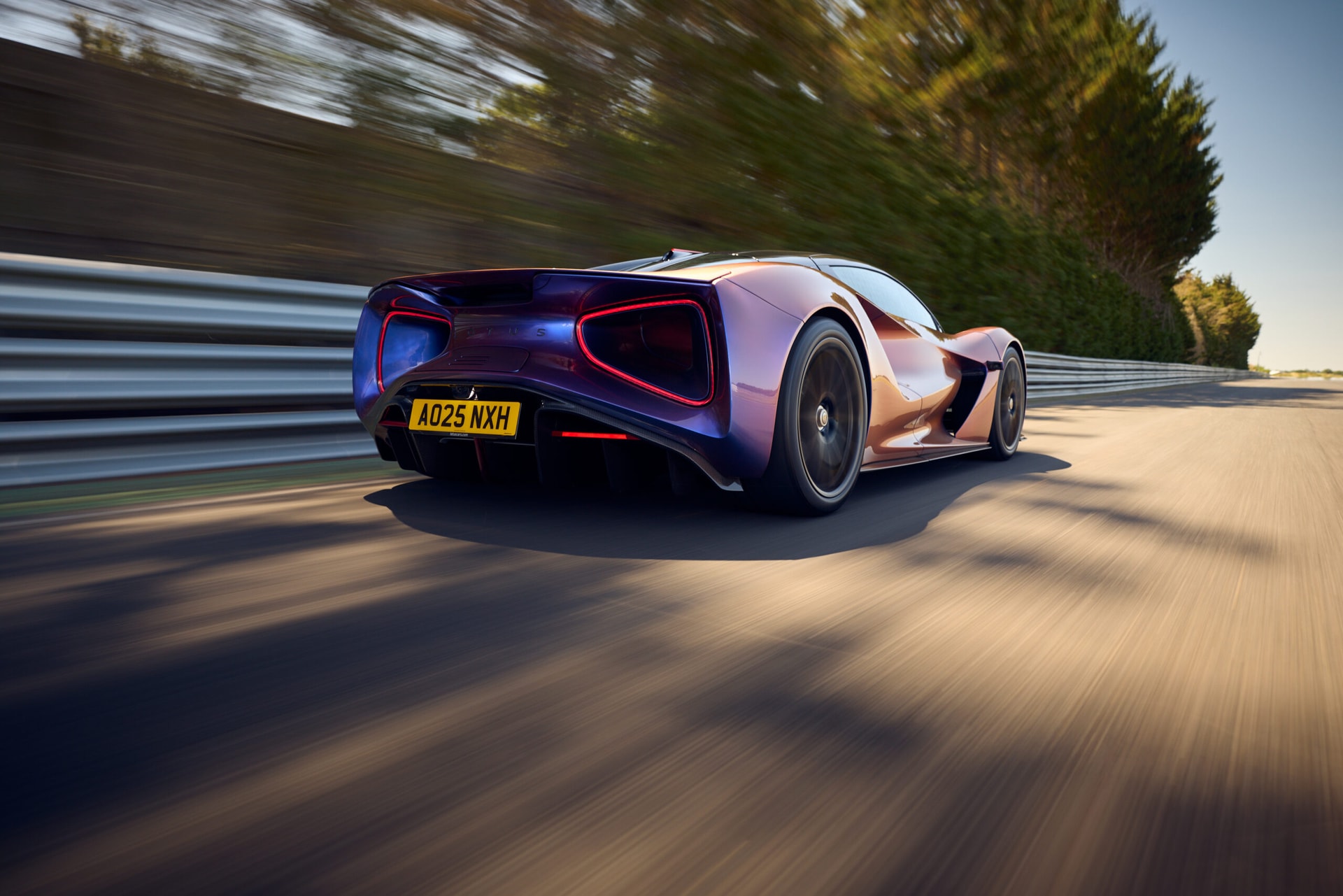
Electric driving is, of course, no longer a niche market. The phenomenon has continued to expand, and even traditional sports car manufacturers are now showing up at charging stations. Lotus, for example, with the Evija, an extremely powerful, fast, and exclusive hyper-EV. But is electrification the magic bullet to future-proof this segment? With 2.000 hp under its right foot, MASTERS searches for answers on sacred ground in Hethel, UK.
Hethel is a village in the rural county of Norfolk in the northeast of England, where Lotus has been based on Potash Lane since 1966. The factory site is situated on a former military airfield, the taxiways and runways of which have been converted into a test track to safely push both Formula 1 and road cars towards the limit. Lotus founder Colin Chapman had already been building cars since 1948. First in his parents-in-law's garage, and later, some parts of the company were distributed across various locations, until Chapman secured the Hethel site. On the 3,5-kilometer circuit, champions like Jim Clark, Jochen Rindt, Emerson Fittipaldi, and Ayrton Senna pushed their cars to the limit, but it would later become clear that none of them ever reached the speeds we now expect…
The atmosphere on the test track at the rear of the factory grounds is relaxed and unpretentious, unlike some other manufacturers operating in the same segment as Lotus. In a shack, we try on a helmet and sign a form releasing Lotus from any liability should we careen over the guardrails into the field while burning. Then we're beckoned towards the car by Gavan Kershaw, Director of Attributes and Product Integrity, and in that role ultimately responsible for the handling of every Lotus, including this Evija. Getting in is easy because the doors swing open upwards and forwards, taking almost the entire sill with them. This places you right next to the carbon fiber bucket seat, allowing you to easily slide under the small steering wheel. Immediately noticeable is the light and spaciousness of the Evija's interior. The dashboard is merely a structural carbon fiber crossbeam, and light shines from behind it into the footwell. The seating is certainly not cramped, and the seats are comfortable and easily adjustable. The digital cockpit and center console are distinguished by their simplicity and clarity, as Lotus hasn't turned them into a shiny jewel box to show off on social media. The doors buzz down via two switches in the overhead console, and after pressing the red start button in the center tunnel and then the "D" above it, 2.039 hp is available at your right foot.
Excessive
We roll out of the small pit lane quietly to explore the tight corners that follow, but warming up is not necessary with electric motors, so in the gentle right-hand bend before the straight, the right pedal already goes to the floor. I won't repeat my statements, but the acceleration is so intimidating that you can't get beyond a few expletives and then focus all your attention on the end of the straight to determine a braking point. With the drive distributed across four electric motors, each producing 500 hp and driving one wheel, the electronic control system makes thousands of calculations per second to keep the Evija's nose pointed in the direction of travel and not plunging into the crash barrier in a cloud of tire smoke. Even at 250 km/h you still feel those interventions. Because there is no gearbox, the acceleration feels not only linear but also overwhelming and is therefore incomparable to almost any other car. This is the kind of acceleration that only modern Formula 1 cars can approach and it is downright irresponsible to give this 'weapon' to inexperienced drivers. Near the end of the straight there's a small chicane, but Gavan gestures to skip it and the digital speedometer rattles on towards 300 km/h, with us having to slam on the brakes just moments later. The deceleration is just as intense as the acceleration, but what is also noticeable is that the feel in both the brake pedal and steering is very analog. Electric cars by definition feel artificial and distant, like a computer racing simulator. However, the Evija has hydraulic power steering and brakes instead of electric, which Kershaw had specified as requirements to ensure the traditional driving experience and Lotus DNA could also be guaranteed in this crazy electric sports car. The weight of almost 1.900 kilos is relatively low for an EV with this performance potential, but it is still more than twice as much as a Lotus Exige. Yet the Evija has good balance and rotates very naturally around its center axis like traditional sports cars, because the battery pack is not housed in the floor like a skateboard, but in the place where the combustion engine and fuel tank are normally located. After our test session, Kershwaw demonstrates what the Evija can do when you know both the car and the track inside and out. The Evija then claws out of bends with unprecedented force, the lateral G-forces being almost uncomfortable. On the straight, even 320 km/h appears possible just before Kershaw slams on the brakes. “We can't reach this speed with any of the Classic Team Lotus Formula 1 cars we've tested here over the years, so that shows how incredibly fast the Evija accelerates,” we hear him say relaxedly as we hang in our seatbelts in the tight right-hand hairpin bend after the straight. After this ride, we need some time to put everything into perspective, which also applies to the market positioning of this hyper-EV. Lotus is asking for a sum of two million pounds (excl. taxes) and builds no more than 130 examples. That number is derived from the internal project code, which is Type 130.
Temper
Any doubts we had about the performance and handling of a fully electric Lotus have now been banished by the extreme G-forces, but the combination of Lotus and electrification still raises some doubts. The Evija was intended as a hypercar for the privileged few, but with the electric Eletre and Emeya, Lotus has charted a new course. This seems to have lost sight of the brand's traditions, and indeed its loyal enthusiasts. Both models are built in China, in a state-of-the-art factory owned by parent company Geely, and are intended to position Lotus globally in the luxury segment. The Eletre is a large SUV with top-level performance, and the Emeya is a four-door GT on the same platform, but aimed at Porsche and Lucid customers. Viewed individually, they are impressively capable cars with powerful powertrains, high-quality interiors, and remarkably good handling. However, those accustomed to the spartan and mechanical Elise and Exige might see this new Lotus generation as a break with the past. Where Lotus once stood for lightweight simplicity and direct communication between man and machine, it now revolves around comfort, digital interfaces, and environmental sustainability. It should be noted, of course, that Lotus is not to blame for this, as manufacturers are being forced to comply with increasingly stringent regulations by governments, without any regard for their feasibility or the long-term impact on both the economy and the environment. This reckless policy not only affects the buying public, but also manufacturers. For example, news recently leaked in the US that Dodge is withdrawing the electric flagship model of the new Charger, the Daytone SRT Banshee, from the market in response to current market developments. Even more telling is the fact that the V8 will make its comeback and, as such, will power the new flagship Charger model. The appeal of the EV market is also waning in Europe, as after years of growth, popularity is declining and consumers are dropping out due to rising prices (read: disappearing government subsidies), disappointing charging infrastructure, and concerns about residual values. In the Netherlands, even more electric cars were exported than imported last year, making it painfully clear that private individuals are wary of used EVs. As a result, manufacturers are reducing production, changing their product strategies, and even brands once considered pioneers are now tempering their expectations. In that light, Lotus's full commitment to electric propulsion seems risky, but fortunately, the brand still has a significant opportunity: Emira.
Garden party
Without delving into Lotus's full model history, it's interesting to take a step back in time, as Lotus often focused on two distinct models in the past: a lightweight, pocket-sized racer and a slightly larger model designed for long distances and potentially everyday use. Think of these pocket racers as the Seven, Elise, and Exige, while examples of the larger models include the Éclat, Esprit, and Evora. Under the internal codename Type 131, Lotus introduced the Emira in 2022, and like its predecessor, the Evora, it combines the two aforementioned categories. With its rear-mid engine and two seats, the Emira rivals not only the Porsche Boxster and the Alpine A110, but also, thanks to a spacious and comfortable interior and excellent luggage space, the BMW M2 and Ford Mustang. Initially, Lotus offered the Emira with a 3,5-liter supercharged V6 from Toyota producing 406 hp and a 2.0-liter turbocharged four-cylinder from AMG producing 365 hp. The Turbo SE has since been added to the lineup, which also delivers 406 hp and marginally better performance than the V6. A brand-new example of this Emira Turbo SE in subdued black awaits us, but there's also an Esprit for reference. This isn't a Turbo SE, by the way, but a rare GT3 owned by our former co-driver, Gavan Kershaw. The GT3 was the last four-cylinder Esprit produced from 1995 to 1999, with a total of only 196 examples. This creates a huge generation gap between the Esprit and the Emira, but it offers a great opportunity to determine whether and, if so, how the current Emira connects with the historical values of the traditional Lotus. The Esprit is considered a paragon of the Lotus philosophy, because despite being an underdog, it always managed to hold its own in comparison tests. That reputation and an unprecedentedly long production run, from 1976 to 2004, make the Esprit not only an icon but also a milestone, and we were privileged to attend the celebration. Every year, Clive Chapman, son of Lotus founder Colin Chapman and head of Classic Team Lotus, organizes a garden party on the family estate commemorating important aspects of Lotus history, including this year's golden jubilee of the Esprit. Also present for the occasion were the four designers who played a role in the design of the various generations of Esprit: Giorgetto Giugiaro, Peter Stevens, Julian Thomson, and Russell Carr, who entertained the audience with anecdotes and trivia. This kind of involvement makes enthusiasts feel welcome and valued, and that's what makes Lotus so special and accessible.
Generation Gap
Getting in and driving away with the Emira is just like in almost any other sports car: no theatrics, no drama, just start, select D, and accelerate. The roads around Hethel are typical British country lanes, tight, with many blind bends and elevation changes. Our test car was equipped with the standard touring suspension, which is the only appropriate choice in these conditions. We'd even venture to say that the optional sports suspension is only useful for drivers who spend almost every weekend on a track. The standard suspension offers the perfect balance between comfort in most conditions and good handling when the throttle is lowered further. Lotus's motto is "For the Drivers," and the Emira lives up to that motto. As soon as we climbed from the Emira into the Esprit, a generation gap was immediately apparent, but it wasn't a culture shock. With a manual transmission and an interior where everything is still controlled by old-fashioned push-button controls, we're transported back decades, yet the driving experience offers immediate confidence. The communication with the chassis is clear, and you feel precisely what's happening beneath you. The Esprit was also developed for these British country roads, which has the advantage that the car excels on any other road surface. You can therefore drive long distances without fatigue from harsh bumps in the chassis, tire noise, or excessive engine noise. You drive a Lotus only for yourself, not for the outside world. When we get back in the Emira and explore its speed potential on a remote stretch, it quickly becomes clear that this distant descendant of the Esprit has so much to offer that you can hardly use it on public roads. Or at least, it shouldn't... The way this car seems to cling to the asphalt and the confidence with which you can dive into corners at extremely high speeds is a tribute to Colin Chapman's legacy. That this legacy is now partly being forced to adopt an electric course is, as mentioned, the result of political choices and therefore not a stain on Lotus's reputation. You could even see it as an enrichment, because a Lotus is now not just for weekends and special occasions, but for enjoying every day and positively distinguishing yourself from the crowd. If you don't just want to stand out, but also have no qualms about being the center of attention and also have a bit of an adrenaline addiction, then there are still a few examples of the Evija available...