Power
BOERDERIJ VAN DE TOEKOMST
BOERDERIJ VAN DE TOEKOMST recently opened in Lelystad. There, Wageningen University & Research, in collaboration with the Ministry of Agriculture, Nature and Food Quality and other stakeholders, investigates how agriculture can be practiced in harmony with people, society, nature and landscape. MASTERS in conversation with Pieter de Wolf, Senior Practical Researcher and Project Leader for Sustainable Agriculture. "The Netherlands is leading the way again."
Farm of the Future recently opened in Lelystad. There, Wageningen University & Research, in collaboration with the Ministry of Agriculture, Nature and Food Quality and other stakeholders, investigates how agriculture can be practiced in harmony with people, society, nature and landscape. MASTERS in conversation with Pieter de Wolf, Senior Practical Researcher and Project Leader for Sustainable Agriculture. “The Netherlands is leading the way again.”Text: Bart-Jan Brouwer | Image: Anne de Hoop
Online editor: Larissa Schaule Jullens
Farm of the Future is located in Lelystad. Why this location?
“When Flevoland was formed around the 1.200s, the government immediately allocated XNUMX hectares of land to research institutes. At the time, practical research stations for arable farming of the Ministry of Agriculture were located at this location. In the XNUMXs it was privatized and merged under the banner of Wageningen University and Research. From the start, we have looked at the challenges and solutions for the future at a system level. For example, not one fertilizer or one type of crop was examined, but always the system as a whole. I think that is also one of the reasons that Farm of the Future came here. We can do this, it is in the genes of the organization.”
What was actually wrong with the 'farm of the past?
“A system functions optimally in a certain context. If that context changes, the system must also change. So there is always development. When I started here in 2002, over-fertilization, environmental risks of crop protection products and leaching of the nitrogen surplus into ground and surface water were the major themes. Major improvements have been and are still being made on these themes. Loss of biodiversity and soil compaction are now the biggest problem facing Dutch agriculture. In the period between 1950 and 2016, six out of seven farms disappeared. The remaining ones became considerably larger: when the Noordoostpolder was allocated in the 12s, farms had a size of 24, 48 and 80 hectares, today a 'viable' arable farm in Flevoland, i.e. where a full family income is achieved, has 100 to 10 hectares. . This increase in scale was accompanied by monocultures and mechanization: for reasons of efficiency, the increasingly large areas of land were sown with a limited number of crops and cultivated with increasingly larger machines. Under wet conditions, such heavy machines close the soil. Due to this soil compaction, crops do not root properly, resulting in 20 to XNUMX percent less yield for farmers.”
In addition to biodiversity and soil compaction, climate change will also be a topic for the future.
“We have had the third dry spring in a row, some warm summers, extreme showers – it is no longer an incident. During heavy rainfall, compacted soil does not absorb water, during drought the roots cannot reach the groundwater. You see that crops really suffer from this. A fourth point of attention is the disappearance of many crop protection products. The authorization of such substances is increasingly a matter of politics. Europe has quite strict environmental regulations, which means that resources are subject to extremely strict assessment. In addition, the following problem arises: onions and carrots, for example, are grown on a large scale in the Netherlands, but worldwide they are insignificant compared to crops such as wheat, corn and rice. Such small crops are not attractive enough for large companies to apply for a separate permit - such a process costs millions. So such companies start focusing on other markets. The result is that there are fewer and fewer crop protection products available. Due to climate change, the current package of protective equipment may no longer work properly and new diseases and pests may emerge. Moreover, harmful insects can survive more easily due to the increasingly mild winters. In short: if you look to the future, agriculture has many issues to solve. At Farm of the Future, we work with farmers to find feasible solutions that contribute to sustainable agriculture and a fair revenue model.”
Was that the reason to establish Farm of the Future?
“We had been working on various partial solutions in our research for some time: more variation in crops on the same plot through strip cultivation; a system with fixed driving paths, where you no longer drive on the land where you grow; the crop protection of the future... All these partial solutions have now been brought together and form the Farm of the Future.”
What are the advantages of strip cultivation?
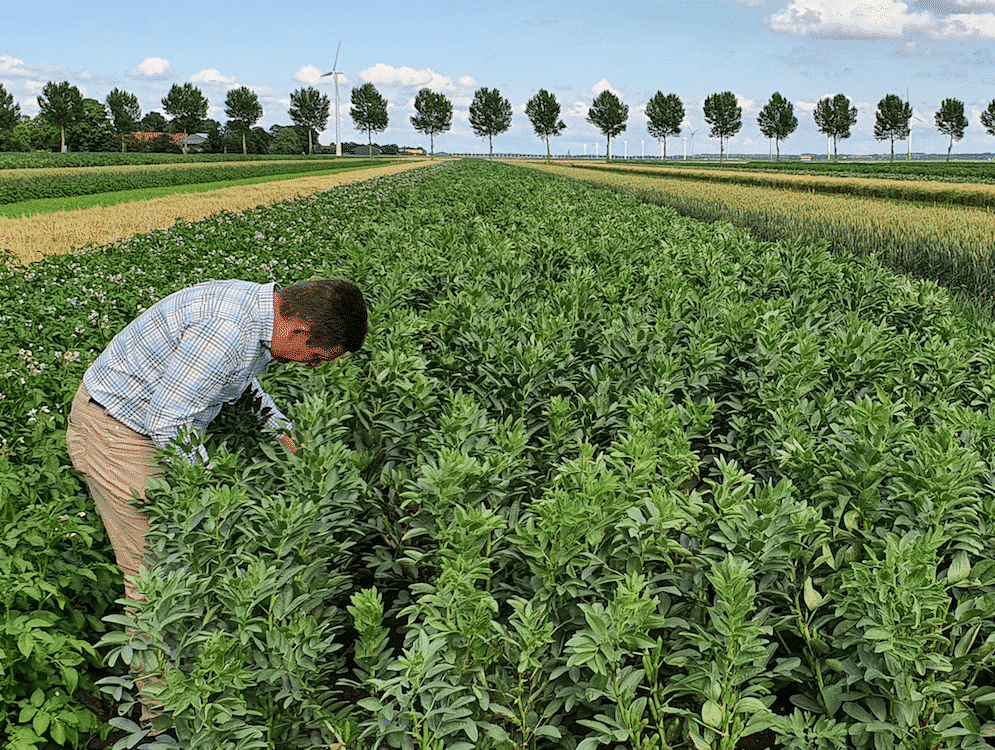
“In the case of less effective crop protection products and monocultures, when a crop becomes sick, the disease can spread across the entire field. Then the entire harvest is destroyed - such a large field with only one crop is table setting for pests. But if you grow several crops next to each other using strips, you build a species social distancing there are barriers between them: one strip with a certain crop becomes diseased, but because the adjacent strips are not susceptible to that disease, you protect the entire field. Variation in vegetation also attracts more species of insects, which help in the natural control of pests. Another advantage of strips is that you provide continuity and shelter to these natural enemies of pest insects, such as ladybugs and spiders. Crops are harvested at different times, so no bare field is left behind and insects can flee to an adjacent strip to survive. Moreover, there is a crop in the field all year round, which also contributes to their chances of survival. These types of natural systems become more important as farmers have fewer crop protection products at their disposal.”
How wide are those strips?
“We have strips here of three meters wide, which may not be very practical, but they best show the effects of strip cultivation. They are separated by lanes of 15 centimeters wide, over which our machines drive - so the lanes are close together. We also have strips that are more practice-oriented and match the practical size of large machines such as sprayers and fertilizer spreaders. These are actually seven three-metre strips, the work unit of our machine, separated by the tramlines. So those strips have a total width of 22,05 meters. This way, farmers can still switch to strips without making large investments in new machines.”
Which crops are best grown next to each other?
“There are a few crops in Flevoland that an arable farm makes money from – potatoes, onions, carrots and carrots. However, if you were to only grow potatoes on the same soil, they would be increasingly affected by soil-borne diseases. You must alternate these with other crops to keep the soil healthy. Grain is such a rest crop. You don't make any money from that, but if you don't grow it, you would have a problem with the potatoes. We call grain one service cropIn fact, he purely provides a service to the potato. Agricultural land in Flevoland is the most expensive in the Netherlands, so farmers prefer to grow as many potatoes and as little grain as possible. But for soil quality you should actually grow a little more grain. That is why we alternate in eight-year cycles the high-yielding crops, which place considerable demands on the soil, with a crop that relaxes the soil somewhat: grain, field beans or grass clover. So on one strip we alternately grow intensive crops and dormant crops. Our order in those eight years is: potato, dormant crop, carrot, dormant crop, potato, dormant crop, onion, dormant crop – and then all over again. The strips next to this strip have a different plan, to prevent a disease that remains in the soil in the adjacent strip from making the same crop sick the following year. So you have to deal with a lot of variables, which makes it quite a puzzle to determine for eight years which crops are most suitable for which strip and at what time.”
Are there any snags to strip cultivation?
“Strip cultivation is not a panacea that solves all problems. The Colorado potato beetle, one of the few insects that can eat potatoes, has few natural enemies, hibernates in the ground and flies easily from one strip to another. Coincidentally, someone in our network has created a prototype of a machine that mechanically removes and captures the beetle from the potato. We encounter problems, but solutions are often offered through our extensive network. As mentioned, we opt for a three-meter wide tractor as a solution for soil compaction for fixed tramlines. With this system you can perform almost all operations, except harvesting, because harvesting requires heavier machines. A lot of weight comes off the land during harvesting: ranging from 10 tons of grain per hectare to 120 tons of carrots, the absolute champion. You need large equipment for that. We are currently working on harvesting mechanization on tramlines. As long as these machines are not available, no one will switch to our system. And as long as no one uses that system, there is no demand for new machines. We are continuously looking for collaborations with innovative companies, startups and investors, in this case to help us build a prototype of such a lightweight harvester. There is an entrepreneurial risk involved, but as soon as we can show that machine here, I am sure that farmers will quickly want to switch to the tramline system. That saves them the 10 to 20 percent yield that they now lose due to soil compaction.”
So for that step forward you are partly dependent on other companies?
"Yes. To come up with solutions together. But also to conduct further research. The Ministry of Agriculture, Nature and Food Quality will support us financially for the next four years, but time moves forward and new challenges will always arise. Such as robotization. That development is still at the very beginning. Legally, you cannot let a robot work unattended, so the idea of having it work 24/7 is not possible at all. And technically, a lot still needs to be done. Want a robot to weed weeds? Then you have to teach a machine through software to distinguish the weeds from the crops. That's so complicated. We desperately need the technology, but its development is not happening quickly. It would be ideal to have a drone fly above the fields that monitors where something is going wrong, after which a robot is sent to solve the problem on the spot. Well, that's going to take a while. Suppose you teach a robot to spray one drop of pesticide on a weed, so you don't have to spray all the plants. If that remedy disappears, you will be left with a robot that can spray droplets, but you will no longer have any droplets. There is therefore a risk of failure in the development of such a robot. We desperately need the technology, but we also need to move towards an ecologically robust system, with resilient varieties and strips that prevent diseases from spreading quickly. You have to make that combination, you can't let everything depend on technology. We do need technology, but we do not want to make ourselves completely dependent on it. Technology should serve, not lead. We are now working on an innovation agenda: looking at our future goal and the preconditions, we will work with experts to identify what kind of technology we need for this. 'This is what we want, who is going to develop it for us?' My dream is that a number of larger parties will set up an innovation ecosystem around Farm of the Future. Then I think of governments and development companies, but also parties that want to contribute to the sustainability of our agricultural food system based on social responsibility, organizations that support startups, such as Start-Life that supports food & agri startups to develop into companies, the classic capital investors and, for example, parties that want to experiment with new, more sustainable chain concepts.”
MASTERS #43
Pre-order via the button below MASTERS with substantive reports, great photography and unique brands, trends and places in the world.


