
Power
Best Building of 2022: "We want to stimulate all the senses"
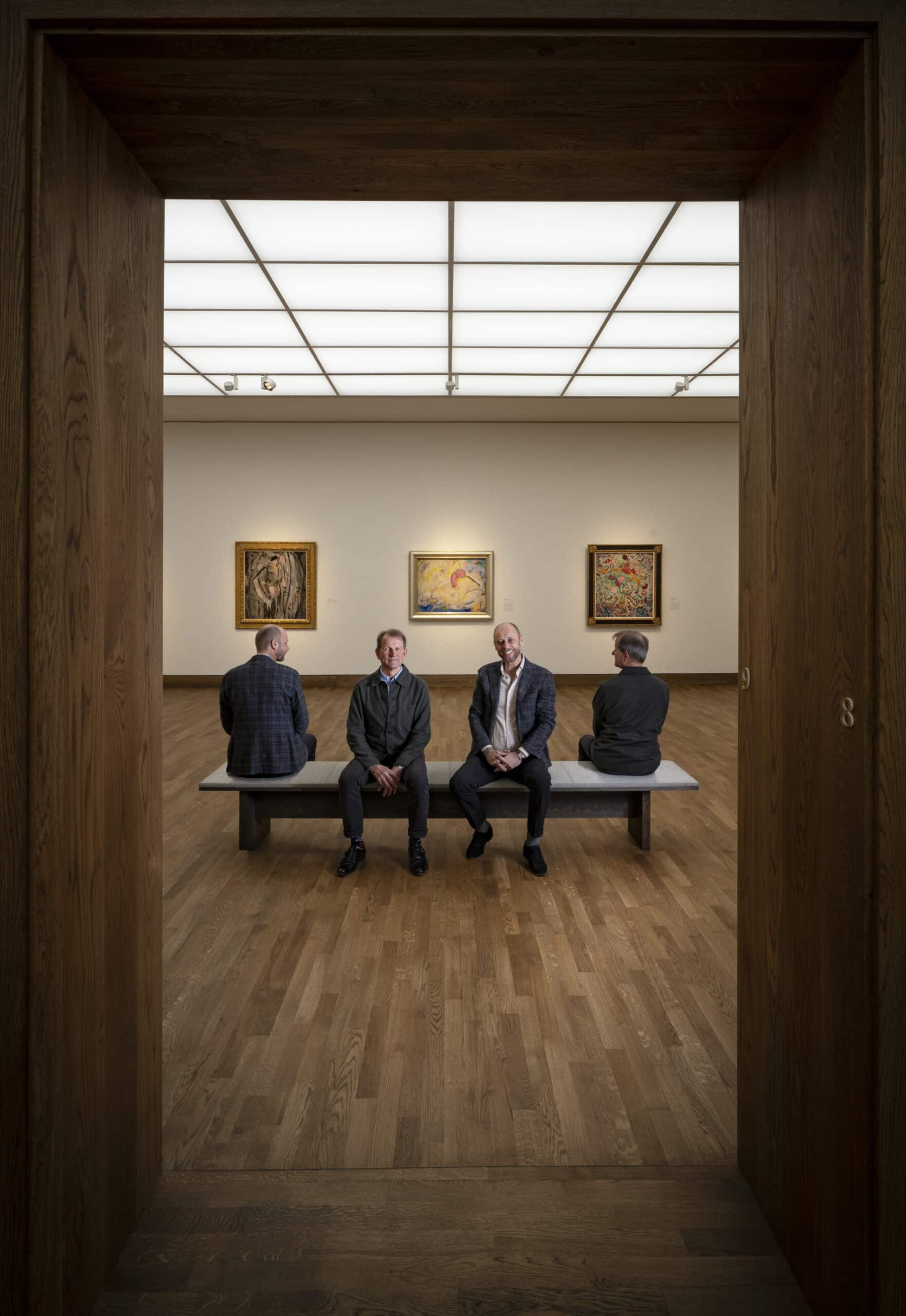
Singer Laren has recently been renovated, renewed and expanded with the art collection of Jaap and Els Blokker. MASTERS spoke to directors Jan Rudolph de Lorm and Evert van Os. "We are operating at a higher level, have more space, a much better collection. Now the real work begins."
Singer Laren has recently been renovated, updated and expanded with the art collection of Jaap and Els Blokker. MASTERS spoke to directors Jan Rudolph de Lorm and Evert van Os. “We are at a higher level, have more space, a much better collection… Now the game begins!”
The renovated museum has now been open for a number of weeks. What are the reactions?
Van Os: “The visitors are unanimously enthusiastic. That the world is open again, that the museums are open again, that this beautiful collection can be seen here and that the building has become so beautiful. The art critics are very positive. And of course we received a great compliment with the election as BNA Best Building of the Year 2022.”
It was opened on March 8 by Princess Beatrix. What did she think?
Van Os: “Beatrix has visited our museum more than once in the past. During the opening she whispered that she hardly recognized it anymore. When saying goodbye, she said that she thought the museum turned out so beautiful.”
Which innovations are you personally most pleased with?
De Lorm: “It's better to ask which ones. I find ugliness very difficult, it bothers me. Thanks to the architects, everything has been made beautiful. From my point of view, the museum should be an ideal vehicle for bringing art as close as possible to the people. They have succeeded so incredibly well in this. And they have not only built this new hall complex, but by extension renovated the entire museum from the same mould made. All rooms are finished in the same way and have the same proportions. I think it has become a pretty perfect exhibition machine.”
Van Os: “We have finally made Singer Laren one whole, with a renovated theater, a central entrance, a beautiful sculpture garden by Piet Oudolf and now the renovated museum as a final touch.”
Don't do anything about it anymore?
De Lorm: “Well, it starts now. We don't have to do anything to the building or interior anymore, but we do have to play the carillon now. So we need to have as many exhibitions as possible, in a new dynamic, taking place in the coming years.”
There wasn't much to play for the past two years. Was it a blessing in disguise that the renovation coincided with the corona era?
Van Os: “We shouldn't pretend that corona has been a blessing, but given the circumstances we were able to make good use of the time by renovating. Because we didn't plan it to that extent. We would actually only start the renovation and renovation of the existing museum halls after the summer of 2022. We brought them forward and made smart use of the time.”
De Lorm: “It was quite an uncertain time and Evert immediately made great progress. Not alone, but he was very much the driving force behind that. He took advantage of the circumstances in a very good way.”
Most museum innovations result in modern eye-catchers, such as the reflective depot by Boijmans Van Beuningen and the 'cloud' on top of De Fundatie. Singer Laren does not participate in that trend?
De Lorm: “No. We reviewed quite a few architectural firms when Mrs. Blokker promised us that we could build. With the theater we had already had a distinctive building made compared to the rest of the complex. We wanted to remain in harmony with the villa from which the museum was built in 1956 by architect Wouter Hamdorff and take that form language, volumes and materialization as a guideline.”
Van Os: “Our starting point was not the architecture itself, but the collection and the visitor. Many museums focus on a distinctive building, but forget that it also needs to contain art. And this is not always done justice within such special architecture.”
De Lorm: “When I worked at the Rijksmuseum (from 1990 to 2001 as Curator of Gold and Silver and from 2002 to 2009 as Head of Exhibitions; ed.), I created Rijksmuseum Schiphol. The whole approach of then director Ronald de Leeuw was: 'You have to be surrounded by art. It's about the art, you have to put it on a pedestal.' Singer Laren has very beautiful halls. Although they were a bit run-down, we wanted to keep the volumes and rhythm that way instead of adding a wing that would stand out like a cathedral from the other halls. A continuous, uniform exhibition circuit throughout the museum, starting with the old rooms and ending at the end of the new rooms, that was actually the goal. Various architects gave presentations and there were also some who showed distinctive extensions. We have chosen the harmonious line of Bedaux de Brouwer Architects. Because they have existed as an agency for a hundred years, they have learned to first study the initial architecture very carefully. Wouter Hamdorff's architecture has led to a very beautiful, clear museum. Based on that clarity, they included us in their plan. They didn't build something new, they added something.”
Van Os: “The garden room where we are now is architecture in the finest sense. This is how they put their signature. They looked at the villa with that warm appearance and turned it into a modern version.”
De Lorm: “They are brick architects, which fits in with the construction we already have. They work with honest materials such as oak, natural stone, brass... All materials that age beautifully, have a certain warm appearance and can also be found in the villa. Of course, it is not by chance that we chose them.”
The new wing was necessary to accommodate the donated collection of Els and Jaap Blokker. How did you manage to acquire the collection for the museum?
De Lorm: “Singer has a large number of supporters, people who support us financially, but who also see the museum as their second home. The Laren population likes to come here often; it is a kind of cultural living room. Jaap and Els Blokker had been part of that supporter group for a long time. When I came here in 2009, I immediately met them in the villa, where they had their regular table. After Jaap Blokker's death, I was invited to look at their collection and immediately stated that I would really like to do something with it sometime. The relationship with Mrs Blokker has only intensified over time. Gradually, our wish, which we had somewhat expressed, and her idea to give the collection, or at least parts of it, a permanent place here, have crossed paths.”
Els Blokker lives within walking distance of the museum. Do you bring cakes with you when you go for an interview?
Van Os: “At a certain point we knew the time was right and we visited her. Not with cakes, but with a booklet in which we had visualized our dream. It stated what that wing could look like, how it could be a home for her collection and also what the financial consequences would be.”
De Lorm: “When I first saw the Nardinc Collection, a coherent collection of 117 works, I really thought: this is the best that cannot be found in Singer. And it fitted in perfectly with the existing collection of the American founders. Impressionism is well represented in our museum and we had a bit of modernism – that was more of a catch-up, because Anna and William Singer had never collected that. The collection of Jaap and Els Blokker contains the pinnacle of Dutch modernism, museum quality. I am also really happy that it turned out this way and that everyone can see this. The collection is embraced by the public. We live in a very dark moment and this is a collection that is about color, cheerfulness, exuberance and freedom, breaking free from rules, letting your feelings speak. We receive personal messages from quite a few visitors asking them to forward them to Mrs Blokker, saying that they are really very grateful to her.”
Van Os: “Els Blokker ultimately wanted not only to donate the collection, but also to co-finance its preservation and housing. Because, she said, if you get over the dog, you also get over the tail. All without further conditions, except one: the expansion could not be called the Blokker wing.”
De Lorm: “We called it the Nardinc wing, after the name of the collection and the former Nardinclant estate of the Blokkers.”
What was the price tag for the renovation?
Van Os: “Calculated from 2017, the year in which the new theater hall and entrance foyer were built, the total amount is approximately 23 million euros. Nearly 20 million of this was donated by private individuals and cultural funds.”
As a private museum, do you rely heavily on donations?
Van Os: “Our operation consists of 4 percent from subsidies and 96 percent from public income. With that we keep our own pants on. The donations make renovations, investments in the building and collection expansions possible. These are therefore indispensable for us to keep up with the times.”
Jan Rudolph, what are the gems from the Nardinc Collection for you?
De Lorm: “As a curator it is so nice when you can add really important art historical moments to the collection. As night cafe (Cafe Olympia), the first of three large paintings that Jan Sluijters made in Paris at the exact moment that future Fauvists such as Picasso and Kees van Dongen presented their work for the first time at the Salon des Indépendants in April 1906. The other two works hang in the Stedelijk, Ball Tabarin, and the Van Gogh Museum, Femmes qui s'embrassent. We can therefore permanently demonstrate here an important momentum in the emergence of modernism. But it also tells about the new city of light Paris, the medieval city that was completely transformed in the nineteenth century - the new going out, the new freedoms of man. A wonderful job to have! Also The evening before the strike (1888) by Jan Toorop is a game changer: it is one of the first pointillist paintings in the Netherlands. Another gem, also from Sluijters, is Laren landscape with cyclists from 1911: a humanistic landscape with a football field, telegraph poles, electricity poles and cycling women, painted in bright unmixed colours. In that work a sense of beauty and a sense of time coincide. He painted it during his three-year stay in the artists' colony in Laren, Villa Vita Nuova on the Hilversumseweg. And the collection contains another key work by Jan Sluijters: Portrait of Greet van Cooten, from 1910. Our face of modernism. Evert affectionately calls her 'Singer's Mona Lisa'. With 41 new works by Jan Sluijters, we are now the Dutch museum with the most paintings by his hand.”
How important is it to show artists who have a link with Laren?
De Lorm: “We call the artists' colony in Laren, Blaricum and a part of Huizen, where many artists came from 1870 onwards, 'holy ground'. It was the first time since the seventeenth century that the Netherlands made art in an original way and at a high level, and immediately caused a sensation internationally. As a result, Americans came to this area, including William Singer. But Max Liebermann, the greatest German impressionist, also spent numerous summers here; Max Beckmann, the greatest German expressionist; Piet Mondriaan, who practiced luminism here together with Jan Sluijters and Leo Gestel... All those developments in art around 1900 largely took place here. To show it at the place where it happened, in the environment that is still there, that is of course an open target. Els Blokker made that possible.”
MASTERS MAGAZINE
Want to read more of the interview? In the summer edition of MASTERS an interview with Sven Kramer, a driving impression of the Bugatti Chiron Super Sport and a study into the Effect of Max. But above all, it features people who bring light to the darkness. Such as Henk Jan Beltman, who took over Tony's Chocolonely because with a company you can make the world a more beautiful place. Chef Emile van der Staak, who has the ambition to change our food culture and therefore cooks with plants and vegetables that he obtains from the food forest. Designer Nienke Hoogvliet, who has introduced natural seaweed paint as an alternative to harmful textile paint. And Anna Nooshin, who criticizes the current social media culture of pretty pictures. In her documentary she also shares the less beautiful aspects of her life. All people who ask questions, hold up mirrors, take steps. Steps towards a healthier world and more understanding society.


