
Taste
Pilgrimage site for the modern industrialist
A weekend in Maastricht? Make it a long weekend, because in the capital of Limburg, the local wine splashes against the quays, the streets are paved with pies, Michelin stars shine in the vault of heaven… And if you shout 'fire!', they come running out with trays of beer. A feast for gourmets! In addition to an extensive culinary offering, the city has a generous cultural program, has no fewer than 1.667 monuments and, as one of the first factory cities in the country, can boast a rich industrial heritage. MASTERS guides you through Mestreech, an enriching & delicious enterprise. “Bránd!”
Maastricht is a piece of foreign country between the borders. Because with a (long) weekend in this cheerful and vibrant city you are just as much out of it as when you are on a city trip abroad. Did I say city? With almost 125.000 inhabitants it feels like a village. And of those, 25.000 are in college, all young people who want to discover life. On my first evening the pubs are packed, the terraces are full, the glasses are quickly empty again. There is laughter, flirting, living. The heartbeat of Maastricht is that of the budding teenager. Although the Vrijthof is known as the epicentre of the city, I start my discovery tour in Wyck, one of the seven city centre neighbourhoods of Maastricht. There I lay a solid foundation in Bouchon d'en Face, 'the finest French restaurant in the Netherlands', where the order is taken by a French-speaking waiter. You have to choose between classics such as Escargots de Bourgogne, Bouillabaisse, Côte à l'Os and Confit de Canard, and desserts such as Dame Blanche and Crème Brulée au Grand Marnier. “C'était délicieux, merci beaucoup!” For a digestif I go to the recently opened Founders Bar, a hundred metres away, which is part of the Beaumont Hotel Maastricht, which with four successive generations is one of the oldest independent family hotels in the Netherlands. The current fourth generation, Jean-Marc and Christophe Beaumont, welcomed Gunay Uslu, former State Secretary for Culture and Media, when she booked a suite here for the opening of the Dutch Dance Days. There is no dancing in the Founders Bar itself. You feel like you are in a Parisian hotel bar from the 1920s, with intimate seating areas divided over several rooms. In addition to a wide range of cocktails and spirits, you will find a unique wine list with over four hundred selections. A place where it can easily get very late. Only I have to keep an eye on the time, since I am dependent on public transport: my weekend bag is in Buitenplaats Vaeshartelt in the heart of the country estate zone, a half-hour bus ride from Maastricht. And the last bus back leaves at half past ten. According to the timetable, that is. The expression and Maastricht keteerke, 'the Maastricht quarter', refers to the fact that a delay of fifteen minutes is socially acceptable. That is Maastricht: easy, relaxed, all the time. Not running, but walking. Or, in my case, taking the bus.
Pot drawing
The next morning, the sun bathes the estate in a warm glow. The estate where kings have hunted, important military personnel have stayed, and wealthy families have lived. One of the most illustrious residents of Vaeshartelt Estate was Petrus Regout (1801-1878). He is considered the pater familias of the Maastricht entrepreneurial family Regout and was the founder of the crystal, glass and earthenware factory Sphinx, which earned him the nickname 'pottekeuning'. In 1851, this industrialist bought the country house from King William II. In the years that followed, he had a smoking room built and an English landscape park laid out, complete with tree-lined avenues, courtyards, water features, orchards, a bee pavilion and a tea house - a kind of mini-Versailles. The park has remained intact to this day. Vaeshartelt remained in the family for more than a century. Today, the 21-hectare country estate is used as a location for overnight stays, food, drinks, meetings and parties. According to Managing Director Paul Janmaat, around 300.000 people visit here every year, generating a turnover of 7,5 to 8 million euros. Almost a million of that is spent on maintenance. “Sustainability is one of our goals, because we have something to do in today's world.” That is why he introduced Dutch Cuisine here. “We make our own wine, harvest our own vegetables, brew our own beer and grow oyster mushrooms.” These oyster mushrooms are the main ingredient of the plant-based bitterbal that is on the drinks platter here in the evening. And it doesn't stop with the 'zwambal': a boutique hotel with a botanical restaurant will be built in the farm on the estate, led by Luc Kusters of Bolenius*, founder of Dutch Cuisine. The plans are big, the mission laudable. This is beautifully expressed in the opening of the menu of the in-house restaurant: 'What you now have in your hands is not just a menu: this is a step in the right direction towards a better world.'
Historic lodging
Sustainable entrepreneurship is also part of the strategy and corporate culture of Oostwegel Collection, which sets a good example by launching annual initiatives such as World Environmental Day or Build Back Biodiversity. The family business’ portfolio includes Restaurant Château Neercanne*, which is located in the beautifully restored 17th-century estate of the same name. When the weather is nice – and it is! – it is heavenly to have lunch there on the terrace, with a view of the Jeker valley and the castle’s UNESCO baroque gardens. Beforehand, I let restaurant manager Maarten van Vliet show me around the restaurant’s own colour, scent and flavour garden. 20 percent of the vegetables served by the restaurant come from here, the rest is supplied by local farmers. Maarten used to be the bar manager at The Dylan in Amsterdam. “When I cycled to the restaurant here for the first time, I just had to cry: the beauty, the nature, the peace – so beautiful! This is a whole different ball game than the Keizersgracht, haha.” In the shade of a parasol I enjoy a cool beer a little later, Brand Heritage Blond. The refreshing beer is made exclusively in collaboration with Brand, which used to own the castle, with the addition of its own apples from the fruit arboretum of Château St. Gerlach, which is also part of the Oostwegel Collection. Then I am spoiled with 'Poached egg from the Jekerdal with stewed spinach from the vegetable garden, mousse of old cheese and summer truffle', 'Redfish with seasonal vegetables' and 'Crème brûlée of tarragon, with fresh summer fruit and yoghurt ice cream from the IJsbaas from Margraten'. The dishes are accompanied by Hommage – Camille and Hommage – Judith, full-bodied fruity wines from St. Martinus, a domain from the nearby mountain village of Vijlen that has regularly been voted the best vineyard in the Low Countries. The labels on both bottles, a tribute to the founders of Oostwegel Collection, were designed by Françoise, granddaughter of Camille Sr. and Judith. She also designed the chandeliers in the seven suites at Château Neercanne, designed by interior architect Roelfien Vos, which are housed in the historic lodging and can be booked since the first quarter of 2024. Recommended: the Superior Garden Suite, which at 69 square meters is the largest. The accommodation has an open bedroom with a super king-size bed in the authentic castle tower, with a private garden terrace and views of the countryside.
110.000 sticks
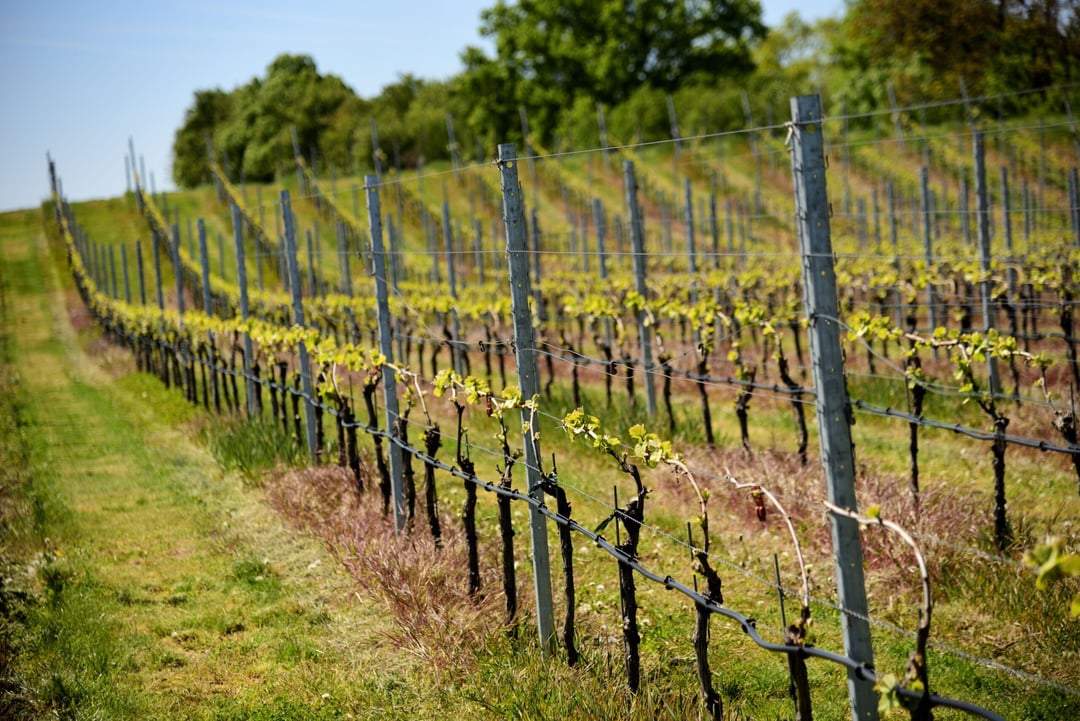
The grapes of the wine that accompanies the redfish, De Apostelhoeve Cuvée XII 2023, literally come from the hill next door. Like Oostwegel Collection, De Apostelhoeve is a family business. In 1970, fruit grower Hugo Hulst established a vineyard on the Louwberg, which, with its soil consisting of chalk, gravel and marl with a layer of loess on top, is extremely suitable for growing grapes. He was encouraged to do so by his mother, who said: 'When I open a bottle, I have to add two more.' Three years later, the first harvest yielded 1.400 bottles of wine. Today, De Apostelhoeve produces an average of 180.000 bottles annually, with last year's peak of 220.000. The country's oldest wine estate is currently run by Hugo's son Mathieu and the third generation Gilbert and Robin, while their mother Jilka takes care of the administration. The difference between the generations? "I was raised as a farmer," says Mathieu. "My sons feel more comfortable among people and are at home on social media." According to him, the growth of his company is partly due to the current climate change. “In the past, we didn’t start picking until October 10, now we do it at the beginning of September because otherwise the wine becomes too alcoholic and sugar has to be added.” The domain covers 30 hectares, where five different grape varieties are planted: Müller-Thurgau, Auxerrois, Riesling, Pinot Gris and Viognier. Previously, it was picked by hand, but now it is done by machine. “In the past, you needed twenty-five people to fill one press, now a harvesting machine does it in an hour. That is partly why we have been able to expand from 700 to 110.000 sticks.” However, the ambition does not lie in increasing numbers, Mathieu believes. “It is about quality. Everything we do must contribute to the quality. That is the guiding principle. And then we will see where it goes.” During a tasting including a Pinot Gris 2022, a Viognier 2023 and a Riesling 2021 ("the aristocrat among white wines. Just like red wine, you can let Riesling mature for twenty years"), Mathieu says that De Apostelhoeve was discovered by two champagne houses that wanted to collaborate with him. "The demand for champagne continues to increase, so they are looking for new land. And the soil here is perfect, because it consists of 98 percent limestone."
Arabian pirates
Until the introduction of brick in 1880, limestone was a popular building material, which explains the limestone quarries in South Limburg. Between 1860 and 1960, scholastics and theologians of the Jesuit order went to the Cannerberg quarry, just south of Maastricht, on their free Wednesdays to relax. They made drawings, paintings, sculptures and statues there, which resulted in a unique collection of works of art. With a temperature of only 10 degrees, it is a lot cooler in the mountain than on it, and so the dress code for the marl cave in the so-called Jesuit mountain is 'a thick coat'. Before we enter the cave, guide Henk corrects us: "It is not marl, not a cave and not a mountain: it is pure limestone, a quarry and a mountain must by definition protrude three hundred metres above its surroundings and this one does not." The Jesuits have installed no less than 330 works of art here, making it an extraterrestrial underground museum. Street Art avant la lettre! With a great variety: from a hippopotamus to a nativity scene, from an Ollie B. Bommel-like scene to Romeo & Juliet, from fairy tale scenes to Christ figures. There is also a lot of art to be found above ground. The range of museums in Maastricht is enormous: Galerie MOA, the Natural History Museum, the Museum of Illusions… and let's not forget Bonnefanten. With its rocket-shaped tower on the Maas, the museum for visual arts, located on Avenue Céramique (the entire district used to be one big ceramics factory), is one of the modern landmarks of the city. The imposing building – with the zinc-clad dome tower and the Treppenstraße leading to the exhibition rooms as eye-catchers – houses several exhibition rooms. I walk along Maps of the New World by Stanley Donwood and former Radiohead frontman Thom Yorke, who have drawn inspiration for their art from 15e-century sea charts of Arab pirates and topographical surveys of the US Army from the 1940s. Another impressive exhibition is Dream On, art that gives hope despite the current grim state of the world by claiming a place for marginalized groups and lost cultures. Speaking of marginalized groups: Matgorzata Mirga-Tas, a Polish artist who belongs to the Roma, gives an intimate representation of the history and culture of this nomadic people with her wall-filling textile works. Until May 4, While retaining character the main poster of Bonnefanten: a tribute to the collectorship of Marlies and Jo Eyck. It is the first time that the collection (147 works, 60 artists) of this Limburg couple is exhibited in its entirety.
Limburg Biennale
Marres, House for Contemporary Culture, focuses on local art, namely through the Limburg Biennale. Every two years, every Limburger can submit a work of art that will be judged. In 2024, there were no fewer than 1.600 entries. Each jury member fills one of the rooms of this former building of the Marres brewing family with the works of art that he or she selects. "The idea behind this initiative is to give Limburg art a boost," explains employee Julie Cordewener. Marres is much smaller and more homely than a Bonnefanten and still has classic elements such as a staircase and a mantelpiece. It feels like you are walking through someone's home, from room to room, past 360 selected works of art. Behind the monumental mansion lies the largest public garden in Maastricht: a thousand square meters with fruit trees, a vegetable garden, a greenhouse, an ice house (a kind of prehistoric refrigerator) and many tables where you can enjoy the Mediterranean and Middle Eastern dishes served there in the sun (from babaganush to smoked eggplant with yogurt and falafel to tortellini filled with gorgonzola). Marres is more than Art, it is also Garden and Kitchen. “We really want to be a home, a meeting place.” The Photography Museum at the Vrijthof is also located in a former residence, the Spaans Gouvernement. This is said to be the oldest preserved residence in Maastricht (the first mention dates from 1333). The building owes its name to Emperor Charles V, who ruled from here as King of Spain. Photography now holds sway in the home, with photographers such as Humberto Tan, Soren Solkjaer, Terry O'Neill and Alison Jackson having recently exhibited there. In March, it's Jimmy Nelson's turn with his touring exhibition Ode to the Netherlands.
Eve, do you want to drink something?
This ode to Maastricht continues in one of the most famous cafés in the Netherlands: In den Ouden Vogelstruys, a (chalk)stone's throw from the Fotomuseum. The drinking establishment dating from 1730 is known as the living room of Maastricht. In the cozy brown café smell you the history, next to the smell of stale beer. Eve to the Struys is a must when you are in Maastricht. But for those who don't need it so brown, Café Zondag on the Wijckerbrugstraat is a nice alternative. An intimate chill spot with mainly regular customers and a unique menu with, among other things, cherry juice from Limburg, homemade lemonades, Bijdehand Honingbier from Heerlen, Maneblusser from Mechelen and all home-made delicacies: paninis, croissants, bagels, pretzels, scones, muffins... Only the pies are supplied by bakery Mathieu Hermans. "This is the nicest pub in town", emphasizes employee Hannah, while she makes a double espresso for me. "I always came here for breakfast as a student. And now I'm behind the bar myself." She has just completed her studies in Psychology and is now considering her next step. Her colleague Rebecca also came to Maastricht to study Liberal Art and Sciences. "What would I ever want? My own restaurant with home-made vegetables, like Landgoed Heerdeberg in Cadier en Keer, with a vegetable garden, herb garden and own cattle and pigs. And respect for the cycle of life: nature takes care of us, we take care of the animals and the earth around us.”
All of Maastricht is baking!
In the nineteenth century, Maastricht was the first real industrial city in the Netherlands, thanks to the growing pottery empire of Petrus Regout. In 1860, more than 35 percent of the Maastricht population worked in industry. Until the mid-twentieth century, Sphinx was the largest employer in Maastricht. This came to an end after a merger and then the takeover by the Finnish Sanitec, after which a few years later Koninklijke Sphinx (it was given this title in 1959) closed its doors. From 2020, the brand name will also disappear and will be replaced by the name of the new owner: Geberit. Where the factories used to be, the Sphinxkwartier has now risen. There, industrial and cultural heritage go hand in hand with innovation and renewal. The former factories are now the setting for creative and cultural entrepreneurs and surprising projects. The old Sphinx warehouse houses the Muziekgieterij, a kind of Maastricht Paradiso, a factory has been transformed into The Student Hotel, the old power station is home to Lumière Cinema, there is design paradise Loods 5, and the renovated shipyard cellars are home to restaurants, galleries and terraces... Despite a new, contemporary design, traces of the industrial heritage have remained clearly visible in most Sphinx buildings. This is also the case in the showroom of the former factory, where Bureau Europa is now located. Managing Director Floor van Spaendonck praises the enormous entrepreneurial spirit of Sphinx: "Dinnerware and toilets went all over the world from here." Her office is a platform for architecture and design that focuses on the design of space with exhibitions, lectures and walks. "The major construction tasks, impact of climate change and sustainability present us with many design challenges. More than ever, it is necessary to understand the space around us well," she defines the starting point. History, culture, crazy solutions and fascinating stories: these backgrounds are told at Bureau Europa, which ends 2024 with All of Maastricht Bakes!, an architectural baking competition in which residents are challenged to bake the houses and buildings of Maastricht and thus stimulate discussion about architecture.
From industrial city to knowledge city
History and culture also come together in the Sphinxpassage, where the rich history of Sphinx and the Maastricht ceramics industry is depicted: in this 120-metre-long covered passage, almost 30.000 tiles bring the company's past to life in words, images and objects. Not only the decline in employment within Sphinx, but also the mine closures in Limburg in the sixties and seventies caused economic decline. The government then decided that Maastricht would get a university as a form of replacement employment. In 1974, the Rijksuniversiteit Limburg (Maastricht University since 1996) was launched. The arrival of the university led to greater diversification of the local population and increasing internationalisation. A gradual transformation took place from industrial city to knowledge city. The arrival of the MECC and a number of European institutes also contributed to this. With the academic hospital of Maastricht, the university is now the largest employer in Limburg. What is striking when walking through the city is that many faculties are housed in a monumental building. The university's main administration is located in the Second Franciscan Monastery, the Faculty of Law in what used to be the Government Building, the Student Service Centre in the Bonnefanten Monastery, the campus in the Tapijnkazerne of the former garrison town and the Theatre Academy is located in a building on Lenculenstraat that was once founded as an orphanage: parents could leave their unwanted newborns there through a hatch. drama spoken…
Floating restaurant
Not all churches and monasteries in Maastricht have been given a university purpose. The centuries-old Dominican church houses the Dominicanen bookstore, with a reading table in the appropriate shape of a large cross. And the 15th-century Kruisherenklooster is home to the five-star Kruisherenhotel (also part of the Oostwegel Collection). Together with the monumental Gothic church, this complex has been transformed into a design hotel. The architectural contrasts between past and present come to life throughout the hotel. You enter the former monastery church through a spectacular copper corridor, where your gaze is immediately drawn to the high vaulted ceilings. Modern art adorns the walls made of marl blocks, the play of light with modern chandeliers is a design by Ingo Maurer. The height of the church has been used optimally: on the ground floor you will find the wine bar, a beautiful cloister between the centuries-old outer walls, Spencer's restaurant floating in the middle of the space, and a lift takes you one floor higher, where you have a wonderful view over the entire church. You can marvel at the art and also get creative yourself: in collaboration with the De Glazerij studio, the hotel offers guests the opportunity to take part in exclusive stained glass workshops, while they can also sign up for watercolour lessons with Françoise Oostwegel. The sixty suites are inspired by the former monastery cells. The interplay of history, design, music, art, hospitality and expertise is impressive. This is a hotel you want to stay at, not least because of its location: right in the city centre. If you prefer to stay outside Maastricht, you can also opt for the brand new Van Oys Maastricht Retreat from March. Just like Kruisherenhotel, it has a five-star rating and is located in a monumental building, Kasteel Oost in Eijsden. The term 'Green luxury and hospitality' indicates which direction has been chosen. With this concept, owners Michel and Léon Maes want to connect with the Cìttaslow concept, in which sustainability plays a major role. Pascal Jalhay, once the youngest two-star chef in the Netherlands at restaurant Vermeer, will become Culinary Director at Van Oys. And in the fine dining restaurant, guests are welcomed by Guido Braeken, who cooked Julemont to two stars. The interior of crEATe was designed by renowned architect Paul Linse. Another nice option for an overnight stay is Cousins Boutique Hotel in the quiet Statenkwartier, an initiative of twenty-somethings Joe Pereboom and Jean van der Heijden, cousins. “We played in the sandbox together, went to the same schools, and grew up inseparable from each other. When we were about thirteen, we came up with the idea of opening a hotel together one day. Ten years later it was already time.” Around the 1940s, the hat factory of the Scottish Campbell family was located here. They made that story central to the entire storytelling. The seven hotel rooms are named after the Scottish family members of that time – Arthur, Jack, Grace, Rose… – and the interior style has been translated into the industrial look of almost a century ago. The hotel has now been open for two years and was named the best new boutique hotel in the Netherlands in 2023. Hats off!
Purgatory
Together with Nijmegen, Maastricht is one of the oldest cities in the country. Excavations show that the city was already inhabited before the Roman occupation of the Low Countries. Maastricht, which boasts no fewer than 1.667 monuments, is like an open history book. Take the two city walls. The first was built in the thirteenth century. Considerable parts of this 2,4 kilometre long wall remain, including the Helpoort (the oldest city gate in the Netherlands), a complete rampart and ten fragments with a total length of approximately 750 metres. The old wall runs along the Jeker. Walking along a path on the wall, you have a beautiful view of the city on one side and the city park on the other. The second city wall was built two centuries later to protect the wealthy city dwellers who moved outside the first wall to have more space. In the Middle Ages, Maastricht was a magnet for pilgrims who wanted to visit the grave of Saint Servatius, the first historically verifiable bishop in the Netherlands and the patron saint of Maastricht. The city's skyline was dominated by the towers of the many monasteries, chapels, basilicas and parish churches. And later also by factory chimneys: an exciting mix of monumental and industrial. Also exciting: the location of the Protestant St. John's Church right next to the country's oldest existing church, the Catholic St. Servatius Basilica (with a striking red coat of paint - the colour of the St. Servatius church council - to protect the soft marlstones somewhat from the elements). The two strongholds of faith are only separated by a road, which is humorously called Het Vagevuur. Just as the name Helpoort seems to be derived from the fact that the red light district used to be located in the street behind the gate, where people would call down 'hell and damnation' upon themselves. And the Heksenstraat? It does not derive its name from witches, but from the Hex family that lived there. The Zakstraat was a dead end street at the time when the French started naming streets. Cul de Sac ('dead end street') was corrupted by the people of Maastricht to Kuuldezakstraot, later Zakstraat. The name Stokstraat, finally, is derived from truncus, stick or tree in Latin. This refers to the tree that once stood there and under which justice was administered. Nowadays, Stokstraat is known as the PC Hooft of Maastricht. In the monumental buildings here you will find international designers, traditional goldsmiths, luxury lingerie, an artisanal chocolatier... It is also fun to shop in Wolfstraat, where you should definitely stop by Blanche Dael, which has been located there since 1878. Here you will find the most delicious tea blends and coffees (try the Mestreechter Mocca). And be sure to pass Bakkerij & Smaaklokaal De Bisschopsmolen via the cozy Onze Lieve Vrouwenplein and Koestraat, the place to get a pie, which is traditionally made from local ingredients. Maastricht is the perfect place to enjoy the good life, a paradise for gourmets, an open-air museum for culture lovers, a place of pilgrimage for the modern industrialist. A nice long weekend or during the week, when the city is buzzing with locals and the Vrijthof is not taken over by tourists. Just before closing time I get a gooseberry and apple-nut pie at De Bisschopsmolen. And take a little piece of Maastricht home with me.