People
Bastiaan Woudt shows latest work
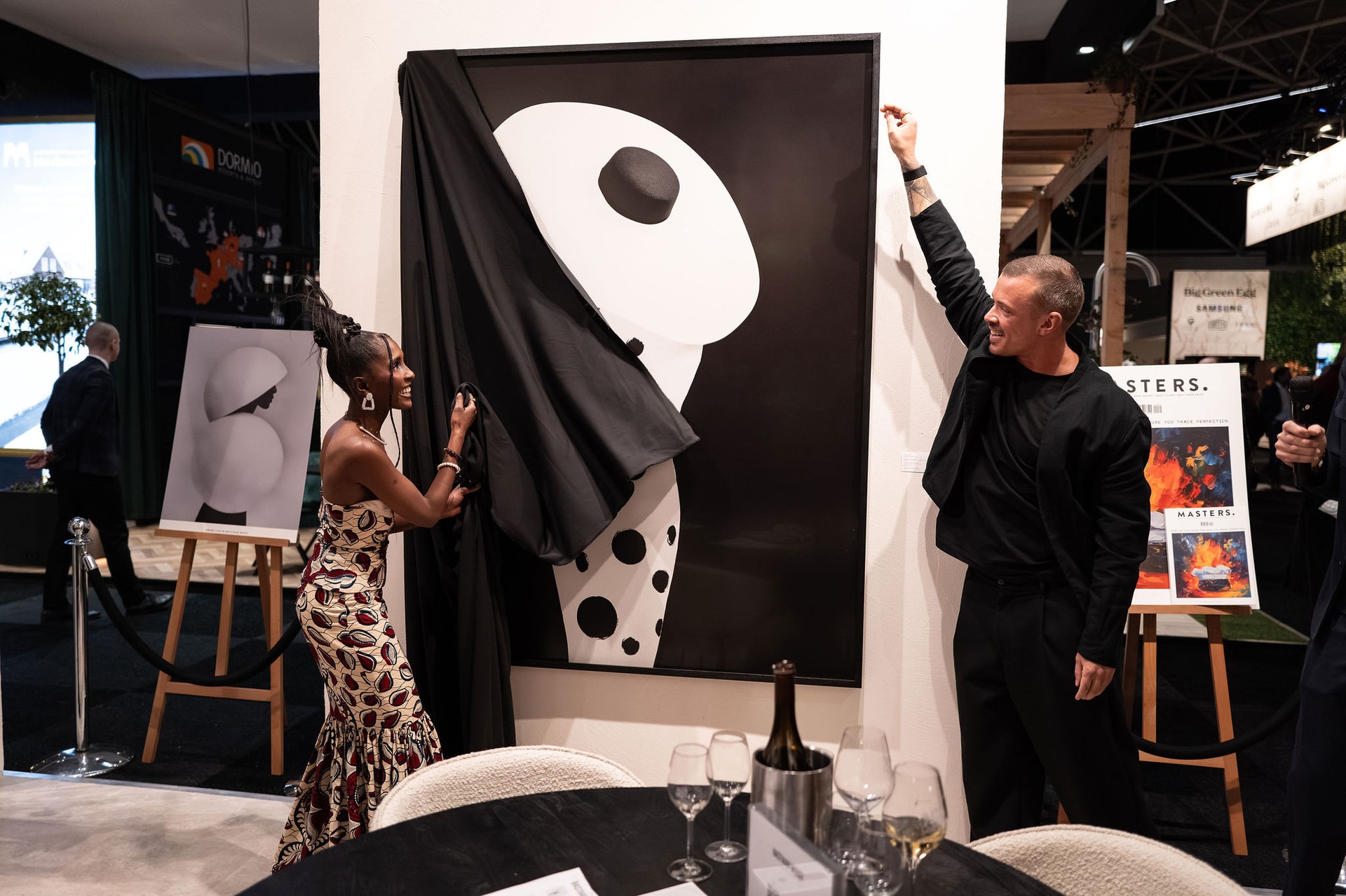
Surrounded by Bastiaan Woudt's iconic black-and-white images, his latest work was unveiled at his stylish booth. It was shown to the public for the first time during MASTERS EXPO, though editor-in-chief Bart-Jan Brouwer had already spoken with the photographer at his 1.200 m² studio in Alkmaar.
Photographer Bastiaan Woudt (born 1987) achieved international recognition with his graphic black-and-white images, rich in contrast and stillness. From his 1.200-square-meter studio in Alkmaar, he runs not only his own gallery but also his publishing house, 1605 Collective. An artist with the mind of an entrepreneur. About autonomy, the power of simplicity, and exploring the world of black and white.
You started out in a small studio in Alkmaar. When did you first think: this is going to be bigger than I ever imagined?
"It happened very organically; there wasn't just one single moment. I actually got off to a flying start. In 2016, I started with nothing, and by 2020, I was already represented by four galleries. That same year, I founded my own publishing house, 1605 Collective, and we grew not only in space, but also in people."
Did you have this in mind when you bought your first camera?
No, absolutely not. In fact, I never intended to do anything with photography at all. I wanted to work in the hospitality industry, the hotel industry. While I was studying Event Management, my first son was born. I bought a camera to photograph him. Not long after, my second son arrived, and I decided I didn't want to work a hundred hours a week in a restaurant or hotel. A career is important, but a family is even more important. Meanwhile, I had fallen in love with photography, with creating images. I did finish my studies, but after that, I immediately started exploring the question: could I make a career out of this?
If you hadn't become a father at such a young age, you might now be working in the hospitality industry...
"Yeah, probably. But that's life, right? If A doesn't happen, B will. The choices you make get you where you are now. I also don't regret my Event Management degree for a moment. It taught me how to run a business, look at numbers, use marketing, build a brand... That knowledge combined with my creativity is the perfect mix. Many artists lack that business aspect; they're only good at the creative side."
What was the hardest decision you've made in your career so far?
I made that decision this year: to stop representing my work in my own country. I still have an excellent relationship with Bildhalle, who continues to represent me in Switzerland, but my view of the contemporary gallery system has changed. And with it, the way artists can present themselves. A gallery can't offer me the opportunity to run a permanent exhibition. Attention has to be divided among the dozens of artists who make up the portfolio. Logically, because a gallery is essentially sales-driven—and you, as an artist, naturally benefit from that. But as soon as your work sells a little less, attention quickly shifts to the next one. Because there's always the pressure to produce more, show more, and sell faster. I'm naturally entrepreneurial and like to be in control. Moreover, I have the space here—a whopping 1.200 square meters. All in all, that led to the decision to open my own gallery space, where I can show my work permanently. It wasn't an easy decision; it's a counterintuitive step in the art world. And there will undoubtedly be people with opinions about that. But I simply thought it could be better.”
Do you sell more than Bildhalle did?
“I've only just started, we're still in the start-up phase. My exhibition ran from October 2024 to February 2025. Champions at Bildhalle – a series I created in Zambia to celebrate 25 years of Orange Babies. Afterward, I spoke with the founder, Mirjam Cavegn. She's a very understanding and accommodating person, and she completely understood my decision. Since July 1st, we've been handling the sales ourselves.
The Bildhalle Amsterdam gallery is located right in the heart of the canal district. Don't you think that's easier to get to than a gallery on an industrial estate in Alkmaar?
If you don't want to make the effort to come to Alkmaar to see a work of art, you're probably not my client. Besides, having your own gallery also has advantages for visitors. In a traditional gallery, you'll usually only find a selection of works. Chances are that the one portrait you have in mind isn't hanging there. You'll have to hope it's in storage somewhere, or you'll only be able to view it on an iPad. Here, there's a lot more work. And I'm there myself; I can talk about the process, the background, the stories. In a gallery, you talk to someone who knows my work well, but didn't create it. Here, you get the creator himself. Visitors also often enjoy taking a look in the studio, where many of the images are created. It's more personal, more intimate, and you get a better feel for what you see. We find that people really appreciate that. Collectors want more than just a transaction; they want to feel something. They want to know the story behind the work and feel connected to the process, not just the price.
How do you maintain the balance between artist and entrepreneur?
I'm good at switching gears and doing many things simultaneously: designing a book, planning a shoot, staying in touch with international galleries… I manage that because I've developed good systems for it. But the artist in me has been a bit lost lately. I run a business 95 percent of the time, and create art 5 percent of the time—even though it might not seem that way, because there's still a lot of work being created. I'd like to do much more creatively. That's why I've been working hard these past few months on how we can better organize that: working more efficiently, automating more, outsourcing more. No more hassle with sending packages or logistics; we've outsourced all that now. This way, we create space to focus on what really matters: creating new things. Because ultimately, that's the most fun thing there is.
Did you also start your own publishing company because you thought things could be done better?
I don't want to tar all publishers with the same brush, but in my experience, you deliver a fully developed book design, all your creative juices, they print it, and then you get two boxes of your own books. 'Great that you have your own book now, isn't it?' they say. And yes, as a starting artist, that's fantastic, of course. But after your second or third book, you start thinking: great, I'm not making any money from this. Once, when I ran out of stock, I emailed my publisher to ask if they could replenish it. They gave me a discount code for the purchase of my own books. That was the moment I thought: I'm going to do it myself.. I had the contacts, the resources—and what's more, I love designing books. From developing the idea and concept to arranging the images. And with creative director Janneke Schrey, who's been working here for five years and is trained as a graphic designer, we can finish everything in-house."
How do you arrange distribution?
Online, through our own webshop. We also collaborate with a lot of bookstores that buy our books directly from us. Of course, we don't have the vast distribution network of a large publisher, so yes, you miss out on certain sales channels. But when you see how that system works—the amount of discount given, how little is left for the creator—it simply can't be a profitable business.
With 1605 Collective you can publish not only your own books, but also those of other artists.
We were so energized by it that we happily started doing it for others too. And not just with two boxes of books and a pat on the back. If we're interested in publishing your book, we'll pay for everything. Once we break even, we'll share the proceeds. It's that simple.
What is your hard greenlight criterion for external projects?
"That's purely a matter of taste and our assessment of quality. So far, we've mainly published first books by other artists—often people who aren't well-known yet, but are in our network. Sometimes we see work that we think: unbelievable that there isn't a book about it yet. Then we say: come to us, and we'll do it. For example, Plastic Ocean from Thirza Schaap, After Beauty by Maura Sullivan, Event Horizon by Kacper Kowalski and Reveal “originated from Tim Verhallen.”
You also publish 1605 Magazine.
For me, it's an opportunity to engage in conversation with artists we're passionate about. And sometimes that ultimately leads to book publications. Initially, we shared the content via social media, but that felt wrong. We're making physical products, and then we'd be giving all that content away online? That didn't make sense. So I decided to compile everything into an annual magazine, with a focus on architecture, art, and design, in addition to photography. The first issue includes a comprehensive interview with Axel Vervoordt. He only does a handful of interviews a year, but he found what we do so interesting that he agreed. That conversation opened other doors, including to Vincent Van Duysen and Mark Manders, who has a major retrospective at Museum Voorlinden until January 18th. Someone I'd really love to speak with is Daniel Arsham. I think it's amazing how he creates a kind of fictional archaeology with sculpture, architecture, drawing, and film, what he calls "future relics of the present." 1605 Magazine shows exactly what inspires me.”
What are typical features of a Bastiaan Woudt photo?
The focus is always on a single subject. A smooth background. Grain. High contrast. Perfect, but with a touch of imperfection—it doesn't have to be perfectly symmetrical. And unrecognizability: I want an image to raise more questions than it answers. Silhouettes also play a major role in my work. And of course, black and white. With that, I remove a bit of reality, which automatically makes you pay more attention to composition, lines, structures, and textures. The power of my photos lies in their simplicity. And that's precisely what makes it difficult. Making a simple image speak requires precision.
Do you also see these characteristics in your tattoos?
Yes. I deliberately looked for a tattoo artist whose style most closely resembles my work: minimalist, with a coarse grain. The images on my body reflect important events in my life, but always in a way that's not immediately recognizable to others. My wife and children are immortalized on my arm, as is my trip to Mount Kilimanjaro in 2015, with my two brothers. That trip truly changed my life. Before that, I lived an unhealthy lifestyle—lots of partying, no exercise. While training for the Kilimanjaro climb, I realized I wasn't in good physical shape. That was a turning point. Since then, I've completely changed my lifestyle. Exercise is now a mainstay of my life. With a family and a business, structure is sacred to me.
Aren't you ever afraid that your style will become a prison from which you can never escape?
"No, not at all. There's still so much to discover within black and white. And besides, I don't just think about photography. I'm currently working on an experimental side project with AI, Echo from BeyondMy photography forms the basis for this – that remains my origin – but with AI as a tool, I arrive at new images, based on, among other things, psychedelic experiences. I am also working on making my photos three-dimensional. A photo is essentially a 3D environment compressed into a 2D object. Now I want to reverse that: from the flat image back to 3D. I've been experimenting with that for a few years now. It's a bit like the dark side of the moon – you know that the other side exists, but you never see it. In the same way, you don't know what the back of a model or object looks like. In that process, you have to reinvent that unknown side, and thus a sculpture emerges from a photograph. Not every photo lends itself to this, especially if the 'unknown side' is supposed to become a face, for example. But it's a fascinating quest."
Making a beautiful print costs money, but a sculpture seems even more expensive to me. How are you going to recoup that?
"By working in editions, just like with my photos. We're currently rolling out those plans. What makes it especially interesting is that there's already interest from Dubai, where I recently visited a gallery."
Dubai, Zambia, Tanzania, Nepal, Morocco… Travel clearly plays a major role in your work.
"Right. And last year I went to Japan with my brother. For a new project, but also to do the Shikoku pilgrimage route: a journey past 88 sacred temples across the island. I love combining a physical challenge with my projects. Normally, you'd do that route in two months, but we didn't have that time. So, very Dutch, we cycled it in one month. Along the way, I wanted to take portraits, but no one wanted to be photographed. I even had a laminated card made with an explanation of my project in Japanese, but the answer was always no. After a week, I knew: this isn't going to work. Still, I couldn't come back empty-handed. So there was a bit of pressure. Then I decided to go back to basics: the time I bought my camera to photograph my son, purely out of curiosity. I just started looking, focusing my camera on everything that touched or intrigued me. I didn't review a single image during the entire trip. Only when I got home did I compare everything."
And?
These photos have a completely different visual signature. Much more poetic, also because there's movement in them. They're more like memories than records. I'm not a photographer who documents the world at all. Although it deviates from my usual style, people I've shown a sneak preview to say, 'Oh, but this is so you.' I'm having the series printed on Japanese paper, and the prints are smaller than usual. That suits the atmosphere of Japan much better. More intimate, softer.
Besides traveling, you also love DJing. Tell us.
Music was my first love. I started playing drums in elementary school, and I did that for years. But when I encountered dance music in a record store in Alkmaar, I was hooked. I was fascinated by what those DJs were doing. I wanted to do that too. I started at fifteen, first with vinyl, later with CDs. And I got good at it pretty quickly. I DJed at quite a few parties in the region. And I'm still doing it! Last October, for example, I played at ADE at the Conservatorium Hotel, under my stage name DJ Bawba, a derivative of my nickname at school.
You currently have an exhibition at Leica Gallery Amsterdam, for which you photographed well-known techno DJs.
I really wanted to get close to those musicians. So I started a project to photograph them – Joris Voorn, Amelie Lens, you name it. Music is a huge factor in my art anyway. You might not immediately see it in my images, but when I'm shooting, and especially during editing, there's always music playing. I can completely lose myself in it. Just like behind the decks, actually. When I'm DJing here in the studio alone, I completely lose track of time. Before I know it, hours have passed.
Do you also make music yourself?
No, but I would consider that the ultimate form of creativity: just sitting behind the controls and making music from scratch. As a photographer, I always need ingredients: a model, lights, a backdrop. Everything has to be organized. Music arises purely from within yourself, which fascinates me enormously. But I also know that if I were to completely focus on that, I would neglect other things. So I'm consciously not pursuing that path. I am, however, increasingly thinking about ways to merge art forms—photography, sculpture, light, sound. A multidisciplinary exhibition where everything comes together: work on the wall, installations, soundscapes. That could easily be a new experience to experience in our own gallery.