
Power
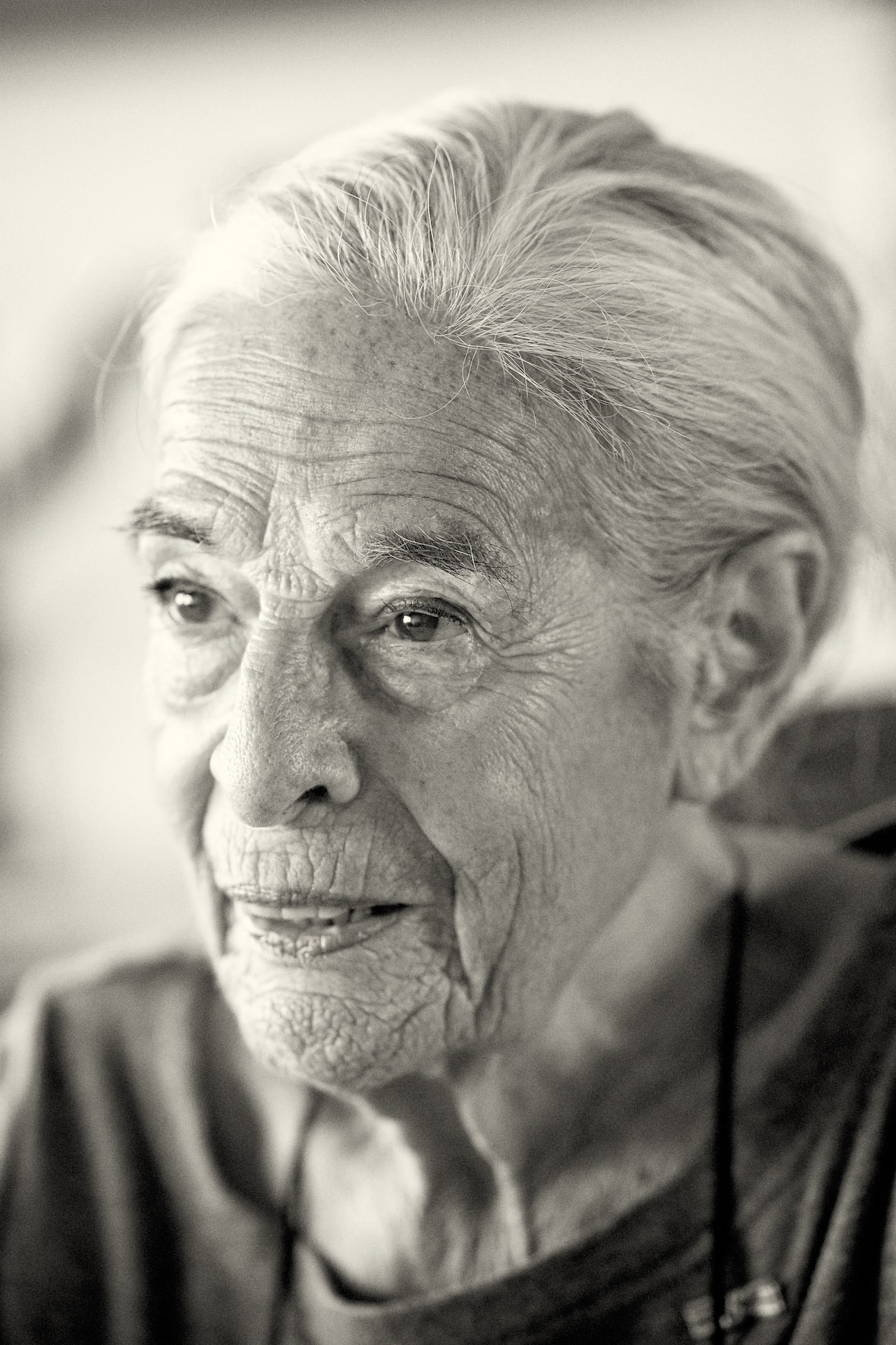
ANITA LEESER-GASSAN: "YOU MUST NOT POSITION YOURSELF AS A VICTIM, BUT AS A SURVIVOR"
She witnessed how her father laid the foundation stone for the current empire after the Second World War. But if Anita Leeser-Gassan (Amsterdam, September 17, 1935) had not survived Bergen-Belsen, hunger, fatal diseases and a two-week journey through hell in the 'train of the lost', there would have been no family business. “I'm the only Gassan left.”
Text: Bart-Jan Brouwer | Online editor: Natasha Hendriks
Image: John van Helvert
What was your early childhood like?
“I was the only daughter of Samuel Gassan (Amsterdam, November 5, 1910) and Carolina Biet (Amsterdam, July 20, 1913). We lived in the Nicolaas Maesstraat, above Paul Huf. And then in the Johannes Vermeerstraat and later the Pieter de Hoochstraat. My father worked as a diamond cutter at the Gebroeders Boas steam diamond cutting company on Uilenburgerstraat. Until the crisis broke out and there was no more work. Then he advertised for the ANWB magazine The champion going to sell. From the beginning of the war I clearly remember the air raid sirens and the bombings. We tried to protect ourselves with copper pans on our heads. A policeman took us to IJmuiden in his car so that we could flee to England by boat. But we could no longer go and went back to Amsterdam. I had to go to Jewish school, wearing my blue vest with the Star of David on it. First to the Montessori school on Corelliplein, then to School 13 in Jan van Eijckstraat. I think I also had thirteen teachers there in two months, but they were always taken away by the Germans.”
Your father and mother divorced in 1942, after which your father fled to Switzerland that same year. What was that like for you?
“My father had a relationship with the wife of a friendly couple. In 1942 the ground became too hot under his feet. He had saved some diamonds, hidden them in the heels of his shoes and fled to Switzerland with his girlfriend. Then the man of that friendly couple, Jacques Smit, took care of my mother. A cross-pollination. From Switzerland my father sent Paraguayan passports for my mother, myself and Jacques – that might save us. My second father was very kind to me. I have good memories of him. To delay employment in Germany for as long as possible, he and my mother worked at the Sterilization Bureau at the Central Israeli Hospital, which is now the Jellinek Clinic. The German doctor who was charged with the compulsory sterilization of Jews did not know what happened to him when he was stationed here. He helped many Jews, for example by describing pregnant women as 'barren'. And he gave us shelter in the hospital. Until he could no longer guarantee our safety: 'It's time to go into hiding.'”
What was that like for you as a child?
“Going into hiding made life very limited. We first went into hiding in a storage room above a shoe store in Van Baerlestraat, a building owned by my grandfather. Until we were betrayed. We were just about to move to another location. While we were holed up in the storage room at the top of the stairs, the Germans came looking for us. They didn't find us. We heard that they received a phone call and they were told what our next address would be. So we knew we shouldn't go there. Then we went to other people in the neighborhood in the middle of the night - who were not happy about it. My second father then called a friend of his, who was hiding with his wife and mother-in-law with a family in Lomanstraat. These people – Dicky and Henk Claassen and their five children – were willing to take us in too. It was already so busy and yet they still took us in! After six weeks we went to a boarding house, where the Claassen family continued to care for us. During a raid on resistance fighters, letters were found mentioning the hiding place. That led to our arrest in mid-1944. During the search, six of us were standing in a cupboard and were discovered by a German soldier. I tried to persuade him not to take us with him: 'Wouldn't you rather have my doll for your children?' We were first taken to the headquarters of the Security Service in the Euterpestraat, the current Gerrit van der Veenstraat, and from there to the House of Detention on the Weteringschans. From there we were transported to Westerbork on July 20, my mother's birthday. And on August 1, my second father's birthday, we were transported to Bergen-Belsen. In that camp, people with dual nationality were held for exchange purposes and were not immediately sent to Poland to be gassed. So with the Paraguayan passports, my father prevented us from being taken straight to Auschwitz.”
You were only eight… Did you realize then that this could be your end point?
“I had no idea what could happen. The camp had of course existed much longer. The people who had been there for a while were annoyed that we were still reasonably well fed. And all the jobs there had already been filled.”
Was there no solidarity?
"Yes and no. What I learned in the camp: it doesn't mean anything whether you are chic or not, what class you are, what you look like. The notary took someone else's bread, and that was actually manslaughter, while the market vendor next to us in the barracks shared her last breadcrumbs with us. And the Jewish boxer Ben Bril, who was in charge of cleaning the latrines, was also someone who took food for other people.”
70.000 people died in Bergen-Belsen. Did you have any idea during your stay there that such numbers were involved?
“It was a very large camp, housing all kinds of nationalities: Hungarians, Albanians... From the end of 1944, tens of thousands of prisoners from the concentration camps were transferred from the front lines to Bergen-Belsen. It became increasingly hell there: there were deadly and contagious diseases and there was no more food. You saw carts with piled up corpses passing by. It was really scary.”
What is it like to be hungry?
“Well, that hurts. When I hear someone say that he is 'hungry', I sometimes have an outburst. 'How hungry? You don't know what hunger is!' Shortly before Bergen-Belsen was liberated by the British on April 15, 1945, we were transported with about 2.500 others to Theresienstadt to be gassed there. Already on the first or second day we had to get off the train at the station in Magdeburg to take shelter under the train with the camp guards from the Allies' guns. The station was bombed and Theresienstadt was no longer accessible. What followed was a two-week wandering by train through parts of Germany that were not yet occupied by the Allies. Nobody knew where we had gone. It was called The Lost Transport. I didn't eat all that time on the train and we were crammed on top of each other. Along the way, people died in droves from malnutrition and disease. We were between the Allied and Russian fronts. With the constant danger of being bombed again. Everyone on the train wearing something white strung it on the roof to show that this was not a war train. As an alternative to Theresienstadt, the Germans wanted to dump our train in the Elbe. But they couldn't get there anymore - everything was cordoned off. The transport finally came to a stop in Tröbitz, about sixty kilometers north of Dresden. On April 23 we were liberated there by three Russians on horseback. "Just see if you can find a place somewhere," the Russians said. We trudged into Tröbitz, a village of about seven hundred souls at the time, which was suddenly confronted with more than two thousand starving and critically ill people in urgent need of help. Not all villagers were equally helpful. But the Russians had a bad one for them: anyone who didn't open the door was shot off the balcony by the Russians. About nine of us ended up on a farm. The first day I played with the residents' child, but then that stopped because his parents did not allow him to play with Jews. Those people had no idea what was happening to them either. In the weeks that followed, another 320 people died as a result of the death transport. In part due to the typhoid epidemic that had broken out. Many villagers who were infected by us have also died. Ultimately, the French Red Cross repatriated us.”
In the meantime, your father, whose parents were killed in Auschwitz on October 5, 1942, was looking for you.
“Towards the end of the war he enlisted in the British Army. He became head of the repatriation service and then started looking for us. When he arrived in Bergen-Belsen, we were no longer there. He did meet the children of his former colleagues there. They were in a separate barracks. The war had just ended. He personally chartered a plane and put these 'diamond children' on a plane to the Netherlands on June 23, 1945 - he was reprimanded for this. He then traveled to the stations that our train had visited. He lost track near Magdeburg, because the registration was also lost with the bombing of the station.”
You first saw him in Eindhoven. What emotion did that evoke?
“My father had been told that a transport had arrived at a school in Eindhoven. He didn't recognize me, but I recognized him. “Daddy, daddy,” I cried. I still can't tell it with dry eyes... That was a very special moment. He put us in his army car and took us to Amsterdam.”
What was it like to return to Amsterdam?
“I first had to go to the hospital, the same CIZ again. I only weighed 23 kilos and had no buttocks to sit on. Then I could go home – our old house on Johannes Vermeerstraat, where NSB members had lived during the war. All around you you heard 'is he still alive?' I was soon able to go back to school, the Aeneas Mackay school on Titiaanstraat, where the children of the Claassen family had also attended. While I was in hiding, they had given me books to help me keep up to date. At that school I was able to continue in the fifth grade, so I never attended the third or fourth grades. I picked up the thread fairly quickly. I was waiting for my second father, but he never returned from the war. That sadness was somewhat alleviated by the fact that my parents got back together.”
Your father immediately went back into the diamond trade.
“The first diamonds were cut as early as October 1945, then in the Diamond Exchange on Weesperplein. First trade, purchasing and sales, internationally. He traveled with a wallet containing diamonds, often to Sweden and India. We had a very good time. My father didn't know how to spoil us! I got ice hockey skates, a very nice red Swedish bicycle, things like that. In 1950 he was able to start a diamond cutting factory on Zwanenburgerstraat and in 1955 the company moved to Nieuwe Achtergracht. That location was more geared towards tourists. You could enter the building from Lepelstraat. My father called himself the 'Landlord of the Spoon Street'. The building had the SG logo on the wall.”
How was your father with his staff?
"Very good. In the evening no one went out without greeting him: "Hello, Mr. Gassan." Like Benno, Samuel was always the first to arrive and the last to leave. Managing by walking around. He knew exactly what was going on at every level. What did happen at that time: there were people who wanted to persuade the cutters to exchange a batch of lower quality diamonds with a batch of good quality – in the organization this form of fraud was called 'flowerpots'. When my father wanted to surprise his staff with Sinterklaas, he told the staff: 'The door closes at five o'clock and no one is allowed to go home.' Those fraudsters were scared to death, were afraid the police would come and tried to flee out the window. While my father wanted to delight them with a Sinterklaas party!”
How would you describe your father?
“He was a very charming man, very well-groomed, very fond of his clothes, and he did not hate women. That sometimes made things complicated. Later he and my mother also separated again.”
Have you never considered entering the diamond trade?
“No, I wanted to study law. I have had that sense of justice since the war. I did work as a guide at the diamond factory during my studies. With my hair back, and my father made me wear high heels. And I learned diamond drawing at Asscher. If the diamond had to be cleaved, it was important that you did it at the most economical rate. In my drawings I indicated the lines where exactly the diamond should be cut.”
What did you take with you from your wartime in your work as a lawyer, judge and later vice president of the court in Amsterdam?
“The common thread has always been that I believe that you should not act as a victim, but as a survivor. During my time as a lawyer, I visited people in the same detention center where I had been. When clients were complaining terribly, I would say, “I've been here too, but I didn't know if I would ever get out, and you will.”
Have you no anger, do you not look with resentment?
“I still don't go on holiday to Germany and I don't buy from shops that I know were wrong during the war. That is no longer possible. I did return to Bergen-Belsen twice. That did me good. The confrontation, the processing.”
Your sons Benno and Guy have followed in your father's footsteps. What do you think about GASSAN becoming a family business?
“That is very special. The company is run by Leeser, Bijlsma and Huisman. In the end, I am the only Gassan left!”


