
Amsterdam 750
Amsterdam in the Future
CENTRUM
Welcome to the Amsterdam of the future, where buildings not only provide square meters of living and working space, but also square meters of chlorophyll. Vertical gardens climb the facades. Greenery wraps around glass windows, collects rainwater, purifies the air, and provides shelter for birds and insects – the number of bird species in the city now exceeds the number of coffee shops! The canals glisten, not with traffic, but with tranquility. The city center is car-free. Instead, electric boats glide by in whispers, cyclists dominate the streets, and pedestrians stroll as if in a futuristic feel-good movie. What was once a stone chaos is now a green oasis. Because Amsterdam chooses not to grow at the expense of nature, but with it. Greenery isn't a luxury; it's a necessity. But luckily, it's also simply beautiful, inviting, and good for your mood. And let's face it: who wouldn't want to live in a city where even the buildings grow leaves?
NORTH AXIS
Welcome to the Noordas, the self-assured counterpart to the Zuidas. No suits stuck in traffic here, but sneakers on the jetty and meetings under a tree on the 38th floor. The Noordas is living proof that economic growth and ecological prosperity can go hand in hand – and that Amsterdam-Noord deserves its own skyline. Skyscrapers? Certainly. But then clad in vertical forests, solar panels, and birdhouses. Meandering between the glass and steel are greenery-filled walkways, coffee shops with mushroom cappuccinos, and offices where you're more likely to find a yoga mat than a printer. Here, not only the IJ flows, but also creativity, innovation, and a touch of courage. Because who would have ever thought that the city's fringes would become the new center of sustainability?
POLDERBAAN 2.0
Schiphol is being expanded with a floating mobility hub where technology, nature, and tranquility converge. No traditional jets taking off here, but elegant seaplane drones. These electric, autonomously flying aircraft will silently transport you to any destination in Europe, without queues or CO₂ emissions. You board, scan your palm, choose a window seat, and glide away over the water like a dragonfly on a tight itinerary. Along the quay, glass terminals stand like luminous seashells. They function as hubs for multimodal transport: from hyperloop connections to drone shuttles and even pedalo taxis for the local adventurer. Wind turbines rotate peacefully in the background, not as a symbol of the fight against climate change, but as silent proof that we have won that battle.
Here, travel becomes magical again. No stress, no traffic jams, no delays. Just technology that works and nature that breathes.
NDSM wharf
In 2075, the NDSM wharf will be fully operational again, but in a way you could never have imagined. What was once the pride of Amsterdam's shipbuilding industry is now a futuristic maritime hub and a breeding ground for culture and innovation. Gigantic autonomous cranes move gracefully across the quay, where electrically powered cargo boats and research vessels are built or repaired in record time using 3D-printed parts and biobased materials.
At the same time, the wharf is a place of encounter and imagination. Between the docks and hangars, creative workspaces, floating galleries, and cafés bob along, offering views of the hard work—and the big dreams. Artists and technicians share tools, ideas, and perhaps even an after-work beer. During the day, the sounds of welders, drones, and ship engines resonate. In the evening, lighting installations, music, and conversations take over. The scent of steel mingles with that of street food and freshly brewed coffee. NDSM isn't a contradiction between past and present, but a fusion of industry and inspiration. It's a place where the future is built and celebrated—with a welding torch in one hand and a paintbrush in the other.
ARENA
By 2075, the football temple has become the multifunctional heart of Zuidoost. An architectural icon that combines futuristic elegance with functional magic. The oval structure resembles a spaceship that has just landed in a sea of city parks. Inside, matches are still played, but e-sports finals, climate conferences, and holographic concerts also take place. The roof opens like a lens to the sky, with a solar panel system that supplies the entire neighborhood with electricity. Rainwater is collected, filtered, and used for the surrounding greenery, which grows lushly between the paths, squares, and residential complexes. Accessibility? Flawless. Thanks to underground maglevs, bicycle highways, and airy walking routes, this stadium is never far away. And because the building also serves as a community center, startup incubator, and energy station, it is in use 24/7 – without disruption, with connectivity. The Arena 2075 is not just a place where you experience something, but where you become a part of it. A beacon of sport, culture, sustainability, and city life – ready for the next kick-off or launch.
IJBURG
IJburg is one of Amsterdam's most innovative and livable districts – a harmonious symbiosis of people, nature, and technology. Homes seem to float between reflective canals, connected by gracefully winding walkways that resemble artworks more than infrastructure. Here, walking is an experience, not a journey.
The city is vertically greened: facades are living and breathing, filled with plants that cool, purify, and provide nourishment. Whisper-quiet vessels glide by on the waterfront, while above you hang modular green capsules: floating cabins for people transport, package deliveries, or even mobile gardens. Living in IJburg isn't an escape from the city, but a redefinition of it. Cars are superfluous here, because everything moves—on water, through the air, or along energy-positive paths. Children swim among water lilies, work is done in hybrid water studios, and evening falls amidst reflections of light art on the canal. IJburg isn't a vision of the future. It is the future—designed with courage, built on water, and supported by a city that dares to look ahead.
AMSTERDAM CENTRAL
Under Pierre Cuypers' iconic glass roof, travelers and technology flow together in perfect harmony. While the historic character remains, the experience is futuristic. Floors are responsive and illuminated, with real-time travel information literally appearing at your feet. Trains glide in silently and emission-free: ultramodern double-deckers, part autonomous, part community space. They effortlessly connect Amsterdam to European hubs in less time than it takes to drink your coffee cup—which, by the way, is compostable and retrieved by a zero-emission robot. Waiting areas have been transformed into green meeting places, quiet work booths, and art installations that respond to movement. Luggage is automatically scanned, transported, and even sent to your accommodation if desired. And above, soft light objects—drones, art, or both?—circle in a rhythmic dance, as if visualizing the city's pulse. Central Station is no longer just a place to depart or arrive. It is the technological and human heart of a city that moves with the times.
ZEAL
What once began as a simple ferry across the IJ River has, by 2075, become a futuristic icon of Amsterdam. The new IJ Ferry – silent, autonomous, and energy-neutral – practically floats over the water, powered by solar energy and hydrogen. The crossing from Central Station to Amsterdam-Noord still takes just a few minutes, but is now an experience in itself. The glass dome offers 360-degree views of a city adapted to the water. Inside, you'll find seating with augmented reality maps of the city and even a coffee bar that roasts its beans on board. And the waiting time? It's practically nonexistent. The ferries depart frequently, flexibly, and based on real-time demand. The system is smart, responsive, and fully accessible. What was once a pragmatic crossing is now a connecting experience. The IJ Ferry of 2075 is not a functional stopover, but a floating piece of the city – a place where the journey begins the moment you step aboard.
KNSM ISLAND
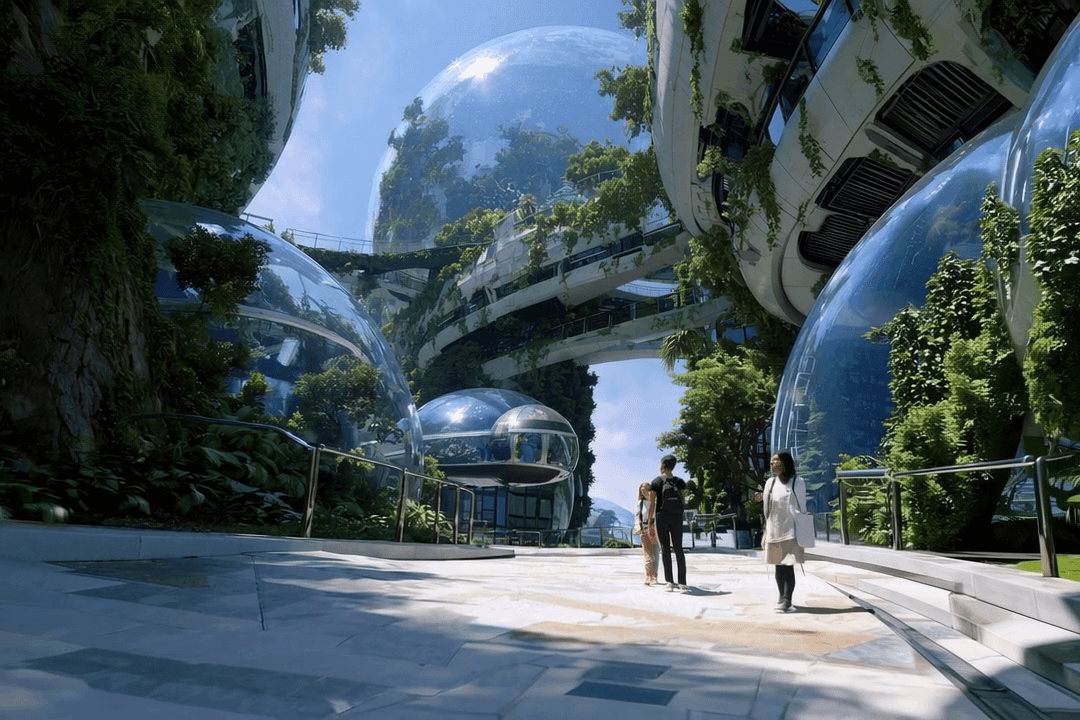
On KNSM Island, we live in glass domes—literally and figuratively. Transparency isn't just architecture here, it's a way of life. The spherical homes are self-sufficient, surrounded by lush greenery, and fully connected to nature and each other. Privacy is reinvented, because glass walls demand trust. The buildings breathe with the climate, filter air, and capture energy and rainwater. Floating walkways connect residents, gardens, and communal areas. Here, life is light, open, and sustainable. A future where transparency doesn't feel oppressive, but liberating—and where living in the light has become a given.
FLOWER MARKET
Along the Singel canal, the flower market is blooming like never before. Under elegant, floating pavilions printed from bioplastic, growers sell their futuristic flora: scentless tulips for hay fever sufferers, luminous ferns, and climate-resilient orchids. Small delivery robots buzz gently past the stalls, ready to deliver bouquets to homes within ten minutes. Yet it feels familiar. Human. Green. A place where tradition and the future collide – and where every flower tells a story of a city that continues to grow.
ROKIN METRO STATION
By 2075, Rokin metro station will be much more than a stop on the North/South metro line: it will be an urban hub that brings together art, water, technology, and connection. Where once only travelers would quickly pass by, the renovated square now invites people to pause, play, and admire. Undulating paving cleverly drains rainwater in playful patterns, while self-driving metro trains silently pass beneath the imposing roof. Here, people no longer collide, but meet. In the heart of the city. The Rokin of the future will be not just a transit point, but a destination in itself.
MUSEUM SQUARE
In 2075, Museumplein will be not only the cultural heart of Amsterdam but also a cutting-edge meeting place where history, art, and technology merge. Under subtly illuminated lines in the pavement, visitors navigate effortlessly from the Rijksmuseum to the futuristic ArtCore—a new museum for digital and immersive art. Free of traffic and disruption, the square is a tranquil space filled with light and tranquility. Integrated climate zones keep it cooler in summer and pleasant in winter. During the day, the square plays with sun and shade. In the evening, it transforms into a light sculpture: moving patterns dance between the buildings, triggered by the movement of visitors. Here, the city is not just viewed, but experienced. Museumplein is no longer a square; it is a stage.
SCHIPHOL
Schiphol has been transformed into a hypermodern air city, where aircraft silently take off and land on floating platforms, powered by hydrogen and solar energy. The terminals resemble shimmering organisms that breathe with the rhythm of the traveler. No queues, no stress: biometrics manage everything, from check-in to boarding. The airways are illuminated with floating, interactive light strips that guide traffic and evoke wonder. Schiphol is no longer just an airport, but an ecological air park. Sound-absorbing moss fields and wind-fed grass sculptures grow around the runways. Travel here is no longer about pollution, but about connection – quiet, clean, and sublime. Where Schiphol once stood for mass and speed, it now stands for precision, comfort, and sustainability. An international gateway to the world, and to the future.


